July 28, 2026
“Innovation without access is injustice.” That message, delivered during Monday evening’s opening ceremony of the 26th International AIDS Conference (AIDS 2026) by Brazil’s Minister of Health, Alexandre Padilha and media personality, Alberto Pereira Jr. captured the defining theme emerging from the first days of the meeting. As scientific innovation accelerates with new prevention options, cure research and long-acting antiretroviral treatment advancing, advocates, researchers, health officials and donors are warning that shrinking funding, unequal access and fragile delivery systems threaten to undermine decades of progress. The message is clear: scientific innovation alone will not end the epidemic.
Read on for AVAC’s highlights from the preconference, satellite and opening sessions.
Innovation Without Access Is Not Innovation
Even before the conference officially opened, Merck/MSD announced voluntary licensing agreements with seven companies in four countries – including Kenya, South Africa and Uganda – for its investigational monthly oral PrEP pill, alimatravir (MK-8527). While the announcement represents an important step toward earlier access planning, advocates quickly noted that several countries involved in the clinical trials, including conference host Brazil, Argentina, Colombia and Peru, are excluded from the licensing territory. As AVAC’s Mitchell Warren noted in this Bhekisisa piece, “We don’t yet know if the medicine will work…but…adding a monthly pill to the choice of options could increase demand even more… [however] for this, we need volumes—tens of millions of doses—which we don’t yet have in the HIV prevention market.”
Activists interrupted the conference opening ceremony calling for affordable HIV prevention and treatment, patent reform and investment in cure research, chanting, “Pills cost pennies, greed costs lives.” Brazil’s Minister Padilha reinforced the broader stakes: “Defending the response to HIV is, more than ever, defending science, human rights, democracy and life.”
An Alarm Bell for the Global HIV Response
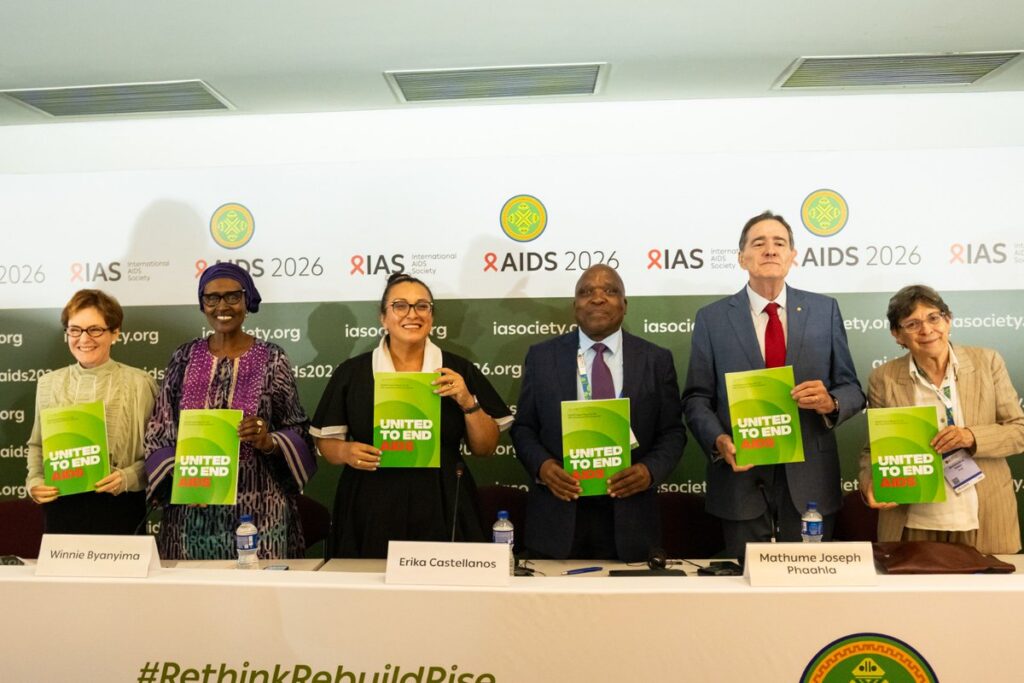
The release of UNAIDS’ United to End AIDS special report and a companion KFF-UNAIDS analysis sharpened those concerns. Despite the recent UN Political Declaration on HIV/AIDS, the reports show the challenge of translating scientific progress into the impact needed to end AIDS as a public health threat by 2030. The report shows HIV financing entering one of its most precarious periods in decades, with international assistance declining 18% between 2024 and 2025. Donor government funding fell by $2.1 billion in 2025—the largest annual decline since global HIV funding began scaling up—and epidemiological progress has stalled, with new HIV infections remaining essentially unchanged for the third consecutive year. Warren described the UNAIDS report as an alarm bell: “It’s not just a warning. It’s not just a ‘cautious stabilization of where things are’,” he said. “It is an alarm bell that we have to change how we do what we do, and how we fund what we do, if we want to succeed.”
Community Engagement is Reshaping R&D and Access
The Advancing HIV Prevention Science and Access preconference session offered a glimpse of how product development, delivery and access are evolving. Merck’s Rebeca Plank recognized that communities and advocates were advising on the development of alimatravir (MK-8527) from the outset, “even before the Phase 3 protocols were written.” Their input influenced the decision to generate data during pregnancy and lactation earlier in development, giving people the information they need to make informed decisions rather than waiting until after approval. Plank also highlighted Merck/MSD’s recently announced initial access plan, including voluntary licensing agreements with seven generic manufacturers while Phase 3 trials are still underway and noted that “these are the initial plans. They’re not comprehensive. They’re not final. We’re still working, working in close collaboration with communities and global health stakeholders as our Phase 3 studies continue.”
HIV Cure: Expanding the Research Agenda
Cure research is also evolving beyond a single strategy. At the HIV Cure Without Borders preconference session, researchers and advocates highlighted the emerging potential of efavirenz as part of future cure approaches, not as a cure itself, but as a way to reduce inflammation and help clear the HIV reservoir before “kick-and-kill” interventions. The session featured the strength of community voices, highlighting Advocacy Academy alumni Pisci Bruja who reminded the audience cure is a “process not a product”. Tuesday’s satellite session on broadly neutralizing antibodies (bNAbs) will explore their growing role in achieving durable viral control without antiretroviral therapy. As Thumbi Ndung’u of the African Health Research Institute in KwaZulu-Natal, South Africa, observed, “This is a very exciting time to be working on HIV cure.” Together, the sessions reflected a cure agenda that is expanding beyond eradication alone toward long-term remission and reinforced the need for continued investment in basic science, community engagement and advocacy.
The Future of PEPFAR
The science and policy discussions went hand in hand in the pre-conference. At a packed session on the US Administration’s America First Global Health Strategy new global health strategy Senior State Department officials defended the MoU agreements as voluntary partnerships designed to build country ownership, in the wake of a civil society demonstration. US delegation leader Jeff Graham said they are “commitments we did not force anybody to make” and are intended to help countries “build the capacity to solve their own challenges, rather than perpetuating dependency.” Activists interrupted the session chanting “Restore PEPFAR now,” challenging the withholding of congressionally-appropriated PEPFAR funding and highlighting increasing evidence on the impact of US policy decisions on health and lives. Jirair Ratevosian summarized the session with 15 takeaways. The following day, the George W. Bush Institute released a set of policy recommendations as next steps for Congress and the Administration in the America First Global Health Strategy, calling for stronger implementation, preserving PEPFAR’s core strengths, and supporting greater country ownership.
These early conversations have set the agenda for AIDS 2026. Stay tuned for our Thursday update after the scientific sessions Tuesday and Wednesday, where we’ll report on the latest data and what it means for the future of the HIV response.