Avac Event

NAM-AVAC Microbicides Webinar

This 90-minute webinar examined the current state of research into topical microbicides – gels, lubes and devices that can be used to prevent HIV transmission during sex. It provided advocates with an overview of global and European topical microbicide research. The presentations were followed by a question and answer session with our expert speakers.

The discussion was moderated by Gus Cairns. He is a writer at NAM, where he edits HIV treatment update and Preventing HIV. He also edits the HIV prevention news: Europe bulletin as part of NAM’s programme of European prevention advocacy. He is a member of the European AIDS Treatment Group, co-chair of the Steering Committee of the PROUD PrEP trial, and a member of the steering committee of the Global Forum for MSM and HIV.

Presenters:

  • Dr Sheena McCormack – Overview of topical microbicide research.

    McCormack is Senior Clinical Scientist at the Clinical Trials Unit of the UK Medical Research Council. She is Principal Investigator of the Microbicides Development Programme, which ran the MDP 301 Phase III microbicide trial in four countries in sub-Saharan Africa, and of the recently started PROUD trial of Truvada pre-exposure prophylaxis in UK gay men.

  • Dr Charles Kelly – News from the CHAARM microbicides research consortium

    Kelly, of King’s College London, is co-ordinator of the Combined Highly Active Anti-Retroviral Microbicides (CHAARM) programme, a collaborative project co-funded by the European Union under the 7th Framework Programme (FP7) for Research and Technological Development. CHAARM is a consortium of 31 partners representing 9 different countries in Europe including Ukraine, as well as South Africa and the US, with a €12m budget.

  • Jeremy Nuttall – Update on IPM’s pipeline: the dapivirine ring and beyond

    Nuttall is the Senior Director of Preclinical Sciences and Product Development for the International Partnership for Microbicides (IPM), where he is responsible for the preclinical testing of candidate microbicides and has broader product development responsibilities. Jeremy joined IPM in 2003 and has over 25 years of experience in drug development. Prior to IPM he worked as a toxicologist in contract research organisations and spent over 8 years in regulatory affairs at GlaxoSmithKline.

  • Harriet Langanke – Community advocacy for microbicides in Europe

    Langanke is founder and director of GSSG: Gemeinnützige Stiftung Sexualität und Gesundheit, the German Foundation on sexuality and health. She is a journalist who has worked in the field of HIV and sexual health since 1991; she is also one of the co-founders of Germany’s national network Women and AIDS which celebrated its 20th anniversary last year. As an expert for HIV and STI prevention she works primarily for and with women.
Avac Event

HIV Prevention Europe Webinars: Rectal microbicides

The seventh webinar in our series addressing a range of topics in HIV prevention research, hosted jointly by NAM and AVAC, will focus on rectal microbicides. The presentation was followed by a Q&A session.

Catherine Madebe

Updated January 2024

Catherine works at the intersection of adolescent girls and young women and sexual and reproductive health. She co-leads the AGWY Forum, founded with 2018 Fellow Alumni Lilian Benjamin Mwakyosi, and is a leading member of the Tanzania HIV Prevention Coalition. Catherine was named SRHR Best Celebrity in Eastern and Southern Africa for her outstanding performance by the Southern African AIDS Trust.

Impact

Catherine cofounded Tanzania’s AGYW Forum, the leading national level advocacy network for HIV prevention of young women. She also won increased funding for AGYW through her direct involvement in the Global Fund and PEPFAR processes.

Media

Materials

Liyema Somnono

Updated January 2024

Liyema is a gender and human rights activist. She is currently employed as a paralegal at SWEAT (Sex Workers Education and Advocacy Task Force) and is a member of the drafting team for the national legislation to decriminalize sex work. Liyema is a member of the Eastern Cape AIDS Council Women’s Sector and serves on the Young Women’s HIV Prevention Council.

Impact

Liyema was a national leader in mobilizing testimonials for public comment in favor of South Africa’s sex worker decriminalization bill (which has been put on hold for now). She also initiated community-led monitoring, highlighting the struggles of young women in rural Eastern Cape to access HIV prevention and family planning services.

Media

Outreach

Natasha Mwila

Updated January 2024

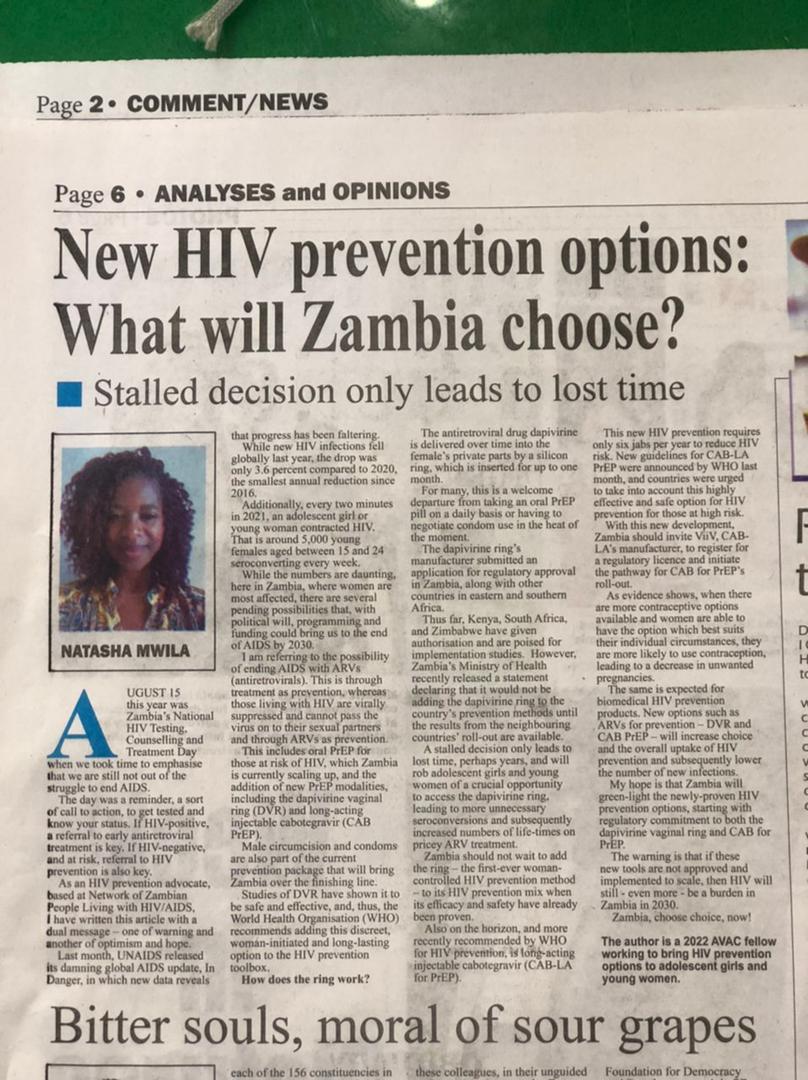
Natasha is the Advocacy, Information and Research Officer at The Network of Zambian People Living with HIV/AIDS. She is actively involved in advocacy and preparedness for the injectable PrEP and the PrEP vaginal ring.

Impact

Natasha successfully pressured Zambia to approve the dapivirine vaginal ring and CAB for PrEP, using both traditional and social media. She helped shape her country’s HIV Prevention Roadmap and guidelines for injectable PrEP. She also led Zambia’s PEPFAR COP process and was on the Global Fund writing team, ensuring allocations for HIV prevention.

Read about some of Natasha’s latest work in our CASPR Results Bulletin (October 2023).

Media

Advocacy

Maureen Luba

Maureen works at AVAC, where she helps to coordinate the COMPASS Project, a regional project focusing on enhancing CSO Advocacy work in Tanzania, Malawi and Zimbabwe. At the time of her Fellow’s project, Maureen worked with the Community of Saint Egidio, Dream Program, as a program manager for HIV treatment and adherence programs. She had been working in the field of HIV for over five years on a range of projects including prevention, positive living, HIV treatment, care and support, behavior change, HIV and human rights, HIV and nutrition integration, economic empowerment of PLHIV and sexual reproductive health and rights for PLHIV.

Fellowship Focus
Maureen’s advocacy focused on HIV prevention options for young women and girls. She increased awareness and preparation for results of the ASPIRE trial among different stakeholders. She facilitated interactions between clinical trial researchers, civil society, the media and policy makers. She also engaged ward councilors on HIV prevention issues, a step which had not previously been accomplished.

In Their Own Words
Malawi needs advocacy to address women and sex workers’ access to burgeoning biomedical prevention like microbicides.

My Work as a Fellow

  • Letter to the editor on male circumcision: This is a letter that the Fellow wrote to the editor of Malawi24 in response to a misleading article on male circumcision and HIV risk.
  • Early treatment as a right: This document makes the case for early treatment of all persons who test HIV positive in Malawi. Maureen Luba, in partnership with a number of Malawian civil society advocates argue that… “The new science creates a new standard and makes access to immediate HIV treatment a core.”
  • The promise of microbicides in future HIV prevention: This is a policy brief that defines and articulates the need for need for effective interventions that women can control and use, particularly microbicides.
  • Video: This is a 15-minute documentary of Maureen Luba’s journey throughout the Fellowship. It highlights the engagements and conversations she had, the opportunities she had, the challenges she faced, how she overcame them and so much more.
  • Fellowship summary report: “Advocacy for more prevention options for young women and girls” is a report on Maureen Luba’s advocacy to ensure that HIV prevention for young women and girls in Malawi is prioritized and that they are involved and engaged in the processes of developing and rolling out current and future interventions for them.

Materials
Poster – Advocacy for More HIV Prevention Options for Women in Malawi

Amaka Enemo

Amaka is a sex worker and HIV activist, as Coordinator of the Nigeria Sex Workers Association and co-chair of Key Affected Populations in Nigeria. She is active in her country’s Global Fund process, where she helped to draft its Concept Note. She has a degree in political science from Delta State University, Abraka.

Why I want to advocate for HIV prevention in 2016:
Being a part of the sex worker community, I notice that most of the members are HIV positive. I really want something to reduce the spread of HIV. PrEP and microbicides, as part of the prevention package, could do a whole lot of good for my community considering the risk associated with our work.

Ntombozuko Kraai

Ntombozuko has been a coordinator of Wellness Foundation’s Young Urban Women project in partnership with ActionAid International. She is a human rights activist focusing on young women and sexual and reproductive health with a special interest in gender-based violence. She has mobilized and educated the community around voluntary medical male circumcision, PrEP, microbicides, clinical trial conduct and more. She has also represented community on the protocol development teams for the vaccine study, HVTN 097, and the microbicide ring study, ASPIRE 020. Ntombozuko is raising three children—two boys and a daughter—and her desire is to see them respect women and to see violence of any kind as a crime.

Why I want to advocate for HIV prevention in 2016?
In South Africa, the HIV incidence rate amongst females aged 15-24 is four times higher than males the same age. There has been a lot done on HIV treatment, care and support, despite the current challenges of antiretroviral stock-outs. Activism has been built for many years and many HIV positive heroes have changed the status quo. We can learn as prevention activists from the ARV rollout but research is still a new concept for many communities. There is a need to educate young women on new biomedical prevention methods, the importance of research and how it’s done so that they will become champions of an HIV free generation.

Munyaradzi Chimwara

Munyaradzi is the Project Lead on COMPASS Zimbabwe, advocating for quality and affordable health service delivery in Zimbabwe. His background is in media production. He got involved in microbicides in 2005 while producing a radio show on HIV/AIDS and subsequently attended Microbicides 2006 in Cape Town, South Africa. During the conference Munyaradzi noted and appreciated the role that advocacy and advocates play in microbicides trials. After having the opportunity to attend a Track D session, “Beyond Involvement: Civil society’s role in making ethical progress towards a microbicide”, conducted by the late Omololu Falobi of the Nigeria HIV Vaccine and Microbicides Advocacy Group, Munyaradzi felt he was challenged to do something about the lack of advocacy initiatives in the Zimbabwe microbicides research landscape.

Fellowship Focus
Munyaradzi’s project mainly addressed how the media reports on and is engaged in HIV prevention trials in Zimbabwe. He identified needs and opportunities to improve the media’s ongoing balanced, accurate, consistent and reliable reporting on HIV prevention trials in Zimbabwe. He provided training and resources to journalists, editors and community advisory board members.

In Their Own Words
It should be understood by all that it is the burden of the disease that has overwhelmed our continent, and it is only when we find new and better tools—including a vaccine—that women and men can use to protect themselves from HIV, only then would we truly have cause for celebration.

Nomfundo Eland

Nono is currently focused on adolescent girls and young women’s programming, women’s sexual and reproductive health and rights (SRHR) and HIV prevention research. She has extensive experience advocating for SRHR, health care and against gender-based violence. Nono is raising her son and nephews to respect women and to see violence of any kind as a crime. She is also a strong advocate for affordable interventions for women in developing countries, including access to HPV vaccines and different HIV prevention options. She was the National Coordinator for the Women’s Rights Campaign at the Treatment Action Campaign (TAC) in South Africa.

Fellowship Focus
Nono brought her extensive community organizing experience to community engagement in key prevention topics, including male circumcision, PrEP, clinical trials conduct, microbicides and other issues. Her project reenergized advocacy around HIV prevention in a feminized epidemic in South Africa and engaged national stakeholders around HIV prevention research.

In Their Own Words
Biomedical prevention research is complex. It includes many scientific and research terms that are hard for the general public to understand. Finding ways to effectively communicate what research is being done and what the results mean needs to be a big part of HIV prevention efforts.