Anatomy of a Target – Treatment U=U

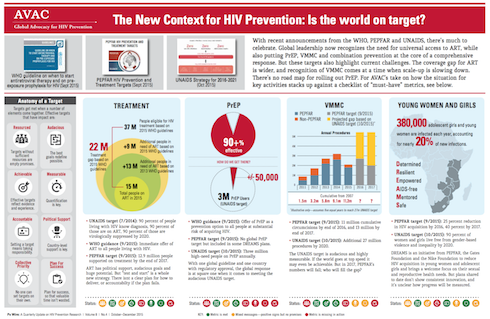
In Px Wire, our quarterly newsletter, we looked at the strengths and limitations of new PEPFAR targets, new UNAIDS targets, new guidelines on ART and PrEP from the WHO and new Sustainable Development Goals.

In this excerpt from our centerspread graphic, we take a closer look at antiretroviral therapy and Treatment U=U.

The New Context for HIV Prevention: Is the world on target?

The new issue of Px Wire, AVAC’s quarterly newsletter on HIV prevention research and implementation, is now available. In this issue, we decipher the strengths and limitations of the multiple recent developments impacting HIV prevention: new PEPFAR targets, new UNAIDS targets, new guidelines on ART and PrEP from the WHO and new Sustainable Development Goals. What does each development mean, and how do advocates tailor their advocacy accordingly?

We’re especially excited about our centerspread graphic (see below) which looks at the sum total of the new targets and guidelines and gives our “take” on whether the current context is on target.

Click here to download.

The full issue of Px Wire, as well as our archive of old issues and information on ordering print copies, can be found at www.avac.org/pxwire.

As always, we welcome your questions and comments at [email protected].

Px Wire October-December 2015, Vol. 8, No. 4

In this issue of Px Wire, our quarterly newsletter, we decipher the strengths and limitations of the multiple recent developments impacting HIV prevention: new PEPFAR targets, new UNAIDS targets, new guidelines on ART and PrEP from the WHO and new Sustainable Development Goals. What does each development mean, and how do advocates tailor their advocacy accordingly?

The New Context for HIV Prevention: Is the world on target?

In this issue of Px Wire, our centerspread graphic looks at the sum total of the new targets and guidelines and gives our “take” on whether the current context is on target.

Groundbreaking New WHO Guidelines on ART and PrEP

UPDATE: Slides and audio from the webinar mentioned below are now available. Click here.

WHO today issued an “Early Release Guideline” on when to start antiretroviral therapy and on pre-exposure prophylaxis (PrEP) for HIV. This document recommends 1) initiation of ART in adults living with HIV, regardless of CD4 cell count, and 2) offer of PrEP as a prevention option to all people at substantial risk of acquiring HIV. (The release is “early” relative to a comprehensive update of its consolidated ARV guidelines, slated to come out at the end of the year.)

If implemented, these sweeping recommendations have the potential to change the world by simplifying ART for people living with HIV and revolutionizing prevention for people at risk. So it is, first, a moment for some celebration. At AVAC, we can’t think of another time in the history of the epidemic when there has been a simultaneous game-changing shift on two fronts—prevention and treatment. Of course, the boundaries are blurred—effective ART in people living with HIV also reduces the chances that they will pass on the virus, so it is a prevention innovation, too. Now the real work begins: figuring out how to bring the blurred boundaries into sharp clarity in comprehensive national plans and global strategies.

As we celebrate, we also note the great work that lies ahead to ensure that these guidelines are turned into practice. There are funding and logistics hurdles, and there are also major information gaps. PrEP-awareness is growing, but there are still plenty of questions—see below for links to some key resources. And ART “on demand” is a wholly new concept in many parts of the world where people were told to wait until they were sick or approaching low CD4 cell counts to begin.

The work of answering these questions with smart implementation, rapid data collection and analysis, and expanded funding for civil society-led service delivery and advocacy is great work indeed. And we can’t wait to get started!

To get the conversation going, here are a few key points from an initial read of the document, as well as some additional background resources related to daily oral PrEP and the new guideline.

In addition, join advocates on a global webinar with representatives from WHO to hear more and ask questions on Monday, October 5:

Guidelines overall:

  • The document lays out four principles that should underpin implementation efforts. One that civil society will need to ensure is enacted is: “Implementation of the guideline needs to be accompanied by efforts to promote and protect the human rights of people in need of HIV services, including by ensuring informed consent, preventing stigma and discrimination in the provision of services and promoting gender equity.” (Click here for more on the barriers and facilitators to women’s access to ART.)

Immediate initiation of ART:

  • The guideline calculates that, if implemented, immediate initiation of ART would increase the number of people living with HIV eligible for treatment by up to 35 percent.
  • Throughout the discussion of on-demand ART—which is broken down by age groups, but not disaggregated by gender or other identity—there is recognition of knowledge gaps in how to deliver ART on demand. The guideline refers to qualitative research with people living with HIV and a literature review highlighting messages about how early ART can reduce mortality risk, compared to waiting until CD4 thresholds from former guidance.
  • The guideline contains a bit of a mixed message regarding CD4 cell count versus viral load. Noting that “it may be reasonable to reduce or stop CD4,” the document also says that CD4 has an important role to play in many contexts.

PrEP:

  • The recommendation of PrEP for all people at substantial risk expands prior WHO guidance focusing on men who have sex with men and serodiscordant couples. Importantly, it vastly expands the likelihood that oral PrEP will be offered to adolescents and young women. As it is the first intervention that women can use discretely—not at the time of sex—this is a potentially profound development, and one that can lay the groundwork for other tools in the pipeline, such as the vaginal dapivirine ring, which is in trials, with data expected in early 2016.
  • But what does substantial risk mean? Well, WHO will tell you—it means living in a context or community where the background incidence (number of new cases of HIV per year) is 3 percent. This doesn’t mean the overall incidence in your country has to be 3 percent—but that this is the estimated or documented rate in a context like serodiscordant couple-hood, being a man who has sex with men, a person in prison, a sex worker, an adolescent girl. The reason it’s phrased this way, WHO says, is to allow offer of PrEP “based on individual assessment, versus risk group.” WHO also notes that there are times when PrEP should be offered at a lower incidence, too.

Some more resources:

Press Release

New WHO guidelines on ART and PrEP can put the world on track to end AIDS – If they are implemented quickly and comprehensively says AVAC

Contacts

Mitchell Warren, [email protected], +1-914-661-1536
Kay Marshall, [email protected], +1-347-249-6375

New York, NY — Today’s World Health Organization (WHO) “Early Release Guideline” on antiretroviral therapy (ART) for HIV treatment and pre-exposure prophylaxis (PrEP) for HIV prevention has the potential to change the world and help begin to end the AIDS epidemic – if the guidance is swiftly and comprehensively funded and implemented. The new guideline recommends providing ART to all adults living with HIV, regardless of CD4 cell count, and offering oral PrEP as an additional prevention option to all people at substantial risk of acquiring HIV.

“This is a cause for celebration,” said Mitchell Warren, AVAC Executive Director. “WHO is paving the way for a fundamental shift in the world’s response to HIV – abandoning the partial or piecemeal use of antiretroviral medicines in favor of full access for men and women in need. Both science and conscience demand that we put these recommendations into effect as quickly as possible.

“If fully funded and implemented, the recommendations will greatly simplify ART for people living with HIV and revolutionize prevention for people at risk. But there is much work ahead to translate them into practice, from securing resources to revamping HIV guidelines in country after country to implementing comprehensive treatment and prevention programs. These new recommendations will contribute to achieving the #GlobalGoals agreed by the UN last week; now global leaders like PEPFAR and the Global Fund and national governments must begin rallying resources and laying out a vision for action.”

ART “on demand” is a wholly new concept in many parts of the world, where people have long been told to wait until they were sick or approaching low CD4 cell counts to begin treatment. Much work will need to be done to ensure that this guidance is understood and implemented.

The recommendation of PrEP for all people at substantial risk replaces prior WHO guidance focusing on men who have sex with men and on heterosexual couples in which one partner is HIV positive and the other negative. Importantly, it vastly expands the likelihood that oral PrEP will be offered to young women, offering them a long-needed prevention option that they can use discretely, not at the time of sex—a profoundly important development.

AVAC works in coalition with advocates, activists and scientists on advancing an effective AIDS response, and many partners welcome the news and call for immediate action.

“We are hoping that the WHO guidelines push governments in the right direction and finally policy makers will move to making both treatment and PrEP available to those who desperately need it,” said Yvette Raphael, a human rights activist who recently completed a year-long project focused on addressing the HIV prevention, treatment, and sexual and reproductive health needs of young South African women. “In South Africa, many young women have expressed the need for PrEP to be available as an option that will work for them. PrEP can help young women and girls take more control of their sexual and reproductive health rights and be more empowered to control their own sex lives. As a woman who has been living with HIV for 15 years, I know the importance of taking control of all aspects of your life and health.”

“Women living with HIV have been on the frontlines of demanding access,” said Lillian Mworeko, Director of ICW EA. “Now we are on the frontlines of demanding programs that include and prioritize peer support, civil society partners, and a rights-based, treatment-literacy oriented approach to the offer of ART to all.”

“A revolution in HIV prevention is now underway,” said Tom Craig, who participated in the IPERGAY trial, and advocates for improved HIV treatment and prevention. “The concept of combination prevention is now widely accepted, and now PrEP is a part of that revolution. The problem is that few people know about it, especially those in key populations, where the rate of new infections are at an all time high. When will we have access to it? Why is it taking so long? How many more people need to be infected before our governments take action?”

“As a sex worker and prevention advocate from Kenya, I have traveled my country speaking about PrEP,” said Carol Njoroge, a rights activist with the Kenya Sex Worker Alliance and a 2015 AVAC Fellow focused on expanding PrEP access. “I see that most of the people at high risk of HIV who know about PrEP and how effective it is, want it. There is demand from male, female and transgender sex workers and others at high risk for HIV, and we have PrEP demonstration studies looking at how best to provide PrEP in the real world. And in Kenya we have a “Prevention Revolution Roadmap.” But there’s still a lot more needed: clear clinical guidelines, regulatory approval, civil society partnership and funding commitments to make PrEP a reality in Kenya. These recommendations from WHO at this time – can help Kenya move towards PrEP rollout.”

AVAC is committed to working with these and other partners around the world to ensure that the new treatment and PrEP recommendations are put into practice as part of comprehensive programs that address and protect human rights, minimize gender inequities and include tailored packages of proven strategies including harm reduction, male and female condoms and voluntary medical male circumcision—a critical intervention to bring to scale in any epidemic driven by heterosexual transmission.

“We can’t let these groundbreaking guidelines sit on a shelf,” said Warren. “If taken seriously, they can help ensure that millions of people with HIV live long and healthy lives, and that millions more women and men at high risk can remain uninfected.”

At the same time, continued research into additional prevention options is critical. Two efficacy trials of a monthly vaginal ring with a different ARV called dapivirine; phase II trials of two different injectable ARVs, used every two or three months; a phase II daily rectal microbicide gel; ongoing HIV vaccine trials and new passive antibody studies may eventually provide additional options for young people and others at high risk of HIV.

“These guidelines are also an important reminder of the essential work of crafting, funding and implementing a truly comprehensive, integrated and sustained response that links rights-based prevention, treatment and research to end the epidemic,” said Warren.

###

About AVAC: Founded in 1995, AVAC is a non-profit organization that uses education, policy analysis, advocacy and a network of global collaborations to accelerate the ethical development and global delivery of AIDS vaccines, male circumcision, microbicides, PrEP and other emerging HIV prevention options as part of a comprehensive response to the pandemic.
Reflections from USCA: What is the role of Public Health in a Police State?

Lindsay Roth, MSW, is on staff at the National Viral Hepatitis Roundtable and is a member of AVAC’s PxROAR Program. She works locally with Project SAFE, a harm reduction collective that provides direct services to women surviving street economies and tweets from @safephila.

I recently attended the 19th annual United States Conference on AIDS (USCA). This is my 3rd time attending, and as I am writing this I feel I am still processing emotions of excitement, solidarity and resilience. Especially with the inclusion of Hepatitis C (HCV)- specific programming, it is clear: the biomedical revolution many activists, scientists and other stakeholders have worked so hard for is upon us. Unlike the past years where PrEP was met with ambivalence, it is being unequivocally embraced as a key prevention method. For those co-infected with Hepatitis C, there are humane curative treatments with remarkable outcomes. For both HIV and HCV, Treatment as Prevention shows promise to eradicate these viruses from vulnerable populations. There is great optimism that we can test and treat our way out of both epidemics. But, in the context of a mass incarceration in the USA that is becoming harder and harder to ignore – can we?

“Biomedical stuff will get us 50 percent of the way there,” Barb Cardell of Positive Women’s Network said to me after my presentation on the visibility of Sex Workers in the HIV/AIDS National Strategy. The strategy offered a powerful framework for USCA, as it was recently updated from its first iteration in 2010. There are many things to be excited about in the President’s ambitious goals for an AIDS free generation. A federal commitment to ending HIV is still too new to take for granted. However, as was recently pointed out by Megan McLemore of Human Rights Watch, this agenda fails to recognize the impact of the criminal justice system on health outcomes. Indeed, biomedical interventions, even cures, mean little in the context of the hypercriminlization in the United States. The impact of mass incarceration is clear in 5 key populations in which the HIV (and HCV viruses) continue to impact disproportionately.

To clarify, mass incarceration is not only the number of people behind bars in this country — and of that we have many. It also includes the various means of justice involvement, including arrest, probation, parole and “alternatives to incarceration” (which are oftentimes not as liberatory as they sound). It is very important to recognize the expansion of our criminal justice system has done little to impact rates of crime and most people behind bars are not violent offenders.

Black Americans

#BlackLivesMatter activism was visible throughout the conference, and featured prominently in the opening plenary, which included presentations We Are the Protesters activist DeRay Mckesson; a long-time public health advocate Valerie Rochester of Black Women’s Health Imperative; and Valerie Spencer, a long-time advocate for Black transgender women. Following the event’s theme of “The Numbers Don’t Lie:” it is undeniable that HIV is disproportionately impacting black Americans and role of the criminal justice system in this disparity is irrefutable. Systems of mass incarceration have generational impact of black Americans, who then suffer poorer housing, education and, naturally, health outcomes. The disruptive factor of the criminal justice system — and an unfair and unequal one at that — needs to be addressed if we ever want to End AIDS.

Sex Workers

Sex workers were excluded yet again from the US strategy. Globally sex workers are considered a key population, yet in the United States the criminalization of prostitution continues to marginalize sex workers within HIV/AIDS prevention efforts. Anna Forbes explained that other countries, like South Africa and Ghana have recognized the role of sex workers in the HIV epidemic, and included them in national strategies through empowerment-based programming. Women from Casa Ruby presented on survival sex work, as the transgender individuals are systemically excluded from legal economies and resort to underground economies like sex work to survive. A participant noted, “The government puts a lot of money incarcerating transwomen [who do sex work], but zero into reentry.”

Jacquie Rorbage of Power Inside explained how women and girls are often forced into trading sex to survive in over criminalized neighborhoods, as well as in prisons and jails. While sex worker laws are recognized as exacerbating the HIV epidemic, the US has fortified prohibitionist policies towards sex work in past years. Rorbage and other presenters including migrant sex worker activist Elene Lam of Butterfly, argued that these laws do little to mitigate the trafficking or coercion of people in the sex trade, but further empower law enforcement to profile and target women of color.

Transgender Individuals

Prostitution laws are but one of the ways that transgender individuals are sucked into the ever-expanding web of the criminal justice system, and this disproportionately impacts transwomen of color. Studies show that young people overwhelmingly enter the sex trade out of necessity because they have been forced from transphobic homes. LGBTQ youth face extreme violence in the child welfare and shelter systems, where they have no protections.

I would be remiss not to mention in addition to this systemic violence faced by transgender individuals, at least 20 transgender women of color have been murdered this year alone.

Bamby Salcedo and #TransLivesMatter activists staged a protest demanding visibility of transgender and gender nonconforming people in HIV programming. Transwomen are often included as “MSM,” or men who have sex with men, which is a crucial misstep to understanding and addressing the needs and experiences of transwomen as distinct from gay men (I can’t believe I am even writing this sentence!).

This country has systemically banished transgender individuals to the streets and then punished them for doing so, and unsurprisingly this population experiences extreme health disparities. Ruby Corodo emphasized that this population needs more than an “HIV test and a gift card”. We need real systemic change that addresses homelessness and employment and reforms the criminal justice system.

People Who Inject Drugs

Much like sex work, the prohibitionist approach to regulating substance use in this country has severely compromised the way we can empirically understand substance use and substance users. This echoed through the conference wherein the treatment of people who use drugs is guided by stigma as opposed to evidence-based interventions. The Harm Reduction Coalition facilitated a harm reduction track to address these enduring issues. Currently, curative treatments for HCV — which impacts as high as 90 percent of substance users — are being withheld due to sobriety requirements. These requirements have no evidence base; in fact research shows us quite the opposite — that treating active drug users will reduce the burden of disease in networks where it is needed most. Drug users have been as successful as non-drug users in HCV treatments.

Syringe exchange programming continues to be celebrated despite a federal ban on funding this evidence based prevention tool. Despite the success of syringe access programs; participants, especially African America participants, still face tremendous targeting by law enforcement. The criminalization of drug users, and successful interventions in their lives, continue to thwart our push to end AIDS. The implementation of proven harm reduction programming remains crucial, but must exist alongside proactive efforts to change the draconian drug laws in this country. We will never end AIDS without ending the war on drugs.

People Living With HIV

The very survivors of this epidemic remain criminalized in direct and extreme ways. We all should know the about Michael Johnson, who now faces decades behind bars. Nearly two-thirds of states in the United States have laws that criminalize potential HIV exposure. Most of theses laws were developed before ART and have not evolved with scientific advances. Many criminalize low risk behaviors.

It would be wrong to address individual risk behavior in a vacuum. All people want to be healthy, yet folks from these historically marginalized communities are pushed out their homes, out of work, and out of care — and often right into prison or jail. It’s systemic.

Effective, tolerable and accessible biomedical interventions means the end of HIV and HCV is in sight, but we, as patients, providers, policy makers and other stake holders must look across movements and work to dismantle the systems that make our efforts to end AIDS impossible.

New Frontiers in HIV Prevention, Treatment and Cure: An advocate’s webinar on passive immunization

This webinar focused on “passive immunization”—a scientific term for an expanding area of research that’s highly relevant to treatment, prevention and cure work. There are trials in humans happening in many regions of the world—and data are beginning to come in that advocates need to understand, analyze and consider. The webinar featured Dr. Sarah Schlesinger (Rockefeller University) who provided an overview of recent developments across the field including new published data.

Injectable Options and Preventable Confusion: An update on the pipeline of antibodies, long-acting ARVS and vaccines

On July 19, AVAC convened a satellite session, Injectable Options and Preventable Confusion: An Update and Interactive Discussion on the Pipeline of Antibodies, Long-acting ARVS and Vaccines. This session, part of the IAS Conference on HIV Pathogenesis, Treatment and Prevention, featured presentations on trials of long-acting injectable PrEP agents by Mike Cohen (HPTN and UNC), Larry Corey (HVTN) gave an update on HIV vaccine research and John Mascola (NIAID Vaccine Research Center) reviewed the state of passive antibody infusions for prevention. The presentations were then discussed by a panel that included Brian Kanyemba (Desmond Tutu HIV Foundation), Veronica Noseda (Sidaction) and Jerome Singh (CAPRISA).

The session provided a moment to consider what might be coming for HIV prevention. The speakers provided a guide to the prevention pipeline. The three approaches that the speakers highlighted—injectable PrEP, an HIV vaccine and passive antibodies—are in trials now. All three approaches, even if they show efficacy, are years from being implemented. But the HIV field must be ready, and must prepare now.

These updates were particularly relevant at a conference that was focused heavily on ART—whether the START results establishing the health benefits of early treatment, or the expanding implementation of daily oral PrEP globally and in different populations.

The lessons from and, ideally, successes of implementation of early treatment and PrEP that will emerge in the months and years after this discussion will provide a roadmap for these new options if they become available. Speakers emphasized the challenge of success. As Glenda Gray said at the session “We are used to failure in HIV prevention but market failure for effective interventions is the thing that worries me the most.”

How Would Bob Say It?

Emily Bass is an AVAC staff member.

The first AIDS conference I attended was the 1999 Conference on Retroviruses and Opportunistic Infections. This annual meeting happens in the northern hemisphere’s winter time, and this particular gathering was in Chicago. It was cold on many levels. Chunks of ice floated in the river that ran between the hotel and the conference center. There was no consensus that AIDS drugs should be made available to poor people in developing countries. The scientists, activists (and hyphenate scientist-activist-journalist types that AIDS work breeds) all seemed fluent in a language I didn’t speak and was just beginning to understand.

The colleague who I’d traveled with said that activists met daily to discuss what they had learned and so at the end of the first day I hovered by an indoor water feature and waited. Slowly people began to arrive—there were men and women, nurses and educators and writers. And we sat down and everyone went around and said what they had seen that was most interesting about the day. There was tremendous warmth in that circle. Commitment, wisdom, frustration and, as I recall, a man with a beautiful smile. That circle is where I met Bob Munk for the first time.

Bob, who passed away earlier this month, has been on my mind as I have watched the events from IAS 2015 in Vancouver unfold. I have thought about him because he was a familiar, friendly face that I saw at AIDS conferences, and because so much of the road that lies ahead depends on the work that Bob, who founded and wrote for AIDS InfoNet, did better than anyone I have ever known.

The final day of the Vancouver meeting, July 22, the international NGO Medecins Sans Frontieres (Doctors without Borders) released a statement that the successful global HIV response will depend on a much greater emphasis on adherence. Adherence is just one of the many words that has crept from public health jargon into widespread use within the community of people living with and working on HIV. But even though it has crossed over, it hasn’t lost its scientific veneer.

Bob Munk’s genius lay, in part, in his ability to explain the most complicated terms in simple language. His black-and-white fact sheets, all designed to be read by someone who hadn’t completed secondary education, were and are unequaled in their accuracy and accessibility. There has not been a year in the two decades that I have done this work that I haven’t suggested that a colleague “see how Bob would say it” or contact him for advice on how to word something. The day that he got in touch with AVAC in recent years to look at the AIDS InfoNet PrEP fact sheet draft, was the day that I realized this intervention would “take off” in the US and around the world.

Adherence is critical, so is saying what that actually is: sticking to the plan. And going forward, it’s not just adherence by people living with HIV or people at risk who receive PrEP—it’s also adherence by the global leaders who promise so much at these meetings and hear so much and present so much of what might be possible, if only action is taken.

Sticking to the plan is only possible if you understand why you’re doing what you’re doing. For a whole generation of AIDS writers and activists and treatment educators, Bob Munk set the gold standard for this understanding. With so much work to be done, we’ll miss him dearly and carry on, as clearly as we can, in his name.

AVAC sends wishes for peace and ease to Bob’s family, friends and husband.