August 5, 2026
By Mitchell Warren, Executive Director, AVAC
One of the most memorable moments for me at AIDS 2026 wasn’t a scientific presentation. It wasn’t a late-breaking abstract, or a standing-room-only session. It was a conversation with a ministry of health official from one of the first countries preparing to introduce lenacapavir (LEN) for HIV prevention. We weren’t discussing whether people wanted the product. We weren’t debating whether it worked. We were talking about running out.
Countries preparing for rollout of this groundbreaking prevention method – one that provides near-perfect protection from infection – are already worried they won’t have enough supply to meet demand.
For decades, the HIV field has worried about generating demand for prevention. At AIDS 2026 in Rio, we confronted a very different challenge: the demand is building. The question now is whether the world is prepared to meet it.
This was a conference defined by something arguably more important than any single scientific breakthrough. It was the recognition that as a field, we must confront the pressing challenge of political will and moral decision-making. As Raphy Landovitz asked in a stirring plenary session: do we have the courage, partnerships, and urgency to fight for science, which remains under attack?
After this week in Rio, I believe we absolutely have the courage, and the conference theme – Rethink. Rebuild. Rise. – provides a roadmap for how we turn it into impact.
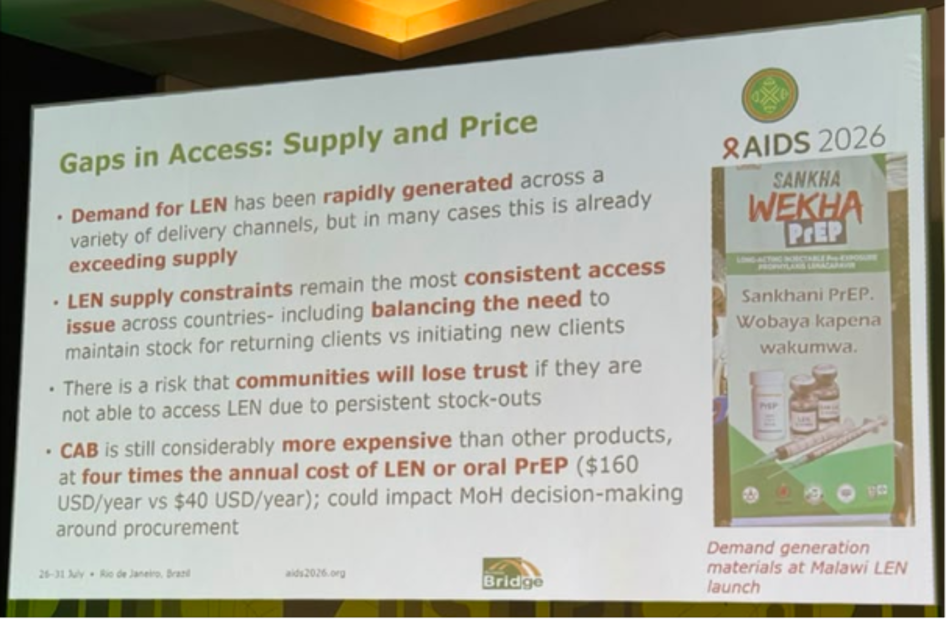
Slides presented at AIDS 2026 by AVAC partner Access Bridge during a session on the promise of long-acting PrEP
First, we must rethink what success looks like. For years, success in HIV prevention meant developing new products to prevent new infections. Today, though, success means ensuring people can actually get the option that best meets their needs – how do we deliver this extraordinary range of options?
The range of HIV prevention options has grown in ways we only dreamed of a decade ago: beyond condoms which remain as essential today as they were at my first AIDS conference 30 years ago, we now have injectable PrEP which provides near-perfect protection in clinical trials and is becoming more widely available; a vaginal ring that provides a unique female-initiated option; and a monthly oral PrEP pill is in late-stage trials (and accelerated access planning).
But more options do not automatically mean more choice. Choice is not simply a shelf full of medicines. Choice is a health system capable of delivering them. It is procurement systems that can purchase multiple options instead of one. It is healthcare workers trained to welcome diverse individuals and counsel people without bias, rather than steering everyone toward the same intervention or the one the health provider thinks is best for them. It is financing that rewards access instead of rationing it.
In Rio, I heard government representatives, implementers, and community advocates ask operational questions about choice that would have sounded impossible just a few years ago. How do we effectively forecast demand and introduce multiple long-acting options? How can we ensure speed, scale and equity across environments, from rural clinics to urban hospitals? How can we simplify delivery and offer PrEP where people want it, and not just where systems want them?
We must think big. In a matter of months, a once-in-a-generation opportunity will present itself as generic lenacapavir becomes available, and this highly effective prevention option, hopefully, becomes more accessible. Governments, donors, manufacturers, and global procurement agencies should be planning for millions of people—not thousands—to access long-acting PrEP. Importantly, we also heard in Rio how the new interest in LEN is actually motivating people who had not come forward to test and are found to already be living with HIV. The novelty of LEN is becoming a catalyst for universally testing and connecting all people with the products and services they need – whether or not they are living with HIV.
The HIV response has always moved fastest when those most affected have shaped research questions, demanded accountability, challenged institutions, and insisted that innovation reach the people who need it most.
As countries begin introducing long-acting prevention, community leadership becomes even more important. Communities that trust delivery systems, prevention methods and messages are much more likely to accept new methods. And ultimately, it will be communities that tell us whether products are truly accessible, whether health systems are delivering meaningful choice, and whether equity is more than just a conference slogan.
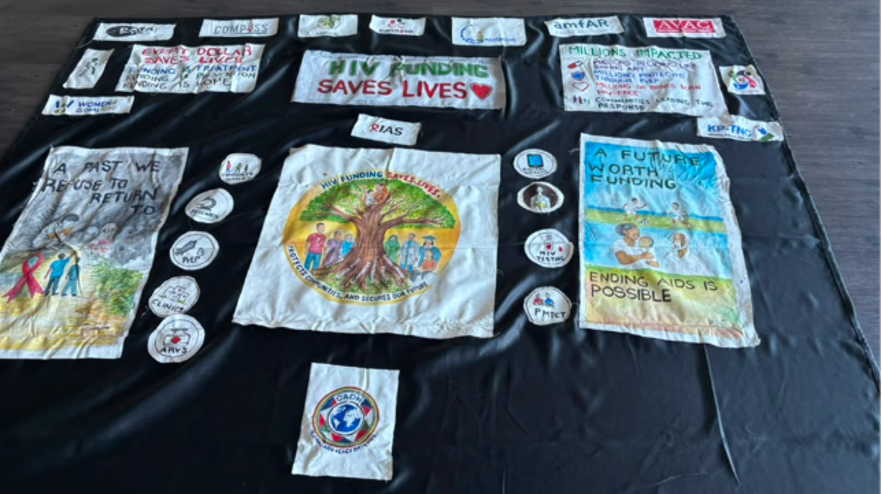
The “HIV Funding Saves Lives” quilt, created by COMPASS and the Global Advocacy Data Hub to convey the impact of funding cuts on communities
Second, we must rebuild. Rio was also the first global AIDS conference that had data presentations about the impacts of the dismantling of USAID and the dramatic restructuring of U.S. foreign assistance.
Since then, prevention programs have been diminished, services for key populations have been interrupted, research has been halted, partnerships have been strained. Organizations have closed their doors. Communities are feeling those consequences every day. Jerop Limo, an AVAC advocacy partner and adolescent HIV programming expert, summed it up perfectly in the recent POZ piece on the impact of funding cuts, “People are disengaging from healthcare spaces and missing appointments. This is not the system we had, the one that was working.”
The release of UNAIDS’ United to End AIDS special report and a companion KFF-UNAIDS analysis show the challenge of translating scientific progress into the impact needed to end AIDS as a public health threat by 2030. The report shows HIV financing entering one of its most precarious periods in decades, with international assistance declining 18% between 2024 and 2025. Donor government funding fell by $2.1 billion in 2025—the largest annual decline since global HIV funding began scaling up. This is not just a warning. It’s not just a ‘cautious stabilization of where things are. It is an alarm bell that we have to change how we do what we do, and how we fund what we do, if we want to succeed.
As colleagues from Duke and Friends of the Global Fight underscore, rebuilding cannot mean returning to the systems that existed before.
We can’t go back, but we also can’t stay still. We have to build something new.
The good news is that new opportunities and promising signs are emerging. Countries are assuming greater ownership of their HIV responses. Regional institutions are stepping forward. New partnerships are forming, and new institutions are stepping up to lead.
Across conversations in Rio, there was broad consensus that sustainability of the HIV response cannot remain overly reliant on any one country government and the whims of its leadership. A broad coalition of countries, communities, philanthropy, industry, and global institutions working toward shared goals must equally share responsibility for the future of the HIV response.
In fact, hosting the conference in Brazil was a powerful reminder that political commitment to universal HIV services can achieve a lot. But even Brazil cannot introduce every new prevention technology without strong partnerships. Manufacturers must be willing to expand access, multilateral organizations must be willing to commit to volume guarantees and investments that meet demand, and donors must prioritize and be willing to invest in what’s required to ensure equitable rollout.
Raphy Landovitz’s plenary highlighted the critical choices the field has ahead of us to ensure we meet this moment.
Lastly, we must rise to meet this moment. After every setback, whether political or scientific, the global HIV community has found a way to turn adversity into action, setbacks into solidarity, and uncertainty into progress. That was on display more than ever in Rio, where we were reminded that disappointment also moves science forward.
One of the week’s significant scientific presentations came from the CAPRISA antibody study. The results were disappointing: the trial found that a six-monthly combination of two broadly neutralizing antibodies (bNAbs) was safe but did not provide protection against HIV acquisition in young women in South Africa and Zambia. Researchers concluded that while the antibody combination demonstrated strong potency in laboratory studies, it did not achieve antibody levels needed for protection in people.
With this study, we had hoped that combining two bNAbs would provide greater protection than a single antibody, but sadly it did not. But antibody research has always been about more than product development. The CAPRISA 012c study continues to deepen our understanding of HIV and the immune system, and will continue to inform vaccine design, cure research and the next generation of prevention strategies.
Every carefully conducted study answers important questions. Every unexpected result helps redirect investments toward more promising approaches. That is how scientific progress works.
AIDS 2026 convened at a pivotal time: we now have just four years until 2030—the deadline for global HIV targets and the Sustainable Development Goals.
By the end of this year, we should know whether long-acting PrEP is reaching people at scale. By the International AIDS Society conference in Geneva next July, we should know whether generic lenacapavir is expanding access, whether research investments are holding, whether community-led programs have been restored, and whether countries are closing the equity gap. If those indicators are moving in the wrong direction, we must change course in real-time.
The legacy of Rio will be determined by whether we seize this extraordinary moment. Even as we rethink and rebuild things, we must ensure that we center communities, follow their lead, and rise up to support the populations that need this work more than ever. And just like a well-conducted clinical trial, a conference should answer some questions and raise new ones:
Will donors and governments purchase enough lenacapavir to meet demand instead of limiting access? Will pharmaceutical companies accelerate voluntary licensing and affordable pricing so new innovations reach everyone, everywhere without years of delay? Will donors invest boldly enough to match the science? Will countries protect community-led organizations and programs for key populations, recognizing that these are not optional additions but essential pillars of an effective response? Will researchers continue pushing the boundaries of vaccines, antibodies, cures, and long-acting treatment, even when some studies disappoint?
The science has never been stronger, communities have never been more ready, and the need has never been more urgent. Rio reminded us that ending HIV is no longer limited by what we know, it is limited only by the courage to act.