July 30, 2026
As the AIDS 2026 conference enters its second half, one message has emerged above all others: the barriers to ending HIV are no longer primarily scientific; they are political. In one of the “most spectacular plenaries”, Raphy Landovitz argued that the field now faces “a challenge of political will” and “moral decision-making,” asking whether the world will choose to deliver lifesaving innovations with “speed, scale and equity” or allow them to remain out of reach. The contrast could not have been sharper. As the global HIV community gathered in Rio, former NIAID Director Anthony Fauci sat before a US Senate committee in Washington amid politically motivated attacks on him and on the scientific institutions that helped make HIV innovations possible.
Read on for AVAC’s highlights so far at the conference.
Science, Systems, and Communities: Turning Progress into Impact
At AVAC’s satellite session, Shared Pipeline; Shared Goal: Innovations in Long-Acting Antiretrovirals for PrEP, PEP and Treatment, Executive Director Mitchell Warren reflected that “16 years since we first learned that PrEP was safe and effective as a daily oral tablet, we have successfully squandered our opportunities.” He urged panelists to focus on building not only the next generation of products, but also on the programs needed to deliver them with speed, scale and equity. The Gates Foundation’s Max Lataillade outlined an integrated vision for treatment, PrEP and PEP built around longer-acting options, emphasizing that “innovation without global access or implementation does not create the impact that we want,” and concluded that “science creates the possibility, collaboration creates the impact, but communities create the future.” Panelists repeatedly called for integrated, person-centered delivery systems. Ezintsha’s François Venter warned, “The delivery systems to get prevention to tens of millions of people are not there.” Root to Rise’s Adaobi Lisa Olisa emphasized engaging communities from the very beginning, while Stacey Hannah of AVAC closed by challenging the field to move “from the pipeline to access”—better, faster and more equitably.
The Future of the HIV Response Depends on Resilient Health Systems and Community Trust
As HIV programs transition to greater domestic ownership amid a shifting donor landscape, sustaining progress requires more than scientific advances. Sessions throughout the conference focused on protecting HIV prevention and treatment services through integrated health systems, sustainable financing, strong supply chains, and maintaining uninterrupted care. During the plenary, Rethink. Rebuild. Rise., Lloyd Mulenga of Zambia’s University Teaching Hospital, said, “Transition is not a choice—it is a mandate to countries.” He called out regional equity challenges, including the consistent exclusion of Latin American countries from voluntary licensing agreements, including conference host, Brazil, from the list of countries covered by the voluntary licenses announced in Merck’s access announcement for the investigational monthly oral pill, alimatravir.
Resilient health systems require innovations that are affordable and accessible at scale. In the session, Economics of impact: Costing studies across the cascade, Andrew Cross of Christchurch Hospital presented new modeling data which suggests that alimatravir could be mass produced for about $3 per person per year if manufactured at scale (though the scale needed to reach this price was not presented). “PrEP needs to be given to tens of millions of people to have a significant effect on the HIV epidemic.” He concluded, “alimatravir for $3 a year could be the cheapest HIV prevention drug the world has ever seen… But it needs to be $3 everywhere, not just some places. Merck needs to do the right thing and extend voluntary licensing access to include all middle-income countries, especially the countries where the EXPrESSIVE trials are taking place.”
Presenters consistently emphasized that resilient health systems represent just one aspect of a strong the HIV response. In a satellite session that shared learnings from LEN implementation in Kenya, Nigeria, Zambia, Mozambique, and Zimbabwe, ministry of health representatives highlighted country-specific experiences and common implementation challenges. Despite differences in context, speakers emphasized that successful rollout depends on more than product availability—it requires meaningful community engagement, trusted communications, informed choice, and demand generation strategies tailored to local communities. These lessons informed the development of the Demand Generation Playbook introduced by Elmari Briedenhann of Wits RHI. The playbook synthesizes experiences from early adopter countries and provides a shared framework to help others design community-centered approaches that translate scientific advances into meaningful impact.
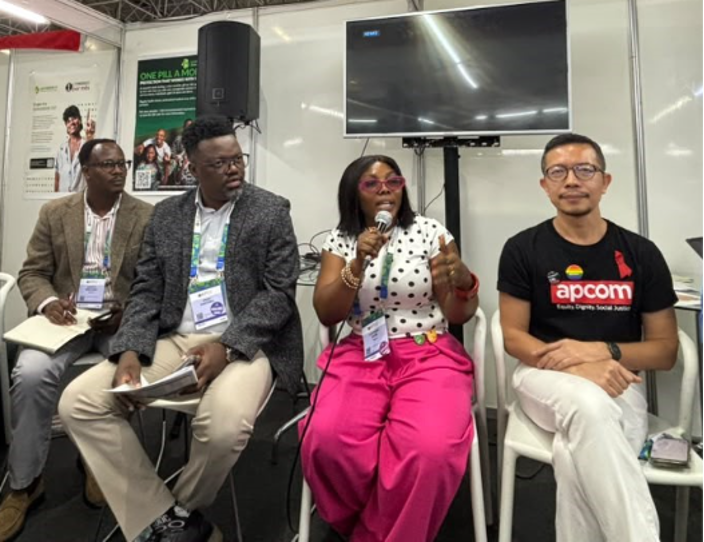
Reinforcing the call for community partnership in shaping implementation, the satellite session hosted by Global Black Gay Men Connect (GBGMC), Choosing impact: Making long-acting HIV prevention a reality for key populations in sub-Saharan Africa, hosted a discussion around what it will take to make long-acting HIV prevention a reality for key populations across sub-Saharan Africa. Access Bridge Executive Director Wawira Nyagah grounded the discussion in a question: “if a young advocate named Amani walked into a clinic tomorrow seeking LEN, would he actually be able to get it?” Through Amani’s story, Nyagah illustrated how access is shaped: through scientific innovation, voluntary licensing, pricing, product allocation, national prioritization, stigma within health services, and the availability of generic products. As both Nyagah and Mitchell Warren emphasized in Rio, the future depends on building HIV programs alongside communities—not simply delivering them to communities.
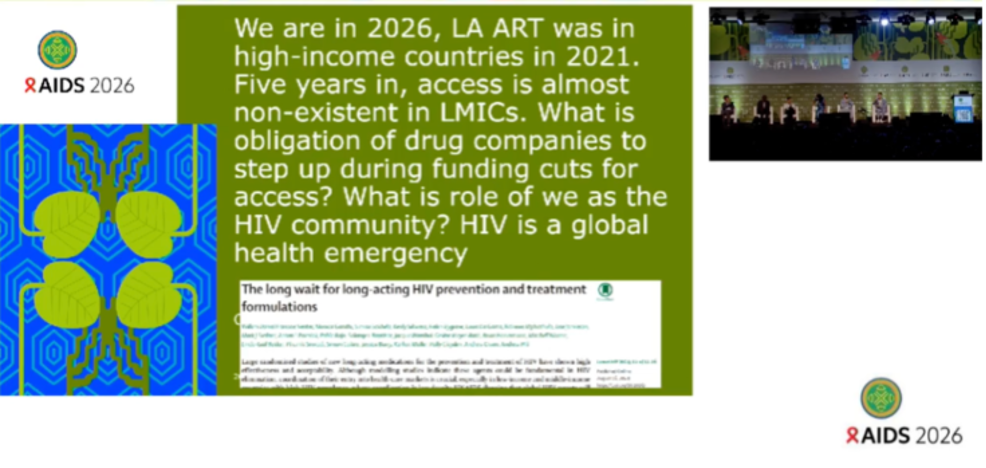
Reinforcing a major conference theme of translating scientific advances into real-world impact, Monica Gandi of the University of California, San Francisco, stressed the urgent need to translate breakthroughs in long-acting therapies into equitable access, calling for greater accountability from the global HIV community to ensure equitable access to innovations. This becomes all the more important as the long-acting treatment pipeline expands, as demonstrated in AVAC’s new tracker.
Deepening our Understanding, Advancing the Science
Sessions on innovation focused on developing new approaches and maximizing the impact of existing scientific advances. In an elegant plenary, Sandy Vasan from the Henry Jackson Foundation and US Military HIV Research Program provided an update on HIV vaccine science. She described why a vaccine is still needed even with expanded PrEP options, in line with AVAC’s recent commentary in Think Global Health, describing the scientific challenges, emerging insights and innovations and highlighting what’s in the research pipeline. While focusing mainly on HIV vaccine science, Vasan also touched on long-standing partnerships with communities as foundational to vaccine research and to vaccine confidence, as well as the need for continued investment and support for upstream vaccine research. She presented while wearing her HIV Unwrapped outfit, developed in partnership with a local Brazilian fashion designer, demonstrating yet another example of how to engage in and partner with communities in advancing science.
At the Co-Chairs Choice session, CAPRISA announced results from the CAP012c Phase 2 trial examining a potential vaccine approach. The trial found that a six-monthly combination of two broadly neutralizing antibodies bNAbs (CAP256 and VRC07) was safe but did not provide protection against HIV acquisition in young women in South Africa and Zambia. Researchers concluded that while CAP256 demonstrated strong potency in laboratory studies, it did not achieve antibody levels needed for protection in people. As Mitchell Warren noted, “we had hoped that combining two bNAbs in this study would provide greater protection than a single antibody, but sadly it did not.” Antibody research has always been about more than product development. The CAPRISA 012c study continues to deepen our understanding of HIV and the immune system, and will, hopefully, continue to inform vaccine design, cure research and the next generation of prevention strategies.
Heading Into the Future
In the session AI & HIV: Who Owns the future of Public Health? speakers focused on potential uses of AI to strengthen the HIV response through improved efficiency and effectiveness in areas like self-care, clinical decision-making, resource allocation, and data access and protection. Presenters stressed the importance of AI governance and the need for transparent regulatory frameworks and partnership with communities in the design, use, and oversight of AI systems. ITPC Executive Director and AVAC Board member Solange Baptiste noted the urgency of approaches to AI that are human-centered: “We need a community governance layer built into the AI ecosystem – added in and not just as an afterthought…one that ensures communities help shape priorities, oversee the implementation, identify harms and hold systems accountable throughout the AI lifecycle.”
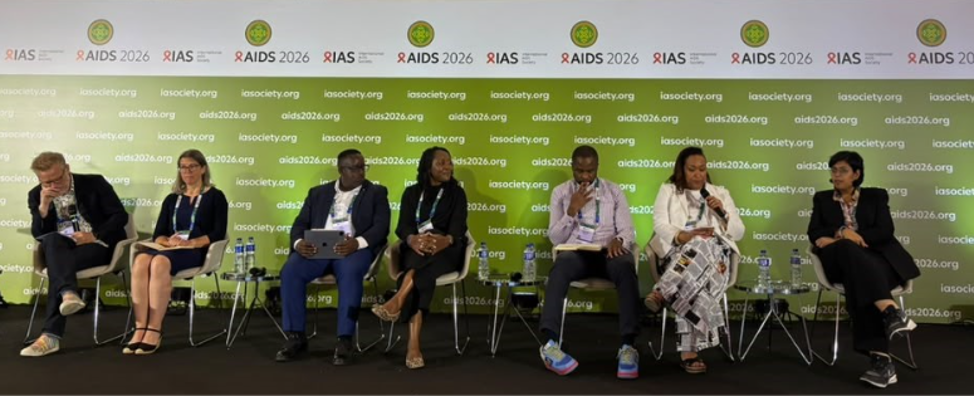
In Leadership at the tipping point: Protecting the gains and advancing progress in a new era of the HIV response, leaders from the Brazil Ministry of Health, Africa CDC and UNAIDS, along with Peter Piot, agreed that systems built to deliver HIV innovations could become a model for primary health care and global health more broadly. If countries can achieve affordable local manufacturing of lenacapavir and alimatravir, the impact could extend well beyond HIV to future technologies, including new TB vaccines. At the same time, the panel – moderated by Nomonde Ngema of HER Voice Fund in South Africa and AVAC’s Mitchell Warren – urged the HIV community to preserve the “rights-based” and inclusive approach that has made the response exceptional, while setting “reasonable, ambitious targets” supported by domestic financing and measurable goals. “The challenge [is] making sure that we actually have metrics for what resilience and sovereignty really look like.”
What We’re Taking Forward
As we move to the final days of AIDS 2026, Access Bridge’s Nyagah summed up at GBGMC’s Choosing impact: Making long-acting HIV prevention a reality for key populations in sub-Saharan Africa satellite, “Yes, we need to rethink, rebuild, and rise. But if we don’t do it with access and with equity, then scientific innovation is not going to make the difference in people’s lives. Communities must lead the conversation on what’s next.”
And as Josephine Aseme, the first person to receive lenacapavir for PrEP in Nigeria and AVAC Advocacy Fellow alumni said during Real Talk, Real Access: KP Community Demands for the Next Wave of PrEP, “PrEP is about choice and our different lifestyles,” underscoring that scientific innovation alone is not enough. Access, equity and community involvement are what transform progress into impact.
Look out for further reflections on the discussion and debate coming out of Rio and be sure to read AVAC’s summary of the first half of AIDS 2026.