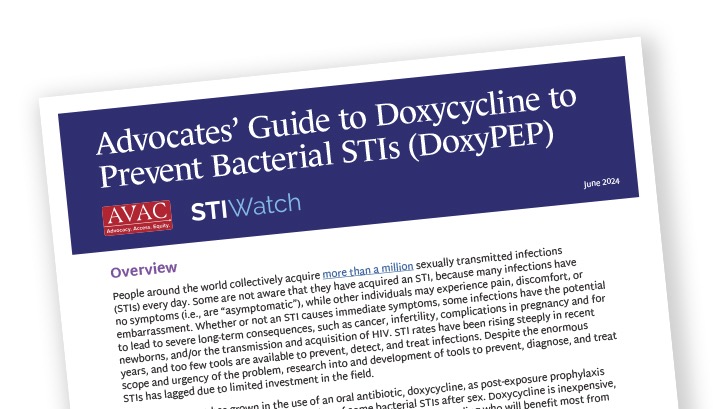
Earlier this month, the US Centers for Disease Control and Prevention released much-needed clinical guidelines on how and when to prescribe an oral antibiotic, doxycycline, as post-exposure prophylaxis to prevent acquisition of some bacterial sexually transmitted infections (STIs) after sex, so called “DoxyPEP”.
Doxycycline is relatively inexpensive, easily tolerated, and widely available. It’s a promising tool to prevent bacterial STIs, including chlamydia and syphilis. However, many questions remain, including how DoxyPEP should be implemented equitably, if it is effective among cisgender women, and how it might impact the STI rates in low- and middle-income countries.
Read AVAC’s New Advocates’ Guide to DoxyPEP
AVAC’s new Advocates’ Guide to Doxycycline to Prevent Bacterial STIs (DoxyPEP) highlights the many DoxyPEP advocacy needs and considerations and covers an update on what the data do and don’t say, what we all need to know about this promising strategy for STI prevention and what critical questions remain that require advocacy and action.
DoxyPEP alone is not a complete solution to the escalating epidemic of STIs. But in a field with few recent innovations and limited investments in new prevention, detection, and treatment tools, DoxyPEP holds important potential. Today’s research, implementation, and policy decisions about DoxyPEP can shape the path for much-needed STI research and development in the future.
We hope this new guide is helpful in our collective advocacy to ensure promising science is translated into public health impact.
The Pandemic Accord
A Critical Fight in 2024
As the World Health Assembly concluded the 2024 session in Geneva last week, member states failed to reach an agreement on the Pandemic Accord. Aimed at formalizing global agreements that would improve pandemic preparedness, prevention and response (PPPR), negotiations for the Pandemic Accord faltered around commitments to key equity measures. Member States agreed to extend the negotiations through 2024.
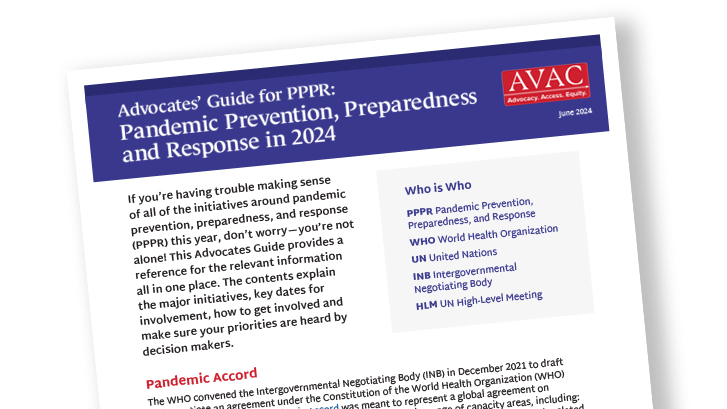
These issues are explained in AVAC’s updated Advocates’ Guide for PPPR in 2024, which covers what you need to know about still unresolved, but critical questions, such as agreements on sharing data and vaccines, and offers timelines in 2024 for strategic advocacy.
“Without these commitments, we will fail to gain the necessary lead time to get ahead of rapidly spreading health emergencies and will have no chance of eliminating new viral threats once they emerge.”
Follow the work of the Coalition of Advocates for Global Health and Pandemic Preparedness and AVAC’s PPPR Work by contacting PPPR specialist Samantha Rick at [email protected].
The Pandemic Accord is a once-in-a-generation opportunity to strategize in ‘peace time’ before the next pandemic hits. Civil Society priorities can and must lead this effort.
Join Us for Our GPP Webinar Series
Good Participatory Practice Guidelines have been shaping and improving clinical research since 2007. They provide a global reference guide for ethical and effective stakeholder engagement, helping ensure the priorities of trial participants and their communities are centered in clinical trials and broader research agendas.
However, GPP implementation is far from easy—it looks different in every context, outcomes can be difficult to quantify, engagement work is often seen as secondary to clinical processes, and therefore, undervalued and under-resourced.
To help solve for this, last year AVAC introduced the GPP Body of Evidence, a new resource that brings together a set of tools highlighting the value of GPP, as well as the nuts and bolts of how to get it done.
Now join us for a series of webinars in collaboration with The Global Health Network, Wellcome Trust, and WHO, to analyze the current state of GPP and discuss areas of growth and further development as we chart the way forward.
Register for the GPP Body of Evidence Series
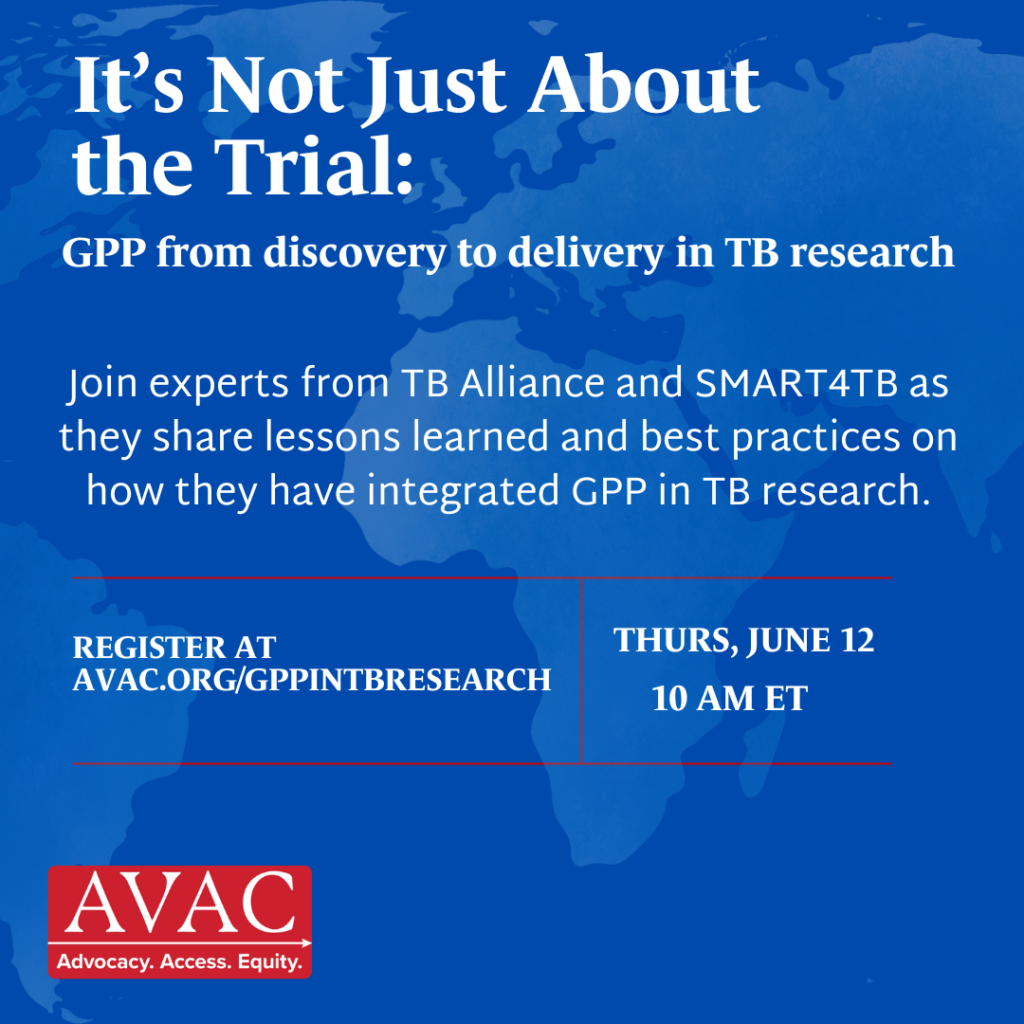
It’s Not Just About the Trial: GPP from discovery to delivery in TB research June 12, 2024 at 10am ET
GPP enhances every stage of the research lifecycle. In this webinar, our partners at TB Alliance and SMART4TB will share their experience, lessons learned, and innovative approaches in integrating GPP at the organizational, network and site level, from drug development through delivery.
More webinars coming soon, including Not Your Average GPP: Non-traditional approaches and A GPP Roadmap for the Future: Professionalizing, measuring and requiring!
Watch this space for more details.
It’s time for GPP to become an international standard for clinical research. Making that case and making it happen, using the GPP Body of Evidence, has never been easier.
Civil Society Voices at World Health Assembly
The annual World Health Assembly (WHA) is convening the last week of May in Geneva, Switzerland. As the decision-making body of the World Health Organization (WHO), amongst many other issues, the WHA will be attempting to finalize the Pandemic Accord after two years of ongoing negotiations.
The Pandemic Accord aims to strengthen pandemic prevention, preparedness and response (PPPR) by addressing coordination, equity principles, and financing expectations. The agreement will, hopefully, also take on a range of capacity issues, such as disease surveillance, support for healthcare workforces, lab facilities, and resources for non-pandemic related healthcare.
The Pandemic Accord is a once-in-a-generation opportunity to strategize in ‘peace time’ before the next pandemic hits. Civil Society priorities can and must lead this effort. Join us!
Upcoming Webinar
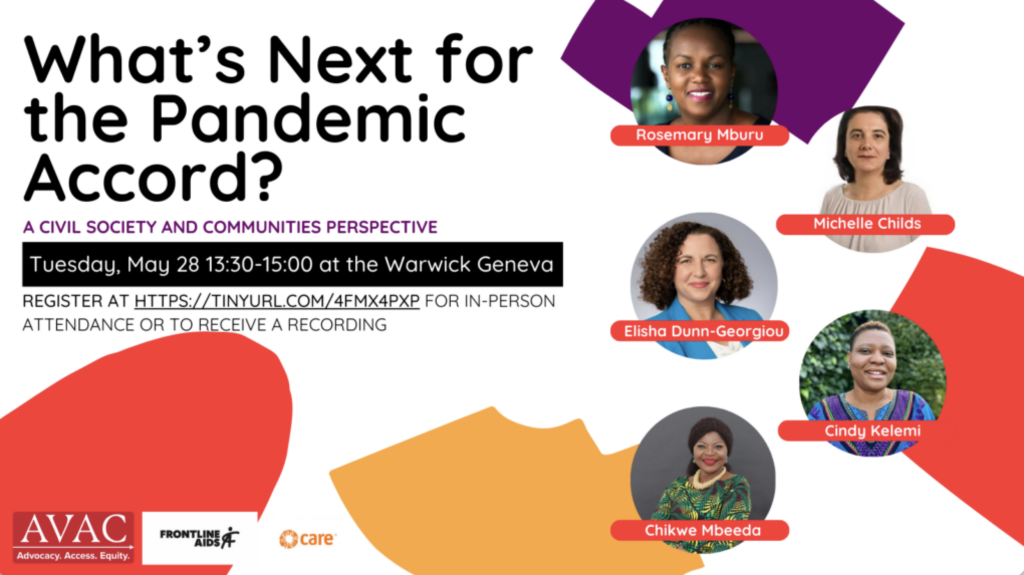
Join us on May 28 for a civil society and community perspective on the Pandemic Accord. Click below for more details and to register.
As we prepare to commemorate HIV Vaccine Awareness Day (HVAD) on May 18, the field continues to see some modest scientific breakthroughs, while still facing extraordinary challenges. Despite having an evolving toolbox of highly effective prevention options including new long-acting PrEP, we continue to see high HIV incidence in hard-hit corners of the world. Many advocates and researchers agree that ending the HIV epidemic globally without a vaccine will be extremely difficult—even with long-acting PrEP products on the market and more on the way.
“This toolbox of PrEP options will hopefully be transformative, but it is critically important that we still prioritize a vaccine.”
– Nina Russell, Director of TB and HIV R&D, the Bill & Melinda Gates Foundation on the new PxPulse podcast
Scroll through our list below for an exciting new podcast, HVAD webinars, and other key resources to mark HVAD 2024.
New PxPulse Podcast Episode!
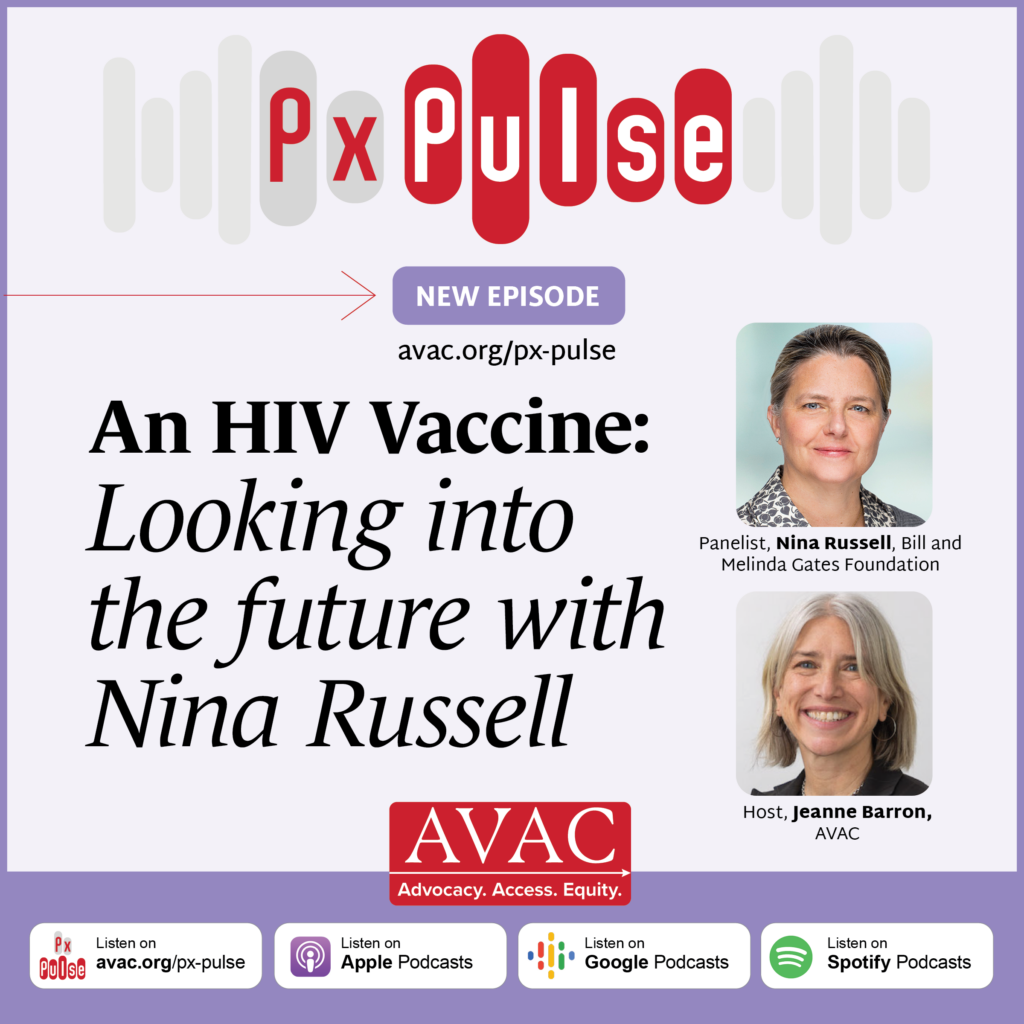
Listen to the newest PxPulse podcast, “An HIV Vaccine: Looking into the future with Nina Russell with Nina Russell of the Bill & Melinda Gates Foundation who talks about where she sees promise in the science, the goals for an HIV vaccine, and why it has an essential role to play alongside the scale up of PrEP.
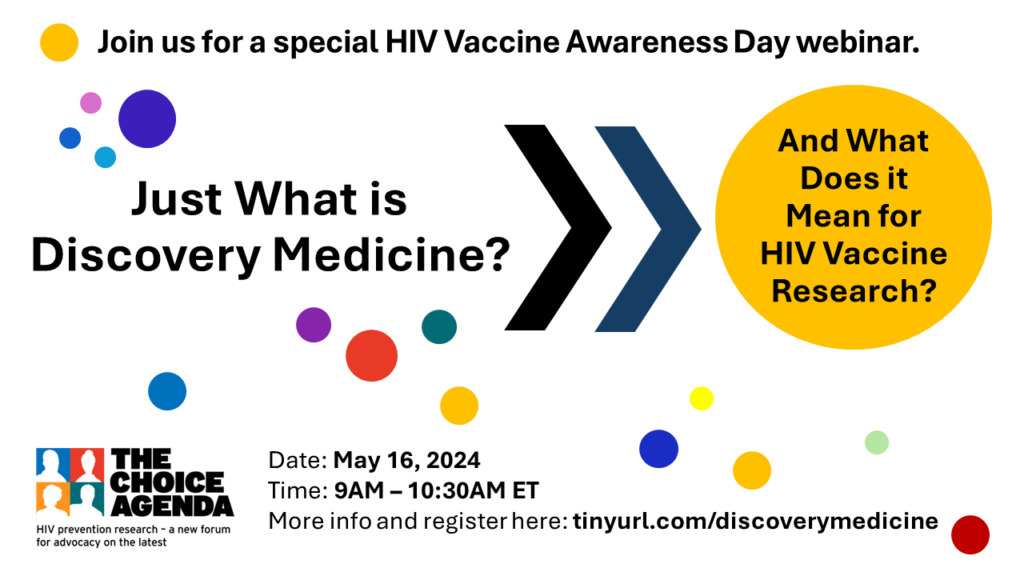
Join the Choice Agenda to gain a broad understanding of the current landscape for HIV vaccines and what discovery medicine means for HIV vaccine research and development moving forward, with a focus on community and advocacy priorities.
AVAC’s issue briefs, From the Lab to the Jab, cover the barriers to, and solutions for equitable access to vaccines in low- and middle-income countries. During this webinar, an expert panel will discuss lessons learned, an international initiative for vaccine development, and how research and access can be improved.
Partner Events
Communities across the globe are engaging in a wide array of events focused on HIV vaccine awareness. Watc this space for upcoming details on local and regional activities the Coalition to Accelerate & Support Prevention Research (CASPR) partners are leading.
Infographic
20 years and 12 efficacy trials have delivered two positive signals for vaccines and bNAbs, but unfortunately many more flat results. This infographic provides this historical timeline and key information about each trial.
And, on the heels of last week’s HIV Vaccine Trials Network (HVTN) annual meeting, where much discussion surrounded the potential of role of bNAbs in prevention (see AVAC’s 2023 HVAD spotlight on bNABs) be sure to watch this space for more resources that unpack it all.
AVAC Response to Uganda’s Constitutional Court Ruling on the Anti-Homosexuality Act
AVAC is gravely concerned with the Constitutional Court of Uganda’s recent decision to uphold the core provisions of the Anti-Homosexuality Act of 2023 (AHA) that was signed into law nearly one year ago. AVAC stands in solidarity with the LGBTQIA+ community in Uganda, and globally, in calling out this dangerous law.
“We had hoped that the AHA would be repealed in its entirety, as it is a clear violation of the health, rights and humanity of the LGBTQIA+ community, and will undermine and reverse Uganda’s progress in HIV prevention, destroying community wellbeing and taking lives along the way,” said Angelo Katumba, Senior Program Manager at AVAC. “We’ve seen the direct link between criminalization and stigma and the devastating impact both have on HIV incidence. Even with the partial repeal of four provisions within the law, the AHA remains in place and will continue to drive people underground, discouraging the most vulnerable populations from seeking testing, treatment and prevention, and they will setback the fight against HIV.”
The Anti-Homosexuality Act of 2023 (AHA) was brought to the Constitutional Court of Uganda for ruling on its legality late last year with advocates challenging the constitutionality of the law before the courts for months. Civil society advocates for LGBTQIA+ and HIV prevention have worked tirelessly over the years to change attitudes and policy in Uganda and around the world. The failure to nullify this law in full intensifies the threats faced by communities that have fought tirelessly for safety and recognition. Advocates are expected to repeal the ruling to the Supreme Court of Uganda.
Uganda’s Anti-Homosexuality Act is one of the world’s most extreme anti-gay laws, enacted at a time when several other countries, including the US, are seeing the right to health undermined through legal action and anti-LGBTQIA+ laws on the increase. Today, the Uganda’s Constitutional Court even referenced the 2022 United States’ Supreme Court opinion on Dobbs v. Jackson Women’s Health Organizationas part of its justification for the legality of the Uganda AHA.
“It is deeply disturbing to see how Uganda’s attack on human rights and evidence-based public health is influenced by and coordinated with extremist views in the US and on the US Supreme Court,” said Mitchell Warren, AVAC’s executive director. “This is a staggering message that a rights-based approach to healthcare is imperiled in many countries by reactionary movements that are gaining strength from each other.”
“We must stand up and fight back against these laws everywhere or we will never end any epidemic. We stand in solidarity with all allies and partners committed to turning the tide from hate and fear to global health equity for all,” Warren added.
Since the Ugandan law was passed last year, the number of clients attending drop-in centres providing HIV prevention and treatment services to key populations, including men who have sex with men, dropped from an average of 40 per week to two.
April Webinars!
This month we will host six webinars on a wide range of important issues, including choice in HIV prevention, PrEP in cisgender women, criminalization and HIV, syphilis in the US and DoxyPEP. Scroll down for what’s coming up later this week and later this month.
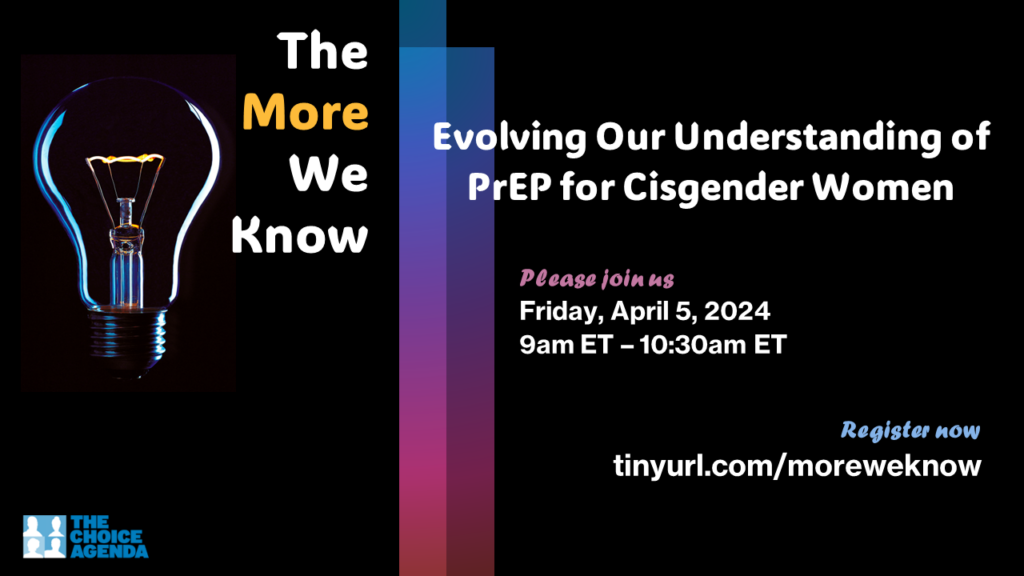
Science and real-world experience continue to demand a re-assessment of our collective understanding of the safety and effectiveness of PrEP options for women, including oral, vaginal ring, and injectable options. Join us, Jeanne Marrazzo of NIAID, Joyce Ng’ang’a of WACI Health and Raniyah Copeland of Equity & Impact Solutions for a conversation with The Choice Agenda.
Positive Women’s Network-USA and The Choice Agenda invite you to join us for a webinar featuring leaders in digital technology, HIV advocacy, and abortion criminalization to examine the existential threat of our ongoing blurred boundaries between public health and policing.
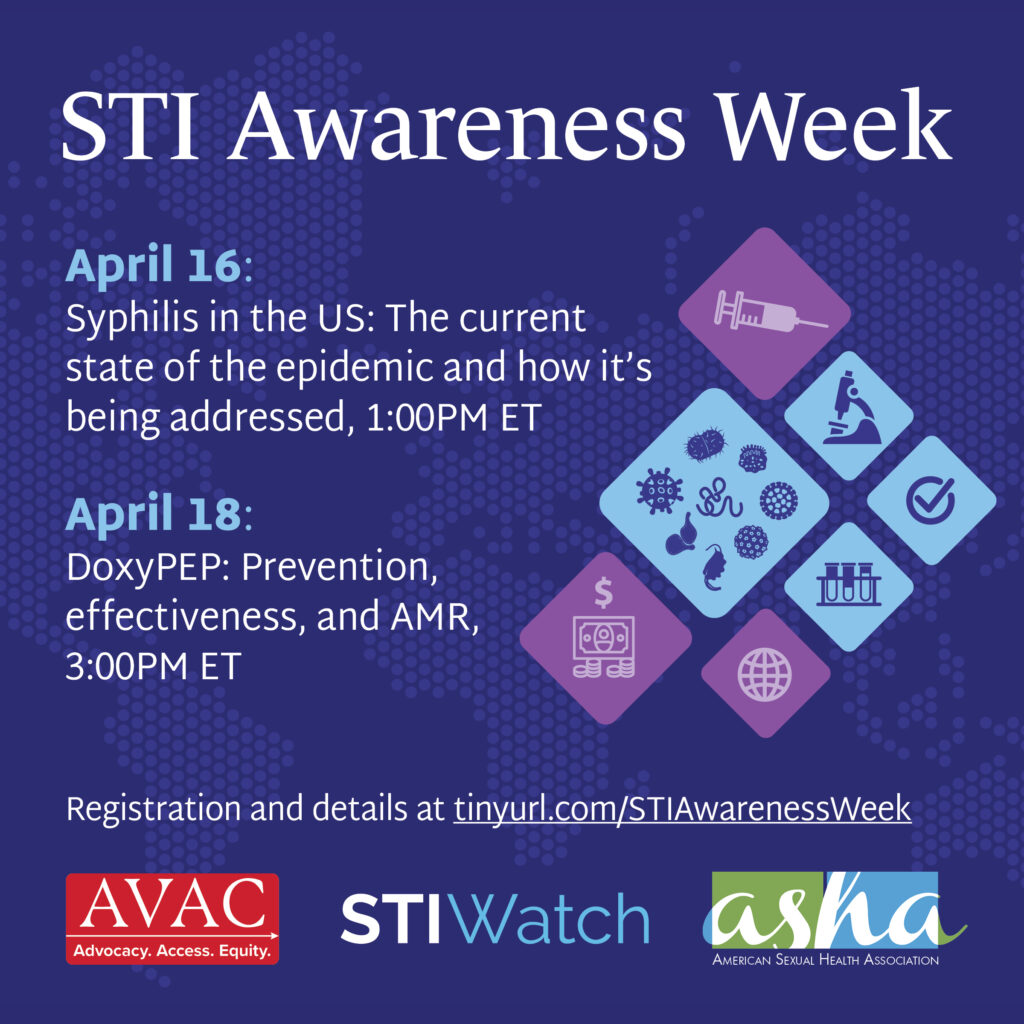
Join us for two webinars focused on syphilis and DoxyPEP. These webinars are intended for health care providers, civil society organizations, public health officials, and others working in the STI/HIV fields.
Join AVAC and Professor Moses Kamya of Makerere University to find out why the early results of the SEARCH Dynamic Choice study were some of the most exciting to come out of CROI in 2024.
Conducted in Kenya and Uganda, the study offered oral PrEP, PEP or injectable cabotegravir to both men and women, and an option to switch products.
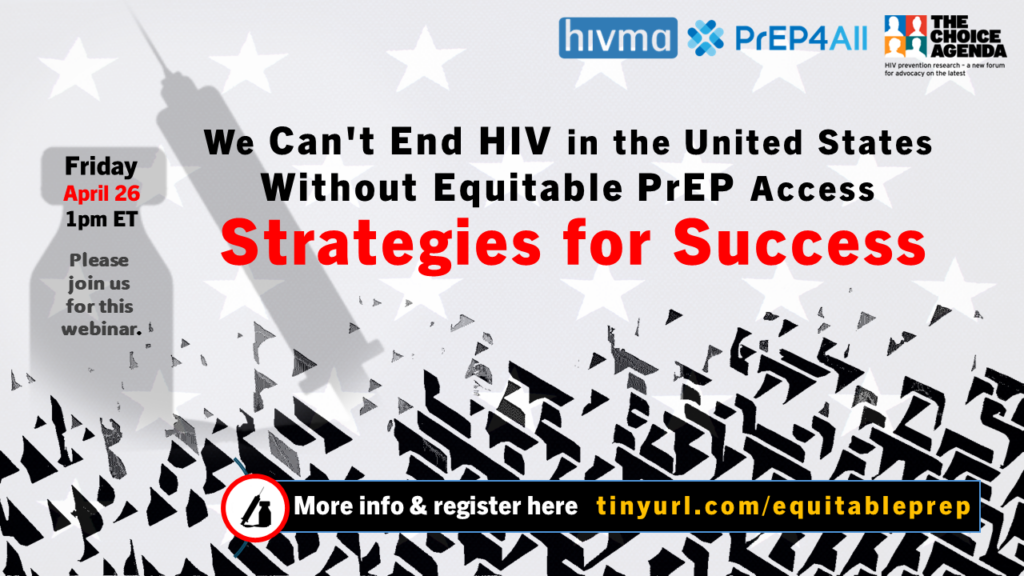
Join HIVMA, PrEP4All and The Choice Agenda, as we assess some of the key challenges to delivering PrEP in the United States equitably, including cost, the complexities of our health care system, and other factors that inhibit uptake amongst the most vulnerable communities. Strategies to address these challenges will be offered, with lots of time for QA, discussion and much-needed debate. Please join us!
The first quarter of 2024 ends with new research and questions on the future directions of STI vaccines and diagnostics. The Conference on Retroviruses and Opportunistic Infections (CROI) was the setting for positive news on the potential for early use of doxycycline to prevent STIs (DoxyPEP) in real-world settings and questions about its effectiveness in cisgender women given major evidence gaps. Important discussions and debates continued around the issue of antimicrobial resistance (AMR), as the field continues to grapple with the rollout of DoxyPEP. Presentations at CROI also highlighted the need for new diagnostics for syphilis as infections continue to increase globally and the need for STI advocacy efforts to ensure these infections get the attention and funding needed to develop vaccines and diagnostics that can prevent, detect, and treat these infections!
In January, the US Centers for Disease Control and Prevention (CDC) released the STI surveillance data from 2022, which showed an increase in chlamydia and syphilis cases from 2021. Gonorrhea cases decreased between 2021 and 2022 by 9%. Alarmingly, 2022 congenital syphilis cases increased by 30% from 2021, signaling an urgent need for novel prevention, treatment, and testing methods.
In Australia, a group of researchers published a response to the Australasian Society for HIV, Viral Hepatitis and Sexual Health Medicine’s October 2023 statement on the use of DoxyPEP in Australia. The authors point to the potential threat of increasing AMR and the urgent need to implement measures to monitor DoxyPEP use and its impact.
Read on for upcoming webinars, must-read resources supporting advocacy for improved funding and commitments for STI vaccines and diagnostics. Afterwards, test your knowledge with AVAC’s new STI Trivia quiz.
New Report! STIs: A Review of the 2022 Vaccine and Diagnostic R&D Pipeline and Investments
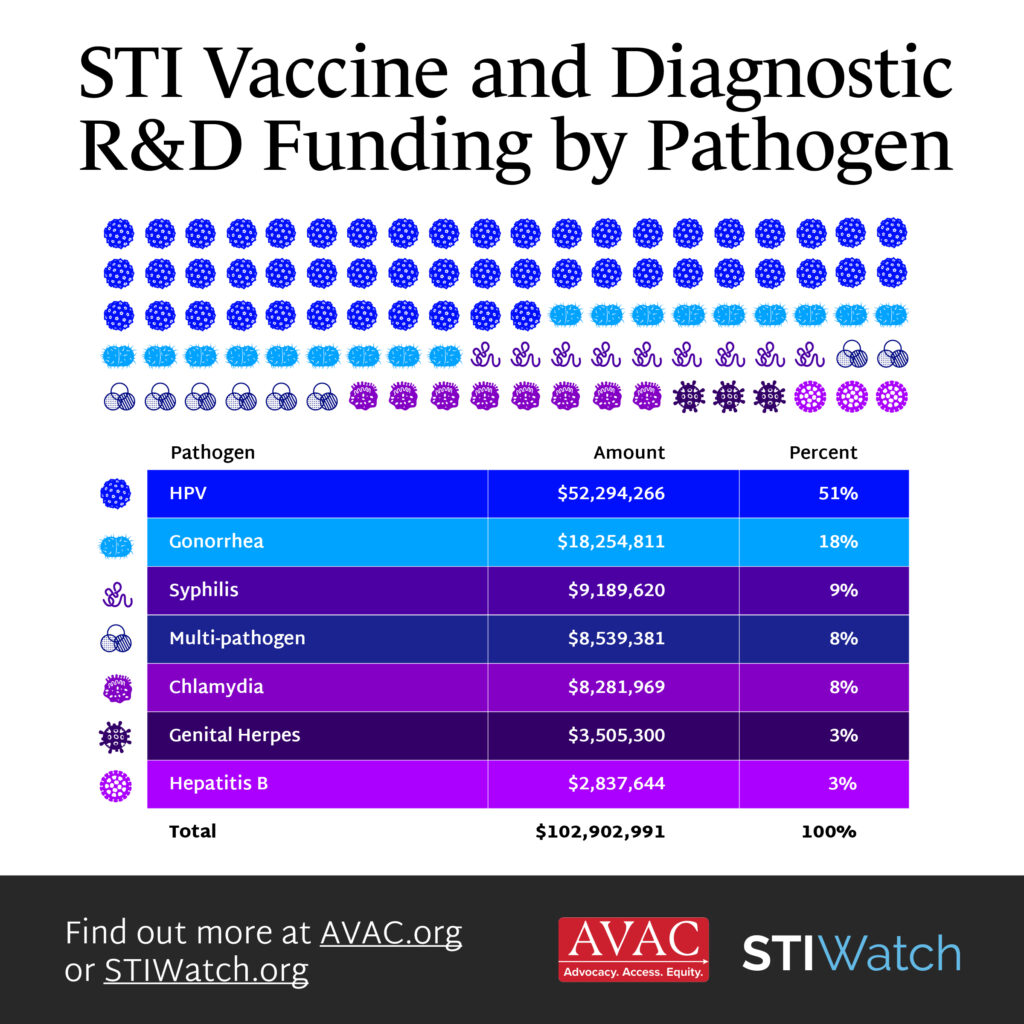
A new AVAC report tracks funding trends in vaccine and diagnostics R&D, and pipeline investments for some of the most common STIs, including chlamydia, genital herpes, gonorrhea, hepatitis B, human papillomavirus (HPV), syphilis, and trichomoniasis. The report finds that STI research remains underfunded and neglected compared to other infectious diseases. Read the report to learn more.
STI Advocacy Updates
AVAC spoke with two cervical cancer advocates, Tamika Felder and Karen Nakawala, in January as part of its cervical cancer webinar series. Felder and Nakawala are breaking taboos and saving lives by empowering people to share their stories of survivorship and senseless loss.
Felder, founder of Cervivor, Inc., was diagnosed with cervical cancer at 25, and turned her struggle into a mission, providing resources and a platform for those affected by the disease. Her impactful work and advocacy inspired Nakawala to found the Teal Sisters Foundation in 2020, following her successful treatment for cervical cancer. To learn more about Tamika and Karen, watch AVACs cervical cancer webinar. Thank you, Tamika and Karen for all that you do!
January 18 marked HPV Awareness Day. AVAC and TogetHER for Health released an updated call to action to improve HPV vaccination among people living with HIV. In total, 31 organizations signed on to this call, urging global leadership to increase access to lifesaving HPV vaccines for people living with HIV.
Join us for two webinars focused on syphilis and DoxyPEP. These webinars are intended for health care providers, civil society organizations, public health officials, and others working in the STI/HIV fields.
September 2024 STI Conferences
Registration is now open for two important STI conferences in September – which unfortunately are running concurrently in different parts of the world!
The 2024 STI Prevention Conference will bring 1,200 conference attendees to Atlanta, Georgia, from September 16-19, 2024. Abstracts are being accepted until March 29.
The 25th IUSTI World Congress will take place September 17-20, 2024, in Sydney, Australia, and provide an opportunity to meet, discuss and learn about the latest research and innovation in sexual and reproductive health.
What We’re Reading and Resources
Testing, testing: the advancing diagnostics for sexually transmitted infections. Diagnostics are urgently needed to detect STIs and this article examines several that are on the horizon. A US-Based company, Qvin is developing the Q-pad, a diagnostic menstrual pad with a removable strip to identify signs of diabetes and symptoms of high-risk human papillomavirus. Daye, a UK based gynecological start-up, launched a diagnostic product that is a tampon with the ability to screen for STIs. These advancements are exciting and serve as a reminder that advocacy is needed to ensure these products get to the people who need them.
CARB-X Funds Visyby Medical to Develop a portable rapid diagnostic for Gonorrhea Including Antibiotic Susceptibility Combating Antibiotic-Resistant Bacteria Biopharmaceutical Accelerator (CARB-X) will award up to US$1.8 million to biotechnology company, Visby Medical, to develop a portable rapid polymerase chain reaction (PCR) diagnostic to detect gonorrhea and its susceptibility to ciprofloxacin, a former frontline oral antibiotic that can no longer treat gonorrhea infections resistant to this medication. Funding will also support development of a test for gonorrhea, chlamydia, and trichomoniasis in men based on urine samples.
Syphilis Complicating Pregnancy and Congenital Syphilis. This manuscript provides a review of syphilis during pregnancy and congenital syphilis. As syphilis and congenital syphilis infections continue to rise, novel approaches are needed to detect, prevent, and treat infections. Because syphilis disproportionately affects populations with limited access to healthcare, new and improved diagnostics and therapeutics will need to be embedded within a health framework that prioritizes equity to improve the diagnosis and treatment of congenital syphilis, a preventable disease.
Near-to-patient-testing to inform targeted antibiotic use for sexually transmitted infections in a public sexual health clinic: the NEPTUNE cohort study. This study examines the effectiveness of a novel lateral flow assay for point-of-care detection of gonorrhea among people with symptoms. Lateral flow assays are tests that can detect the presence of proteins or antigens for specific infections, like COVID-19 and HIV. This test had excellent clinical sensitivity and specificity in detecting gonorrhea among male and female patients with symptoms. A test like this could provide an important tool to better detect infections in settings without direct access to laboratory testing and reduce overtreatment.
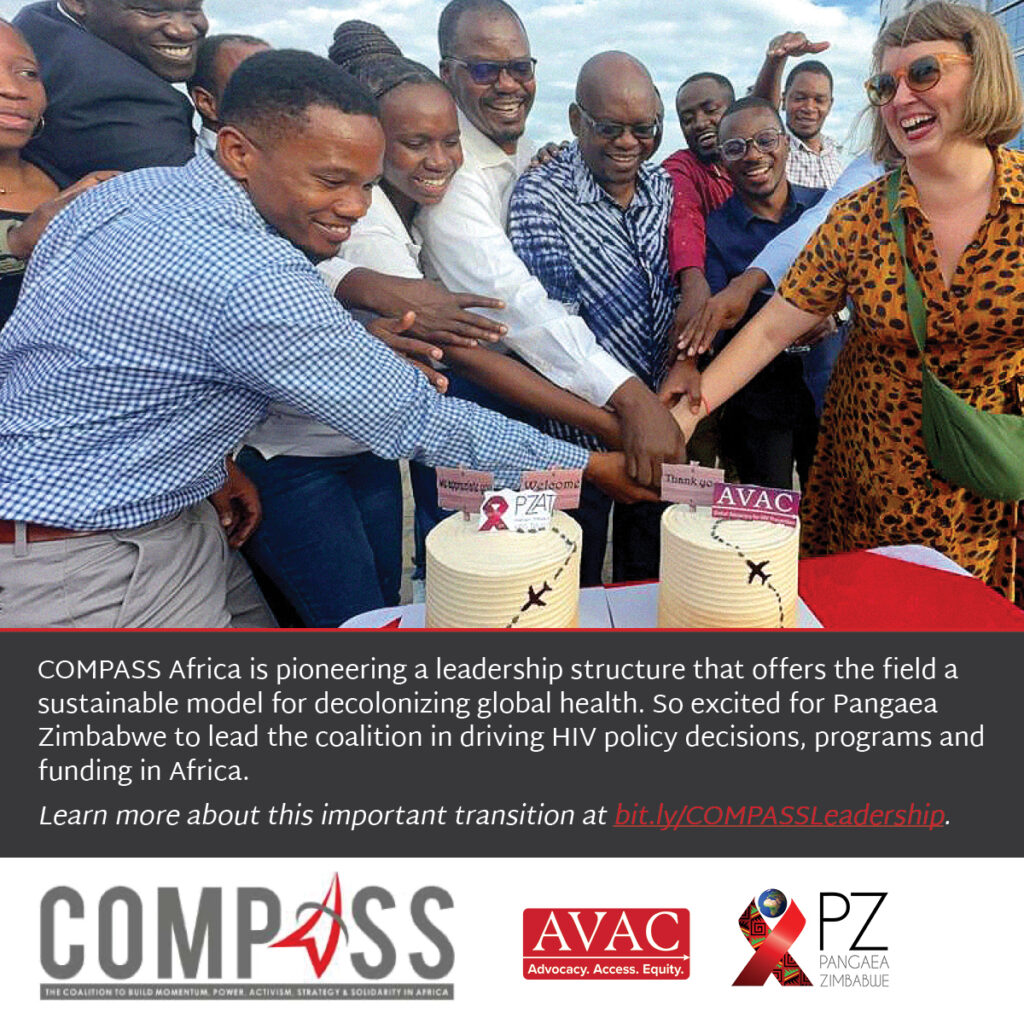
The Coalition to build Momentum, Power, Activism, Strategy & Solidarity in Africa (COMPASS) has finalized a transformative and power-sharing approach to the governance and leadership of South-North coalitions. This new approach represents innovation that harnesses the power of the coalition. It is redefining and strengthening South-North relationships, and it offers a model for a field seeking to decolonize global health. The effort was built on a founding principle of power-sharing, and a commitment that COMPASS would ultimately be led by an African-based organization. Pursuing this vision has involved a multi-year, member-led process for creating a participatory governance framework. And it has resulted in reimagining COMPASS leadership, with African organizations in control.
This case study explores the COMPASS approach that made these changes possible, the growing pains that informed the process for instituting change, and what others can learn from this experience.
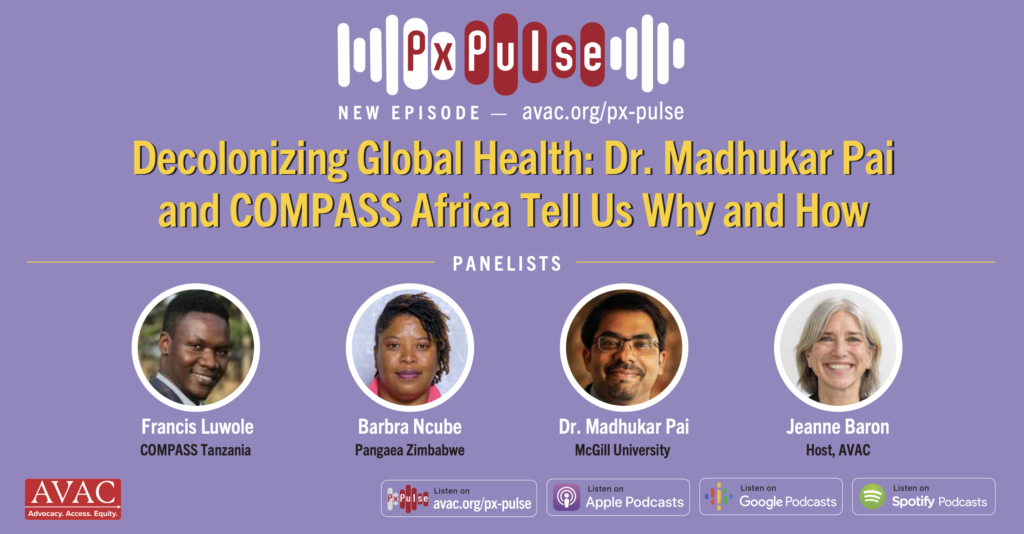
Tune in for a podcast from AVAC!
Hear from COMPASS partners on the pioneering approach to power sharing, and from Dr. Madhukar Pai on the global context.
COMPASS was founded in 2017 as a data and evidence-based South-North civil society coalition. The coalition from its beginnings has been dedicated to advancing strategic advocacy campaigns to influence policies, programs and funding for the HIV response in East and Southern Africa, with a particular focus in Malawi, Tanzania, and Zimbabwe, and at the global level. In December 2023, Pangaea Zimbabwe signed a new two-year, $4.9 million grant agreement with the Bill & Melinda Gates Foundation as the new secretariat of COMPASS Africa, a role previously served by AVAC. In recent years, AVAC was part of a coalition-wide effort to develop a clear transition plan for COMPASS to be led by African civil society organizations.
Since 2017, with a grant from the Bill & Melinda Gates Foundation, 29 COMPASS partner organizations have launched dozens of campaigns and logged 31 significant advocacy wins, with many multi-year campaigns still in progress. To name just a few of the wins from COMPASS campaigns:
Tanzania has changed the legal age of consent to access HIV services from age 18 to 15 and uptake has since seen a marked increase in testing, and increased awareness of HIV status among people 15 and older from approximately 60% to 82%.
Zimbabwe and Tanzania piloted community-led monitoring (CLM), which funds communities to track data on HIV services and report back on progress toward country targets, and whether services are meeting community needs. CLM was so successful, PEPFAR expanded the program in Zimbabwe and rolled it out globally.
Malawi’s once marginalized civil society now serves on technical working groups, influences the allocation of PEPFAR dollars and has become an essential partner to the national government in planning for HIV policies and programs. All three countries have secured funds for key population programs.
In the initial three years, results like these were delivered from a coalition with centralized leadership. Africa-based partners identified priorities, activated strategic relationships, navigated in-country challenges and executed co-created campaigns. US-based COMPASS partner organizations shared expertise on data and other technical assistance and leveraged access to global-level decision makers, with AVAC holding the primary grant and coordinating the coalition Secretariat. Coalition guidelines, partnership agreements and a robust process for co-developing strategy kept the coalition on track, but with success came challenges.
Partners wanted more opportunities to share lessons learned from each other’s campaigns and to lend capacity to one another. Roles and responsibilities needed more clarity. Partners sought broader participation and transparency in coalition decision-making, in selecting new members, and having a more formalized governance. Partners also sought to improve the existing channels for sharing feedback and resolving conflicts transparently and equitably.
Coalition members were ready to see power structures rearranged, redistributed, formalized and documented.
Ulanda Mtamba, a COMPASS member based in Malawi, put it this way: “For us partners in the South, it could feel like someone else is driving the vehicle from afar, while all the work is happening here.”
These sentiments reinforced the founding plan to shift management of the primary grant to an African-based partner. Just as important, these considerations informed an effort to re-shape the coalition and create structures to support an African partner-led, multi-country, multi-continent coalition.
Coalition Governance: Transparency, Participation and Trust
To create the needed structures and support for greater transparency and power-sharing among all partners in the coalition, COMPASS spent one year developing a governance manual that increases accountability and consistency, formulates the coalition structure, clarifies roles and responsibilities, and establishes a process for determining who holds the Secretariat.
Thirty-six volunteers from across the COMPASS Africa responded to an open call to develop a comprehensive, participatory governance framework. The volunteers selected a two-chair leadership team and a steering committee to run the development process.
“Partners were given a chance to select the leaders of the process. It was important that the process was community-led and participatory, so coalition members truly felt ownership of COMPASS. That itself was something very important,” said Francis Luwole, COMPASS country coordinator in Tanzania.
As four working groups tackled issues such as sub-granting protocols, new membership and definition of roles and responsibilities, the steering committee focused on overall goals to be reflected in the governance manual: prioritize transparency; ensure accountability to COMPASS values; maximize opportunities for members to participate in decision-making; and ensure the country coalitions had ample opportunity to review, provide feedback and validate the manual. Through regular in-person and remote meetings, anonymous surveys and country visits, the co-chairs fostered a shared ownership of the coalition’s structure, purpose and future.
“Before now… there were no guidelines to answer questions such as ‘who we are, why we’re here, or who are we doing this for—there was no clarity in some of the roles and responsibilities of members in the coalition, especially for new members. The expectation now is for the governance manual to provide an outline of what the structure of the coalition is and the roles and responsibilities of all coalition members,” said Ulanda Mtamba.
The case study found that the participatory nature of the process ensured that diversity and inclusivity were at the forefront of the new COMPASS governance structure by allowing the opportunity for as many voices as possible to have their opinions and inputs considered. It also fostered a shared sense of ownership that empowered many coalition members to invest and believe in the change to create an African-led coalition.
The 63-page governance manual now covers, among other things: member obligations and benefits; a protocol for conflict resolution; a selection process for new members; guidelines for meetings; sub-grant management; an M&E framework; a process for ending coalition membership and terminating the secretariat; and defined principles and core values. It also establishes a governance committee to serve as a decision-making and strategy-setting body with representatives from every COMPASS country, global partners, and key constituencies such as adolescent girls and young women, key populations and people living with HIV. The governance committee will be the primary leadership structure of COMPASS going forward, with coordination support from Pangaea Zimbabwe as the coalition secretariat.
“It speaks to inclusion. It speaks to equity. Our core values and principles have been reflected in the way we have structured the coalition. I’m very optimistic that, once we fully operationalize the governance manual, we are going to come up with something really beautiful, something that other partners or other coalitions may want to adapt,” said Maureen Luba, Malawi-based COMPASS member.
For more on the colonial legacy of global health, The Choice Agenda held a discussion examining the historical legacies and power dynamics that continue shaping global health. Watch the recording.
Shifting the Secretariat
As of December 2023, coalition member Pangaea Zimbabwe became the primary grant-holder and COMPASS Secretariat. In this role, Pangaea Zimbabwe will make sub-grants, convene the coalition, and be the primary point of contact for the coalition with its donors, support campaign tracking & evaluation, and administer the process that selects coalition leadership and new members. Dedicated teams comprised of in-country partners with expertise on data analysis and monitoring & evaluation will provide technical assistance across the coalition. AVAC is now a sub-grantee partner of COMPASS, continuing to coordinate the team that provides strategic and technical support to partner campaigns, provide status updates and background on the R&D pipeline for HIV prevention, support COMPASS partners in their engagement with PEPFAR and the Global Fund, and link the coalition to global platforms and advocacy initiatives.
“From our earliest conception, we outlined a vision of collective power and shared decision-making that has been central to COMPASS’s success. For that success to be sustainable, AVAC and the COMPASS coalition at large pursued a future in which governance would be centered among African-based partners,” said Mitchell Warren.
“Since 2017, we’ve been breaking new ground under COMPASS. We’ve expanded our networks and brought together the superpowers of seasoned advocates with diverse strengths to develop and share technical expertise and winning strategies,” said Imelda Mahaka, Executive Director of Pangaea Zimbabwe. “COMPASS has built a strong foundation based on collaboration, knowledge-exchange and trust that can and will accelerate innovative advocacy under African leadership.”
Putting in the Time: Sustaining the partnerships
The development of the manual and Pangaea Zimbabwe’s assumption of the Secretariat involved a phased, transparent multi-year transition plan to guide the handover of the secretariat and sub-grants management. AVAC and Pangaea Zimbabwe held weekly calls on the process, COMPASS partners contributed feedback to the plan, and the entire coalition was able to track milestones defined for the transition process.
“Partners stressed to us repeatedly the importance of not rushing the process. All coalition partners needed time and opportunity to meaningfully participate in designing the new governance framework. Integrating this input into the governance manual was more important than finding quick solutions. We found the same was true in the process of transitioning the secretariat. Pangaea Zimbabwe wanted an appropriate on-ramp to get comfortable in their new role, with plenty of support and other partners also wanted to know how AVAC was supporting the relationship between Pangaea Zimbabwe and the project’s donor. We all invested time in building trust and confidence. For those in power who are now looking for a sustainable way to shift that power to others, my message to you is that you can’t just throw the bag and run,” said Justine MacWilliam, AVAC’s senior program manager.
“This process has showed how to share power and take away the dominance of power. The desire for social justice has underpinned these values, the desire to equalize power, and the desire to contribute to something that is a legacy,” said David Kamkwamba of the Network of Journalists living with HIV (JONEHA) in Malawi.
As COMPASS campaigns continue apace with a freshly inked grant from the Gates Foundation, coalition members, and Pangaea Zimbabwe are referencing the manual, testing its strength, making changes and sharing their insights. It is bold, careful and imperative work to build and use structures for collective power and effective action.
“AVAC and COMPASS have set new benchmarks in effective civil society mobilization, advocacy and collaboration between global North and South. AVAC’s commitment to empowering African leadership within the coalition reflects a profound dedication to ensuring sustainability and maximizing impact. Coalition members are beginning a new chapter, founded on their inspired, tireless commitment to deepening the impact of COMPASS under African leadership,” said Uganda-based COMPASS member, Kenneth Mwehonge.
“This is givinghope, especially to global south partners, especially in these times when we are talking about decolonizing global health. It’s timely and strategic. It’s proving to each other our readiness to say ‘This is possible. We can have leadership in the Global South where the work is happening, where the epidemic is being fought,” said Luba.
The COMPASS Coalition understands that doing business as usual will not advance HIV prevention or global health equity. And this new power-sharing model cannot turn the tide all by itself. But COMPASS partners hope fellow travelers who see the necessity of decolonizing global health will be interested in this model and will follow its progress. The work will certainly change and evolve based on what is learned in the months and years ahead, but there’s no going back.
New Podcast Episode: Decolonizing Global Health
Dear Advocate,
Investing in the long-term success of African leadership is essential to breaking cycles that perpetuate inequity and that stall progress in the HIV response. In our newest episode of PxPulse, we explore why and how the decisions that shape global health must be made by those facing the greatest risks. As the world evaluates the pandemic response and debates on decolonizing global health gain momentum, equity in global health has never been more urgent.
For more than seven years, COMPASS Africa, a civil society coalition of 29 organizations working in three countries as well as regionally and globally, has used data-driven advocacy to improve the HIV response with high-impact campaigns. In January, the coalition underwent a major transition, with Pangaea Zimbabwe assuming the role of secretariat (previously held by AVAC), marking a historic milestone in the development of innovative models for power-sharing in coalition and an important step toward decolonizing global health. These changes in COMPASS come as other efforts, such as negotiations on the Pandemic Accord, are struggling to advance, uphold or safeguard equity.