Virtual CROI 2022 Roundup for Advocates: It’s all about choice

Welcome to Virtual CROI week two!

Here’s a roundup of the exciting science heard last week across the spectrum of HIV prevention, and on cure research (more on this further down) with a groundbreaking new case of HIV remission. We also want to be sure you are all aware of the CROI Margarita Breakfast Club dialogues—both last week and this week. Superb discussions last week and three more this week are not to be missed—recordings from last week’s conversations and registrations for this week are here.

The overarching message coming from CROI last week was clear: no one biomedical strategy will do the job, the world needs multiple options and real choices. In this round up, the importance of choice leads our coverage. (And listen to Carlos del Rio from Emory University put it all in context in a terrific US National Public Radio interview here.)

Choice and the Ring

New data from the REACH study, which incorporated informed choice into its design, made this point unmistakable. Almost all (98 percent) of the 247 adolescent girls and young women in this study where both daily oral PrEP and the Dapivirine Vaginal Ring were offered, chose one of the products over none at all. All participants tried each product for 6 months, followed by 6 months where they could choose their preferred method. Kenneth Ngure, presenting on the REACH Study, said about ⅔ of the participants chose the ring. But most of the women who had very high adherence to the daily oral pill preferred the daily pills to the ring. Ngure said overall adherence in the REACH trial surpassed levels seen in previous studies. More findings on factors driving adherence is under analysis. “REACH is just a small example of what the potential impact could be in the real world of HIV prevention, simply by allowing young women and girls the ability to choose,” said Ngure.

Choice and Injectable PrEP

HPTN 083, evaluating injectable cabotegravir as PrEP among gay men, transgender women and other men who have sex with men (MSM), presented updated data that evaluated new infections that have occurred since the trial unblinded in May 2020. Raphy Landovitz, from UCLA and HPTN 083 protocol chair, reported that adherence went down during this phase of the trial, but break-through infections among those receiving on-time injections remained rare. (He reported a total of 7 such cases in the life of the study that covers 4,660-person years.) The data continue to confirm both the safety and efficacy of cabotegravir for PrEP. Reflecting on the significance of the drop in adherence to both daily oral PrEP and injectable cabotegravir during the unblinded phase, Landovitz said complex barriers to adherence make it clear that “no one biomedical prevention option will address all issues in HIV prevention”.

Additional data from Susan Eshleman of John Hopkins University School of Medicine and the HPTN 083 team deepened the discussion on effective and feasible testing. Detecting HIV is a crucial part of prevention strategies that rely on antiretrovirals (ARVs). Exposure to a single ARV, which is the protocol for PrEP (in contrast to combination ARV used in treatment), can lead to resistant HIV. Eshleman reported on data showing that using a highly sensitive RNA-based HIV test to confirm a person is HIV negative could reduce the risk of someone with undetected HIV developing resistance to first line treatment. But she said access to these tests should not limit access to this highly effective intervention, “In the context of proven high efficacy, CAB-LA should be considered for HIV PrEP in settings where HIV RNA screening is not readily available.”

Choice and Vaccines

IAVI’s Mark Feinberg summarized the state of vaccine science. One the one hand, two recent large-scale trials showed no efficacy (Uhambo and Imbokodo). On the other hand, Feinberg said cutting edge approaches offer “a strong and vibrant source of promise” for HIV vaccine development, particularly the development of broadly neutralizing antibodies (bNAbs). Looking ahead, Feinberg predicted the next major priority to make a large-scale trial a possibility will be validating a “correlate of protection”, a mark or sign in the immune system that can be linked to preventing HIV acquisition.

As this research evolves, the need for many options that deliver real choices remains clear. In a later session on immune responses, South Africa Medical Research Council and HVTN leader Glenda Gray said the high rate of HIV in hard-hit places (as high as 4 percent) will mean effective prevention may well require a combination of strategies. “We will likely need a combination of PrEP with vaccines to combat high rates—4 percent incidence rate is just too much for a vaccine alone to overcome.”

Another Step in the Journey Toward a Cure

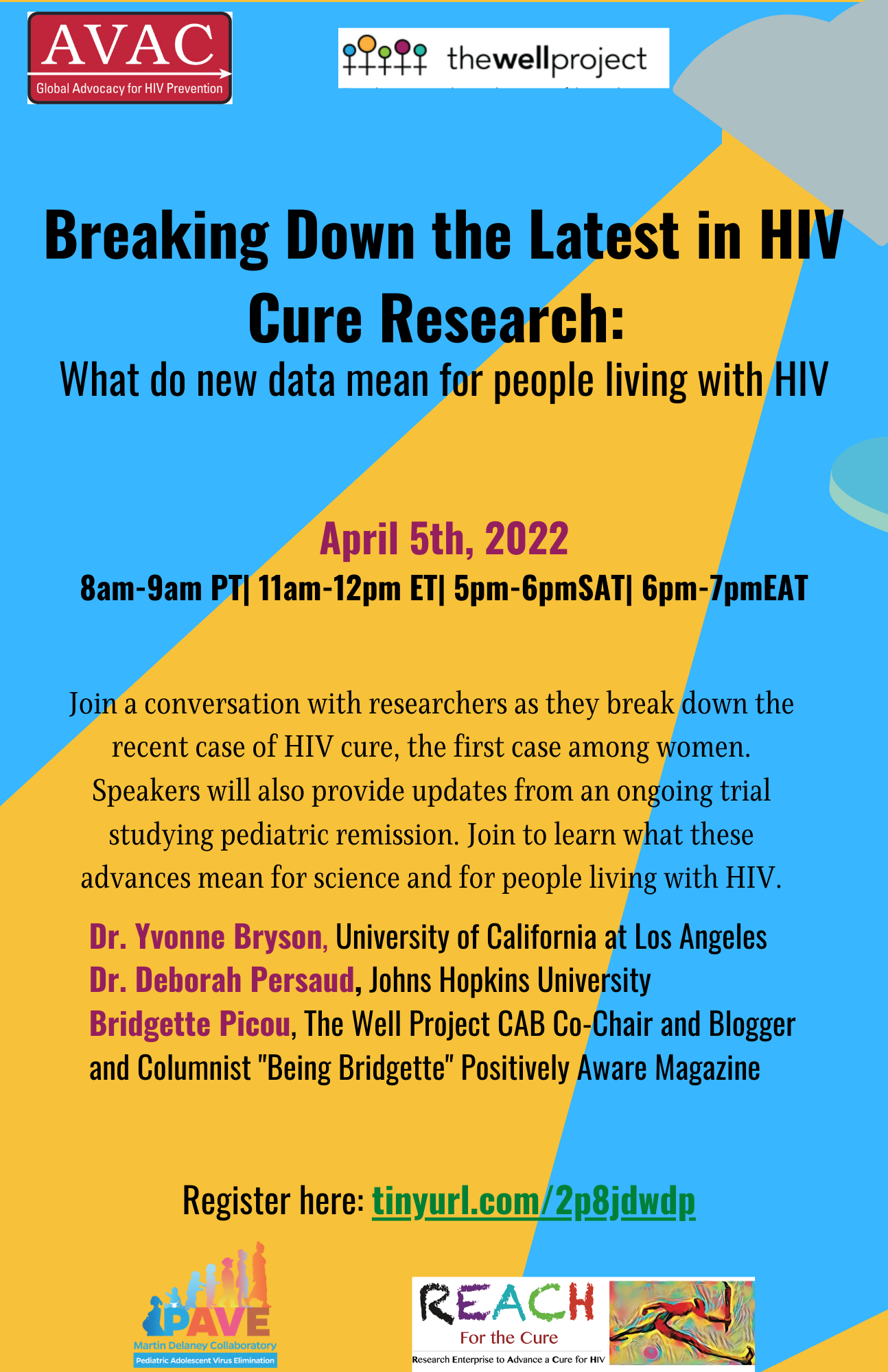
A fourth person was reported to achieve HIV remission, the first case among women, according to data from Yvonne Bryson from the David Geffen School of Medicine at University of California. The New York woman has no detectable HIV since she stopped treatment 14 months ago. Her treatment interruption followed a stem cell transplant from a donor with an HIV resistant mutation. As in the other three cases, the stem cell transplant was an urgent intervention to treat advanced cancer. This stem cell transplant pioneered an innovation where a family donor provided stem cells in combination with stem cells from umbilical cord blood that had the needed mutation. One possible implication for cure research is confirmation of the role of a critical receptor on white blood cells known as CCR5. HIV relies on CCR5 to enter and infect the cells. Mutations to CCR5 have once again led to a case of remission, and two of these cases have endured long enough to be confirmed as a cure. Want to learn more? One of last week’s Margarita Breakfast Club discussion was River Deep, Mountain High: Pathways Toward a Cure for HIV, with a wonderful discussion about these findings.

There’s more CROI coverage coming and please continue to follow along with us this week, www.avac.org/croi-2022, and check out great summaries from our friends at aidsmap.

Virtual CROI 2022

This year’s annual Conference on Retroviruses and Opportunistic Infections (CROI), February 12-24, begins this weekend and will once again, be virtual! This forum offers the latest from research on HIV, tuberculosis (TB) and hepatitis (HEP) and now also features findings from COVID-19 studies. The opening session begins Sunday Feb. 13. Plenaries and oral abstract sessions run from Monday, Feb. 14 through Wednesday, Feb. 16. Symposia are offered Tuesday Feb. 22 through Thursday Feb. 24. You must be registered to access the sessions during the virtual meeting, however, this email shares other ways to follow along and join in the discussion and debate. Note that all sessions will be available (without registration) 30 days after the conference ends.

Follow Along

Conference coverage is available via aidsmap, AVAC on Twitter: @hivpxresearch and the conference hashtag: #CROI2022.

Preview CROI

CROI’s Community Liaison Subcommittee (CLS), AVAC and EATG hosted a preview of CROI for global advocates to explore some of the key research on the program, get tips for how to get the most out of the conference, and learn where and how to stay connected. Here is a link to the recording.

Participate in Daily Research Updates at the Margarita Breakfast Club (CROI registration not required)

7:15–8:15 am MT (time converter) Feb 14-24
The Margarita Breakfast Clubs (MBCs) are one-hour Zooms that provide an intimate setting for dialogue between researchers and community advocates on the hottest #CROI2022 science being presented this year. These sessions are open to anyone and are made possible through a collaboration including the CROI Community Liaison Subcommittee, AVAC, EATG and other groups.

  • Topic: From Long to Longer – How New ARVs are Rewriting the Script for HIV Prevention and Treatment
    Date: Monday, February 14

    Speaker: Dr. Chloe Orkin
    Moderators: Ntando Yola and Jim Pickett
    Watch the recording.
  • Topic: River Deep, Mountain High: Pathways Toward a Cure for HIV
    Date: Wednesday, February 16

    Speakers: Dr. Katharine Bar and Moses Supercharger
    Moderators: Danielle Campbell and Michael Louella
    Watch the recording.
  • Topic: Aging with HIV – Frailty, Comorbidities and a Call to Action
    Date: Tuesday, February 22

    Speakers: Dr. Kristine Erlandson and Jules Levin
    Moderator: Jeff Taylor
    Watch the recording.
  • Topic: Rings and Injectable Things: Moving from options to choices for HIV prevention in cisgender women
    Date: Wednesday, February 23

    Speakers: Drs. Sinead Delany-Moretlwe and Kenneth Ngure
    Moderator: Danielle Campbell and Breanne Lesnar
    Watch the recording.
  • Topic: Long COVID – What We Know, What We Need to Know, and What We Need to Do
    Date: Thursday February 24

    Speakers: Dr. Steve Deeks and JD Davids
    Moderator: Michael Louella
    Watch the recording.

CROI 2022 Conference Materials

Check out the conference agenda and FAQs.

Looking forward to seeing you at the daily updates!

PrEP and more PrEP: An update and important resources

2022 is a critical year for the evolving role of PrEP, anti-retroviral drugs (ARVS) used to prevent HIV. Currently, two types of daily pills (FTC/TDF and F/TAF), injectable cabotegravir administered every two months (CAB-LA) and a monthly Dapivirine Vaginal Ring (DVR) are approved in some countries for at least some populations. But each face challenges that must be overcome for these proven interventions to effectively reach people who need and want them.

In addition, the pipeline of next-generation PrEP products in research and development is intensely dynamic. But if advocacy, global coordination, funding, and community-centered responses come together now, PrEP programs can be scaled, and these biomedical options can be translated into actual choices. This work is essential for the world to hit 2030 targets for ending the epidemic.

AVAC is tracking all things PrEP. Here are some resources to keep you up to date and to help frame key issues for your advocacy.

Global PrEP Tracker

Check out global trends in oral PrEP initiations with AVAC’s just updated PrEP Tracker, found on PrEPWatch.org. 2021 saw marked increases in global PrEP uptake, up 50 percent from 2020. Five countries in sub-Saharan Africa are driving this growth with expanding programs: Kenya, Nigeria, South Africa, Uganda and Zambia. Get details on the data here.

Overview of the Pipeline

These trends can be put into context with the Biomedical HIV Prevention Research in 2022 and Beyond which provides a concise update on the full landscape of biomedical interventions, including: PrEP products in the market, next-gen products in the pipeline, including multipurpose products (MPTs) and vaccines and broadly neutralizing antibodies. And check our handy cheat-sheet on Evolving Designs for HIV Prevention Trials.

Primer on Injectable Cabotegravir for PrEP

With the recent US FDA approval of CAB for PrEP, we’ve updated our advocates’ primer to outline what’s known and what’s next for this new prevention option.

Two Training Packages for Peer-led Product Introduction

The HIV Prevention Ambassador Training Package for adolescent girls and young women (AGYW) supports them to play a meaningful role in the rollout of PrEP products in their communities. Developed by the PROMISE & CHOICE consortiums, it includes a training manual on essential topics and session instructions, and a toolkit. This version of the Ambassador Training Package is intended for all priority populations, including men who have sex with men, people who inject drugs, serodiscordant couples, pregnant and breastfeeding people, sex workers, transgender people as well as adolescent girls and young women.

A Strategy for the Future of PrEP, From Research to Rollout

The Biomedical Prevention Implementation Collaborative (BioPIC) is developing a model for a comprehensive and coordinated global platform for the introduction of new biomedical products for HIV prevention. The BioPIC Adaptable Framework incorporates stakeholders from all stages of product development and delivery, from research to rollout. And watch this space for the upcoming launch of BioPIC’s online dashboard that will be tracking efforts to introduce CAB for PrEP.

Learning Lessons from Oral PrEP – and Implications for the Future

AVAC’s six-year HIV Prevention Market Manager program produced a wealth of insights on how to get rollout right. Learning the lessons from oral PrEP introduction is essential, and this series of issue briefs distills the priorities for advocates, implementers, funders, product developers and ministries of health. And in case you missed it, check out the recent webinar recording and summary.

Resources to Support the Introduction of the Dapivirine Vaginal Ring

This package of resources supporting the introduction of the Dapivirine Vaginal Ring includes: advocacy messages, an introductory slide deck, FAQ’s and more.

Are We PrEPared This Time?

Just last week, the AIDS Foundation Chicago, AVAC and partners hosted a webinar, Are we PrEPared this time? Ensuring a Swift Translation of Research into Community Impact, featuring presentations and debate on what must happen for positive research results to effectively reach communities without delay. A link to the recording is here.

The PrEP field is moving at an historic pace, but significant obstacles threaten to derail the potential PrEP holds for contributing to the end of the epidemic by 2030. Our joint work will confront these challenges. Keep watching this space for the information, resources, analysis and convening opportunities to keep this work on track.

3 Weeks, 3 Webinars: An agenda for 2022

So much is happening (and not) in HIV prevention and the larger world of global health equity. AVAC is tracking it all, bringing together different perspectives and hosting global dialogues to help inform and set a powerful agenda for 2022.

In the first three weeks of January, AVAC hosted three important conversations for the year ahead. Global health leaders and stalwart advocates provide critical perspectives and compass points on the issues that will make and break advances in HIV prevention and global health equity this year. (And read to the end for info about the first webinar in February.)

We’ve synthesized the key messages of each of the three, and posted the recordings and slides:

Understanding—And Improving—COVID-19 Vaccine Uptake
Jan 10, 2022
Recording | Summary

In collaboration with the COVID Advocates Advisory Board (CAAB) and the Coalition to Accelerate and Support Prevention Research (CASPR), this webinar, moderated by WACI Health’s Rosemary Mburu, looked closely at how global health leaders are tackling public resistance to COVID-19 vaccines, and lessons for the HIV field. Speakers included: John Nkengasong, current director of the Africa Centres for Disease Control and Prevention; Heidi Larson, founding director of the Vaccine Confidence Project at the London School of Hygiene and Tropical Medicine; and Kate Hopkins, Director of Research, Vaccine Acceptance & Demand at the Sabin Vaccine Institute.

Ups & Downs in the Field: Setting an Agenda Together for HIV Prevention in 2022
Jan 13, 2022
Recording | Summary

This webinar reviewed the latest advances, opportunities and disappointments in HIV prevention and provided an opportunity to address key questions including: where we are with the introduction of injectable cabotegravir and the Dapivirine Vaginal Ring; the development status (including setbacks) of promising new PrEP agents; and how to ensure HIV prevention and equitable access to innovation do not fall further behind; and much more. This webinar featured the perspectives of Linda-Gail Bekker from South Africa’s Desmond Tutu Health Foundation (and AVAC’s board); Grace Kumwenda of Pakachere Institute of Health and Development Communication in Malawi and Kenneth Mwehonge, the new executive director of Coalition for Health Promotion and Social Development (HEPS-Uganda) — both former AVAC Fellows — and Rachel Baggaley from the World Health Organization.

Oral PrEP Implementation and Implications for Next Generation PrEP
Jan 19, 2022
Recording | Summary

This webinar discussed insights from oral PrEP programs and how these experiences can inform faster, smarter and more affordable rollout of next-generation HIV prevention products. It featured Saiqa Mullick of Wits RHI in South Africa, Joseph Murungu of Pangaea Zimbabwe AIDS Trust (PZAT), and Daniel Were of Jhpiego in Kenya.

And the conversations continue!

Join the AIDS Foundation Chicago, AVAC and partners February 3 at 1:00pm ET/12:00pm CT for: Are we PrEPared this time? Ensuring a Swift Translation of Research into Community Impact. This webinar will feature presentations and debate on what must happen for positive research results to effectively reach communities without delay. Register here.

We hope you’ll look at the summaries of these important conversations and/or listen to the recordings and share with your colleagues, partners and friends. With this round-up of webinars setting the stage for 2022, we at AVAC are preparing for a year of deep collaboration and action with you.

Jan 19 Webinar: Oral PrEP Implementation and Implications for Next Generation PrEP

[UPDATE]: Visit here for the recording and to read a summary.

On Wednesday, January 19, AVAC and partners shared critical insights and lessons from oral PrEP programs in Kenya, South Africa, and Zimbabwe. Learning from these efforts, and other key lessons from oral PrEP introduction to date, is essential to faster, smarter and more affordable rollout of future HIV prevention products, including the Dapivirine Vaginal Ring and injectable cabotegravir. These lessons are built on more than six years of analysis and collaboration with partners and reflect urgent priorities for the field. The world cannot afford to make the same mistakes twice as a growing number of tools for prevention gain regulatory approval.

Click here to watch Oral PrEP Implementation and Implications for Next Generation PrEP. You’ll hear Saiqa Mullick of WitsRHI, Joseph Murungu of Pangaea Zimbabwe AIDS Trust (PZAT), and Daniel Were of Jhpiego discuss what has worked and what must change to transform options into choices, to finally reach the targets that will end the epidemic of HIV.

These insights offer a unique opportunity to fulfill the potential of HIV biomedical prevention, demonstrate the impact of informed choice, and realize the full benefits of increasing the use of HIV prevention among those who need it most. As additional PrEP options come to market, they could transform the landscape of HIV prevention—offering more personalized options, increasing the number of PrEP users, and ultimately contributing to lower HIV incidence. These products must be accessible, acceptable and used effectively by those who need them.

This webinar follows the important discussion AVAC convened yesterday, where leading voices in the field of HIV prevention identified their priorities in 2022. Check out the recording of Ups & Downs in the Field: Setting an agenda together for 2022, and watch the January 19th discussion to focus on next steps for these priorities on getting rollout right in 2022.

Jan 13 Webinar – Ups & Downs in the Field: Setting an agenda together for 2022

[UPDATE]: Visit here for the recording, to download slides, and read a summary.

On Thursday, January 13, AVAC held Ups & Downs in the Field: Setting an Agenda Together for HIV Prevention in 2022, a webinar looking at the latest advances, disappointments and opportunities in HIV prevention.

Watch the lively conversation with Rachel Baggaley from the World Health Organization; Linda-Gail Bekker from South Africa’s Desmond Tutu Health Foundation; Grace Kumwenda of Pakachere Institute of Health and Development Communication; and Kenneth Mwehonge, the new executive director of Coalition for Health Promotion and Social Development (HEPS-Uganda).

2022 begins in the midst of possibility and uncertainty. Some HIV prevention interventions are advancing at record speed while others face unexpected challenges. With lessons learned from oral PrEP, new targets from UNAIDS putting social drivers of epidemics in focus, and pioneering innovation ignited in the response to COVID-19, the ability is at hand to fundamentally impact the epidemic through primary prevention. It means offering a full spectrum of much needed prevention choices to the people who need them most. And it depends on the core priorities AVAC has long championed: follow the science, center communities in the response and lead with equity.

This webinar provided an opportunity to address key questions including: where we are with the introduction of injectable CAB-LA and the Dapivirine Vaginal Ring; the development status of islatravir as a monthly pill and injectable lenacapavir as promising new PrEP agents whose trials were put on hold late in 2021; and how to ensure HIV prevention, and equitable access to innovation, do not fall further behind; and much more.

Jan 10 Webinar: How to boost vaccine uptake with John Nkengasong

[UPDATE]: Visit here to view the recording and read a summary.

On January 10th, the COVID Advocates Advisory Board (CAAB), the Coalition to Accelerate and Support Prevention Research (CASPR) and AVAC held a webinar that looked closely at how global health leaders are tackling public resistance to COVID-19 vaccines, and lessons for the HIV field.

View the recording here for Understanding—and Improving—COVID-19 Vaccine Uptake, the first in a series of webinars on vaccine confidence. WACI Health’s Rosemary Mburu will moderate a discussion with:

The causes of vaccine hesitancy are complex, but its impact on prolonging pandemics is clear. Low uptake, particularly in countries with widespread access to vaccines, is hobbling the global COVID-19 response. Learning from efforts to build confidence in effective vaccines, and in the health systems that develop, manufacture, approve and distribute them, is essential. These lessons are integral to ending the current pandemic and preparing the field for future vaccines to address HIV, malaria, tuberculosis and whatever pandemic might be next.

This webinar is part of a series hosted by the CAAB and CASPR exploring key topics in pandemic preparedness and response. The series is focused on capturing insights from the response to COVID-19 that will inform public health policy and practice moving forward. For more, visit covidadvocates.org.

The Weekly NewsDigest will return January 7

There will be no issue next week. The NewsDigest will return on January 7, 2022. Our best wishes for happy holidays and a peaceful new year, and our thanks for reading!

Ups & Downs in the Field: Setting an Agenda Together for HIV Prevention in 2022

Join AVAC on Thursday, January 13 at 9:00 am EST for Ups & Downs in the Field: Setting an Agenda Together for HIV Prevention in 2022, a webinar to discuss the latest ups and downs in HIV prevention, and set an advocacy agenda together for the future. Click here to register.

A World In Transition: Charting the Future of HIV Prevention and Global Health Advocacy and Action

We close the year with the exciting news that injectable cabotegravir has gained FDA approval as PrEP. It’s an important achievement, adding another much needed HIV prevention option to the mix. But as we reflect on the many lessons of the year, we recognize this milestone sits within a larger, more complicated context. This regulatory approval is only one, albeit essential, step (for a single product among a much-needed pipeline of many) in a greater effort to transform options into real choices that have impact on epidemics and in people’s lives.

The story of 2021 is one of advances, disappointments, uncertainty, perseverance and solidarity. Through it all, we recognize themes that have been similar throughout AVAC’s 26-year history: follow the science, center community in the response, and lead with equity, always.

2021 brought no end to challenges in global health, and we hope that everyone finds time to reflect, and, hopefully, rejuvenate for the year ahead and the work that we hope to do collaboratively.

To start the new year right, please mark your calendars for Thursday, January 13 at 9:00 am EST for a webinar to discuss the latest ups and downs in HIV prevention, and set an advocacy agenda together for the future: Ups & Downs in the Field: Setting an Agenda Together for HIV Prevention in 2022; click here to register.

In the meantime, if you’re looking to catch-up on the year that was, planning for the year ahead, or just want to have some good holiday reading and listening, here are a few important reminders of 2021:

  1. On the heels of this week’s FDA approval of injectable PrEP, and with decisions from other regulatory bodies anticipated in early 2022, check out An Advocates’ Primer on Injectable Cabotegravir for PrEP and explore our Biomedical Prevention Implementation Collaborative (BioPIC) that is working to close the gap between research, regulatory approval and rollout for injectable cabotegravir and future products.
  2. In January, WHO officially recommended the Dapivirine Vaginal Ring (DVR) be included as a prevention choice for women at risk of HIV. The regulatory approval process has taken longer than we all wanted with various twists and turns, but happily WHO just this month restated their commitment to support countries as they consider whether to include the DVR as an additional prevention option for women.
  3. With the introduction of the new ring and injectable PrEP on the horizon in 2022, it has never been more important to reflect on the lessons we recently documented from the past decade of oral PrEP and their implications for these next generation PrEP products.
  4. Even as the new PrEP options rollout, the need to develop additional PrEP options continues. We have a full menu of resources related to the research agenda. New ethics guidelines support ongoing and future trials in an era of existing PrEP, which we reviewed earlier this year; our Px Pulse podcast series Research Fundamentals looks at the fundamental role of endpoints in trial design; our continued focus on next generation trial design includes this quick reference to critical updates on ethical guidance in HIV prevention trials; and a new fact sheet on Evolving Designs for HIV Prevention Trials that includes descriptions of new trials of the six-monthly injectable lenacapavir and once-monthly oral islatravir. Unfortunately, news in the past two weeks about holds on both the lenacapavir and islatravir trials (for very different reasons) are important reminders of the uncertainties of product development AND the enduring need for research literacy, ongoing stakeholder engagement and Good Participatory Practices to help navigate it all.
  5. Beyond ARV-based PrEP, what’s the future of antibody mediated prevention, following important results that were presented in January? Read our Understanding Results of the AMP Trials, and listen to our Px Pulse podcast with a Dive into the AMP Trials.
  6. Nothing about HIV vaccine research has ever been easy, and results of the Imbokodo study reminded us all both how difficult this research is and how essential it continues to be. Listen to our webinar from September to understand the results and their implications, and be sure to check out this special supplement on HIV vaccine R&D in the Journal of the International AIDS Society, including a number of critical articles from AVAC staff and partners. And if you want to learn even more about how HIV vaccine research paved the way for COVID mRNA vaccines—and how HIV might get paid back—be sure to watch this CNBC video with a number of leading researchers and advocates, including our Executive Director.
  7. Speaking of COVID-19, AVAC and many partners have spent the past two years developing the COVID Advocates Advisory Board (the CAAB), which is playing a critical role in engaging and convening essential conversations in responding to yet another pandemic. Check out the CAAB’s new website, and listen to a webinar on the global readiness for vaccine manufacturing with New York Times reporter Stephanie Nolen and another remarkable conversation on the Omicron variant with CAPRISA’s Slim Abdool Karim.
  8. In HIV or COVID or any area of public health, representation matters. It’s core to effective advocacy, and one of the reasons we are so excited about No Data, No More: Manifesto to Align HIV Prevention Research with Trans and Gender Diverse Realities. Developed in collaboration with trans and gender diverse activists from Cape Town to Berlin, this report takes critical steps toward a comprehensive research agenda for HIV prevention that serves trans and gender diverse people.
  9. Leadership also matters, which is why we are grateful to Acting US Global AIDS Coordinator Angeli Achrekar for her continued efforts to advance PEPFAR and excited about the nomination of John Nkengasong to lead PEPFAR going forward. Read more about our views here and here.
  10. Last but not least, 2021 got us at AVAC thinking not only about the larger field but our place in it. We undertook the most encompassing reflections on our work since AVAC was founded 26 years ago. As part of this process we reviewed our work from top to bottom and undertook a months-long process to forge a strategy for the years ahead that will advance HIV prevention in the broadest context necessary to advocate for global health equity. We are proud to share with you our strategic plan through 2026 and our commitment to equity, diversity and inclusion. We also issued a preview of our 2021 AVAC Report: Developing Options, Delivering Choices, which describes the concerted actions needed to transform prevention “options”, developed through research, into prevention “choices” that reach the people who need them most.

What a year—and what a “to do” list for our ongoing collaborations with all of you! We look forward to working with you to understand how the field is evolving, where it’s stuck, and what we will do together to advance HIV prevention and drive global health equity forward—so please do register to join us on Thursday, January 13 at 9:00 am EST to discuss the latest ups and downs and set an advocacy agenda together for the future.