Generation Now Responds

On World AIDS Day 2019 this year we are thinking about how communities make the difference with a series of blog posts, a blog carnival, that amplify the voices of young advocates who are doing remarkable work to shape the global HIV/AIDS response.

In AVAC Report 2019: Now What?, we called out to these advocates, members of “Generation Now”, encouraging them to sustain their bold efforts in the fight against HIV. Four stalwart fighters responded with their firsthand perspectives:

Look for additional responses in the weeks to come!

The Challenges for Young Nigeria

In AVAC Report 2019: Now What?, we called out to these advocates, members of “Generation Now”, encouraging them to sustain their bold efforts in the fight against HIV. Below is one response and more are available here.

The author, David Ita, is a community HIV prevention advocate from Nigeria and 2019 AVAC Advocacy Fellow with New Vaccine and Microbicide Advocacy Society (NHVMAS).

Dear AVAC,

Reading your letter to Generation Now, made me think of my own work in HIV advocacy and the particular challenges young people in Nigeria face accessing both sexual and reproductive health services and HIV prevention options. These barriers have a particularly negative affect on young women. Adolescent girls and young women contract HIV earlier in life and have higher incidence of HIV infection than their male peers.

As an AVAC Advocacy Fellow, I promote the integration of sexual and reproductive health (SRH) services and HIV prevention for young people in Nigeria and I’m working to increase young people’s capacity to serve as HIV prevention advocates in their community. This work makes connections that simply must be made if we want to succeed in defeating HIV. For example, I have worked with civil society, the Ministry of Health and the Ministry of Education to address reducing the age of consent for HIV testing and treatment. I want to equip young people with the knowledge necessary to make informed choices regarding their health. This means integrating SRH curriculum in schools and disseminating information regarding PrEP amongst youth. Sharing knowledge is essential amongst this population. Imagine, a 2017 National Health Survey showed that only 29 percent of young women and 27.9 percent of young men in Nigeria were able to name accurate prevention methodologies! We all must awaken to how important this work is, now imperative it is to change numbers like those. It’s also important to be very serious about incorporating a range of perspectives into the work I do. I have surveyed young people throughout Nigeria on their experiences, and opinions regarding SRH and HIV prevention. These perspectives continue to inform my work with young people.

I have learned much from what they have shared with me. As the youth in my community work together to respond to serious structural obstacles and demand access to necessary services, I see their passion and dedication. To look to the future with optimism, I have made a dedication of my own, putting the younger generation in the center of my advocacy. We all must awaken to how important this work is.

David Ita

Their Insights are Crucial: Young women and the integration of SRH & HIV Prevention

In AVAC Report 2019: Now What?, we called out to these advocates, members of “Generation Now”, encouraging them to sustain their bold efforts in the fight against HIV. Below is one response and more are available here.

The author, Ulanda Mtamba, is a behavioral change and communication specialist from Malawi who served as a 2018 AVAC Advocacy Fellow with the organization Advancing Girls Education in Africa.

Dear AVAC,

Thank you for highlighting the importance of engaging youth in HIV prevention advocacy in your letter to Generation Now. In my own experience working with young people, I have developed a deep appreciation for the vital role youth play in pushing for social change. Young people understand their own challenges intimately and their participation in HIV prevention advocacy and research is essential in developing and implementing technologies that work for younger generations.

Young women, in particular, possess crucial insights concerning the relationship between HIV/AIDS and sexual and reproductive health. They understand the importance of integrating HIV/AIDS and sexual and reproductive health services because their lives are affected by siloed interventions. My belief in the importance of young women’s participation in the field has propelled me to establish community education programs that increase their knowledge of oral PrEP and the dapivirine ring in my home country of Malawi. I believe that by familiarizing young women with HIV prevention research, we can better empower this generation to engage in national dialogues and inform the HIV research agenda in Malawi and around the world. I look forward to continuing my work with young women to advance our participation in biomedical research and advocacy. I also call on leaders in the field to prioritize the integration of sexual and reproductive health services in HIV/AIDS prevention, care and treatment as an essential public health intervention.

Ulanda Mtamba

Youth Voices are Weapons in the Fight Against HIV

In AVAC Report 2019: Now What?, we called out to these advocates, members of “Generation Now”, encouraging them to sustain their bold efforts in the fight against HIV. Below is one response and more are available here.

The author, Mercy Mutonyi is a young advocate from Kenya and 2019 AVAC Advocacy Fellow with Bar Hostess Empowerment and Support Programme.

Dear AVAC,

Your letter to Generation Now in AVAC’s 2019 Report identified important issues regarding youth organizing that spoke directly to my personal experience as an advocate working on the frontlines of HIV prevention advocacy. As a young woman and HIV prevention advocate, I understand firsthand the importance of youth engagement in HIV prevention advocacy. I believe that young people need to be directly involved in shaping discussions that affect us personally and demand a primary role in co-creating prevention campaigns that speak to my communities’ particular concerns. While young people may tune out sexual health messages from the adults in their lives, they pay close attention to their peers and it is essential that we are empowered to help shape the messages and their dissemination amongst our generation. Youth voices and peer-to-peer education are powerful weapons in the fight against the AIDS epidemic.

I am proud to represent my community as a leader in key decision-making forums such as Kenya’s HIV technical working group and to have played a key role in developing Kenya’s national PrEP guidelines. I am also honored to have served as the lead PrEP Ambassador, Project Co-Investigator and Administrator of the medical and community education components of the oral PrEP (Truvada) pilot study project implemented by BHESP-LVCT-SWOP in 2015-2017. In this role, I coordinated and worked with 12 other PrEP ambassadors to create awareness of PrEP at different hotspots in Nairobi. We shared feedback from female sex workers on their views and opinion’s of PrEP and supported female sex workers interested in oral PrEP screening and enrollment. I have also shared my experiences using PrEP on national and local radio stations, social media and national TV stations, and community engagement meetings. This kind of participation from young leaders is essential to ending the epidemic where I live and work. Without it, young people will look in vain for faces and voices they trust as complex issues around HIV treatment and prevention unfold. Thank you for recognizing the significance of this work and the unique contributions young people, and particularly young women, bring to the field.

Mercy Mutonyi

Helping Young People Influence the HIV Research Agenda in Zimbabwe

In AVAC Report 2019: Now What?, we called out to these advocates, members of “Generation Now”, encouraging them to sustain their bold efforts in the fight against HIV. Below is one response and more are available here.

The author, Deloune Matongo, is a sexual and reproductive health youth advocate from Zimbabwe who served as a 2018 AVAC Advocacy Fellow with GALZ (An Association of LGBTI People in Zimbabwe).

Dear AVAC,

I was encouraged to read your letter addressed to the generation of young people working on the frontlines of HIV prevention. I personally understand the importance of partnering with youth in biomedical research from idea conceptualization to commodity distribution. The field of HIV prevention needs leaders like AVAC to continue to speak out about the role that youth play in shaping our movement.

According to the World Bank, 42 percent of the world’s population is under the age of 25. Unfortunately, far too many of these young people are living with HIV, and youth between ages 15 and 25 comprise more than 30 percent of all new HIV infections globally. Deaths related to HIV and AIDS among young people tripled between 2000 and 2015 globally and in Africa it is the leading cause of death among youths. In light of these devastating statistics, it is clear that young people should be taken seriously when it comes to designing and implementing HIV prevention technologies that work for them. It’s not just logical, it’s also a matter of ethics and human rights.

My work today and during my AVAC Fellowship in 2018 is centered around capacitating youth to understand, participate in and influence biomedical research. I am proud to work with GALZ (an association of LGBTIQ people in Zimbabwe) to familiarize LGBTQ youth with the most up to date research in HIV prevention and to work in partnership with young people to influence the HIV and AIDS research agenda in Zimbabwe and around the world. The youth advocates with whom I work inspire me every day to continue to call on institutions and governments to provide the institutional and financial support necessary for robust HIV prevention, treatment and cure research.

Deloune Matongo

World AIDS Day 2019: Generation Now shares priorities for fighting HIV

In commemoration of World AIDS Day 2019 and this year’s theme, communities make the difference, AVAC is throwing a blog carnival—a series of blog posts that amplify the voices of young advocates who are doing remarkable work to shape the global HIV/AIDS response.

In AVAC Report 2019: Now What?, we wrote a letter to these advocates, members of Generation Now, encouraging them to sustain their bold efforts in the fight against HIV and to lead with a vision of the future they want to see. A number of our partners have responded, imparting firsthand perspectives on what it means for them to mobilize in various contexts across Africa.

We encourage you to read their responses for their take on the state-of-the-field and the advocacy priorities of some of its young leaders:

AVAC’s Maureen Luba and a long-time partner, Charles Holmes, also address this in their editorial, We Can Beat AIDS with Youth in the Lead.

As we enter 2020 and beyond, we commit to supporting young people as leaders in the response to HIV and AIDS. Join the conversation and let us know what you think should be prioritized in 2020 by sharing your response to the vital question AVAC poses in our annual report, Now What?. Tweet at @HIVpxresearch using the the hashtags #NowWhat2020 #WorldAIDSDay #WAD2019 and look for additional blogs in the weeks to come!

ICASA 2019: Navigating Prevention at the Conference

The 20th International Conference on AIDS and Sexually Transmitted Infections in Africa (ICASA 2019) is coming right up, December 2-7 in Kigali, Rwanda. Find details below on select events of interest and how to follow the conference. AVAC will be there along with many of our partners participating in sessions both before and during the conference. There are several ways you can link to HIV prevention research and rollout-related events—both in-person and from afar.

For the latest, including a list of poster presentations, visit our ICASA page.

ICASA 2019 HIV Prevention Research Roadmap

Amidst a wide range of topics that will be covered at the conference (full program available here), we have pulled together a roadmap of select sessions that may be of interest to those tracking biomedical prevention research and rollout. And on arrival, be sure to check out the various Networking Zone schedules in the Community Village for more great programming on prevention and more!

Download as a PDF or XLS file and please let us know of any other related events that should be added to the roadmap.

Pre-conferences

Biomedical HIV Prevention Forum Pre-Conference
Monday, December 2, 9:00 – 17:00 at the Kigali Marriott Hotel. Register here.

  • The Biomedical HIV Prevention Forum (BHPF)—co-organized by AfNHi (the network of HIV prevention research advocates in Africa) and the New HIV Vaccines and Microbicides Advocacy Society (NHVMAS)—puts HIV prevention research on the spotlight by providing a unique platform where participants gather to learn about progress made and best practices in biomedical HIV prevention research and development. The forum is a space for participants to share HIV prevention research related perspectives and experiences.

Satellite and Special Sessions

PEPFAR Watch
Tuesday, December 3, 8:00 – 11:00. RSVP here.

  • Does your country receive PEPFAR funding? PEPFAR’s annual planning process for 2020 is starting now. Join for a skills-building workshop—organized by Health GAP and partners—to find out how to monitor and influence PEPFAR via updates on how activists can ensure money is aligned with community priorities; share experiences and best practices to increase accountability and share tools for organizing and data analysis.

Why Do Pre-Exposure Prophylaxis Costs Differ So Much: Methods or Setting?
Tuesday, December 3, 10:45 – 12:15 in room Jeanne Gapiya (MH4). Register at prep-costing.eventbrite.com.

  • This satellite session— co-hosted by the OPTIONS Consortium and Jilinde—will review why cost estimates and cost effectiveness of PrEP can vary so widely within and across programs, countries, and methodological approaches. Hear from a variety of programs and perspectives to identify key drivers of costs and how to make sense of estimates for use in modelling and programming.

Laying the Foundation for an HIV Cure in Africa
Tuesday, December 3, 18:30 – 20:30 in room Joel Nana (AD10).

20 Years After Abuja, What Next?
Wednesday, December 4, 10:45 – 12:15 in room Prof. Madeleine Okome (MH 3)

  • This special session—organized by the Society for AIDS in Africa (SAA)—on the Abuja Declaration is a platform to evaluate the impact of various declarations on domestic funding and their implementation in Africa. The Society for AIDS in Africa (SAA) with a group of African and global HIV advocates including AVAC, has developed an African HIV Financing Scorecard in partnership with Accountability International as a means to analyse the existing funding, interrogate the gaps in required funding, and provides evidence-based advocacy messaging for action by the various stakeholders involved. The report will be released during this session and includes recommendations for an African advocacy campaign in the context of broader campaign to increase domestic funding for HIV programming.

ICASA on Social Media: Follow the conference in real-time on social media by following us on Twitter and Facebook—and using the official conference hashtag #ICASA2019.

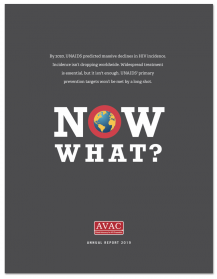
AVAC Report 2019: With 2020 targets sure to be missed, we ask Now What?

Report cover

Today, AVAC released Now What?, our 2019 annual report on the state of the HIV prevention field. Each year, the AVAC Report frames the most pressing advocacy issues facing the HIV response. At the threshold of 2020, it’s clear that global goals for HIV prevention will miss the mark by a long shot.

Though important progress has been made, the crisis UNAIDS called out in 2016 persists today with new infections around 1.7 million annually, a far cry from the 2020 target of fewer than 500,000.

So, we asked ourselves, Now What?, and answered with cross-cutting analysis and an advocacy agenda to match.

FIRST, we call for leadership that is bold, visible and activist, from the new head of UNAIDS, to houses of parliament to civil society coalitions: take uncompromising stances, demand accountability, speak out for intersectional issues of race, gender, class and climate. This work needs to be funded, full-throttle and fearless.

SECOND, we call for the use of today’s most recent evidence to guide new prevention targets that will pave the way for epidemic control. Clear milestones for the prevention research pipeline must be set. Investments over the past decades have provided us with the prevention options we have today, and much-needed new strategies are under now investigation. The field needs targets for prevention research that people can understand and influence.

THIRD, we call for multilayered prevention approaches that are centered around the person, not the virus. Since last World AIDS Day, we’ve learned again, perhaps most strikingly from the ECHO trial, about the dynamic needs of women for HIV and pregnancy prevention. The complexity of translating results into policy, bring renewed urgency to the need for comprehensive HIV prevention and reproductive health approaches. Multilayered prevention incorporates multipurpose strategies (i.e., products that prevent both pregnancy and HIV) within programs designed to address structural barriers (i.e., policy reform, transforming community norms, facilitating educational empowerment).

2020 will be a pivotal year—join us in calling on leaders, from the grassroots to global capitals, to make 2020 a turning point, when siloes come down, crises are transformed by innovation, and prevention is center stage in the fight against HIV.

Happy reading, and we’d love to hear how you answer Now What?

POSTPONED: Nov 15 webinar on PK/PD & F/TAF

Due to last-minute scheduling conflicts, we must postpone Friday’s (Nov 15) webinar—PK, PD and F/TAF: What does an advocate need to know about the pharmacology of safety and efficacy and today’s PrEP drugs. We apologize for the inconvenience but stay tuned for details on its rescheduling!

And, in case you missed it, download and view the rest of the webinar series via the links below:

Trial Design Takes a Step in the Post PrEP Era: What will Gilead’s study of F/TAF among cisgender women tell us about next gen PrEP and next-gen trial design [Nov 13]

Gilead is designing a novel trial, planned to begin in Africa in 2020, to gather missing data about the safety and efficacy of F/TAF among cisgender women. What are the implications of this trial? The FDA’s Jeff Murray presented how an innovative design will enable a relatively smaller trial, and the questions it raises.
Recording and Slides: YouTube / Jeff Murray’s Slides

It’s Complicated—Implementation questions regarding price, programming and policies for Descovy as PrEP [Nov 11]

An array of experts helped us sift through the questions on pricing, policy and programming related to Descovy, none of which have easy answers, all of which have significant implications for PrEP implementation in the United States.
Recording and Slides: YouTube / David Hardy and Craig Hendrix’s Slides / Amy Killelea and Tim Horn’s Slides

Advocates’ Debrief on the Science of Daily F/TAF vs. TDF/FTC as PrEP [Oct 7]

This webinar was the first the series, responding to advocates’ desire to better understand the research to date on F/TAF as PrEP, especially as it relates to its safety profile [compared to TDF/FTC] and the lack of robust data in cisgender women.
Recording and Slides: YouTube / Andrew Hill’s slides / Monica Gandhi’s slides

For additional background visit our F/TAF page on our website at www.avac.org/ftaf.

Trial Design Takes a Step in the Post PrEP Era

What will Gilead’s study of F/TAF among cisgender women tell us about next gen PrEP and next gen trial design

The FDA’s October approval excluded F/TAF as PrEP “for those who have receptive vaginal sex.” Many voices have expressed outrage that Gilead’s strategy for F/TAF regulatory approval left women by the wayside. Gilead had previously claimed finding a relevant cohort of women would not be feasible. Gilead is designing a novel trial, planned to begin in Africa in 2020, to gather missing data about the safety and efficacy of F/TAF among cisgender women. What are the implications of this trial?

On Wednesday, November 13, the FDA’s Jeff Murray presented how an innovative design will enable a relatively smaller trial, and the questions it raises.

Recording and Slides: YouTube / Jeff Murray’s Slides