HIV Vaccine Awareness Day 2018: Tools & more

HIV Vaccine Awareness Day, May 18, commemorates the vital and ongoing work to develop a vaccine against HIV. This work advances because of the ingenuity, courage and commitment of trial participants, host communities, funders, scientists and advocates. AVAC salutes the collective trust and sustained dedication to end the epidemic.

2018 is marked by great advances in research and important opportunities for advocacy. In addition to a host of tools AVAC updates annually to keep you current on this front, The Rise of Broadly Neutralizing Antibodies by AVAC founder and former Global HIV Vaccine Enterprise executive director Bill Snow offers a comprehensive look at antibody mediated prevention and its connection to vaccine research.

In case you missed it, check out the recording and slides from the May 17 webinar featuring Dr. Sandhya Vasan’s discussion on the legacy of RV144 and vaccine advocate Mark Hubbard’s take on today’s agenda for HIV vaccine advocacy.

The complete set of AVAC’s HVAD resources includes:

And add to the conversation on social media at #HIVvaccineAware and #HVAD2018.

The Rise of Broadly Neutralizing Antibodies

Bill Snow founded AVAC and is the former Global HIV Vaccine Enterprise Executive Director.

Research on broadly neutralizing antibodies (bNAbs) is taking the field of HIV prevention science in new directions, with implications for new prevention interventions and vaccine development. There’s much to know and much to learn about these powerful instruments of the immune system.

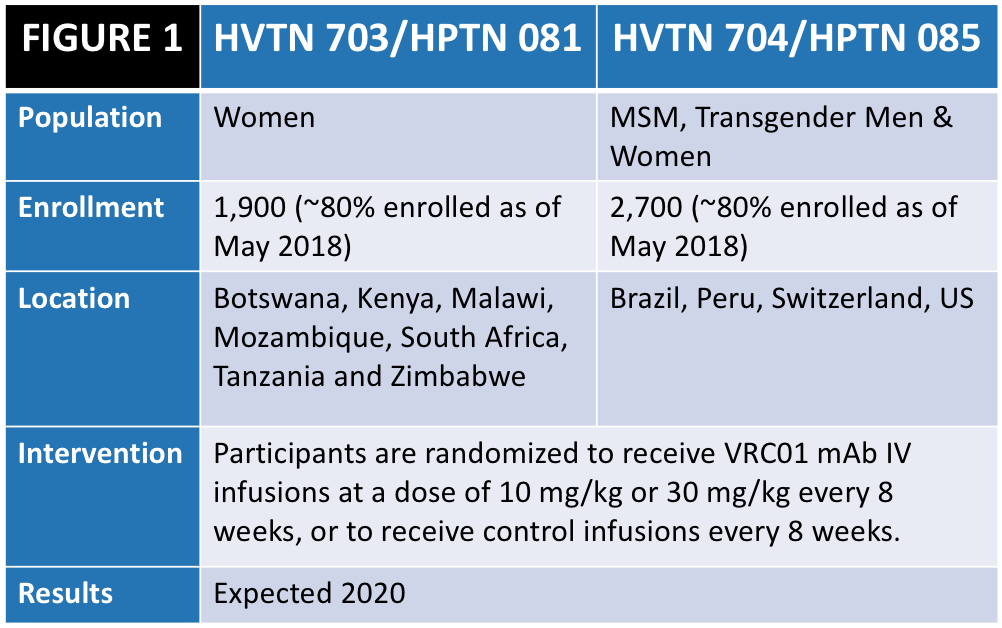
Since 2016, more than 2,700 men in Brazil, Peru, Switzerland and the US, and 1,900 women in Southern Africa have begun to enroll in clinical trials looking at antibody-mediated prevention, or AMP (see Figure 1). A collaboration between the HIV Prevention Trials Network (HPTN) and HIV Vaccine Trials Network (HVTN) (both funded by the National Institutes of Health), the AMP studies test the safety and efficacy of the broadly neutralizing antibody (bNAb) VRC01 when it is given every 8 weeks to reduce the risk of HIV infection. But how did this approach come about, why is it important and what may happen next with bNAbs for HIV prevention?


Click to enlarge.

What’s an antibody?

Antibodies are Y-shaped proteins produced by B cells to clear infected cells and pathogens in the bloodstream. B cells are part of what is known as the adaptive immune system, which mounts defenses aimed at specific invaders—like a cold virus or chicken pox or HIV. The innate immune system also defends against invaders, but its defenses are not so finely tailored to a specific pathogen. When a virus encounters the right B cell, the B cell begins cloning itself and produces antibodies designed to battle that virus. These antibodies circulate throughout the body looking for the virus, and they evolve continuously, becoming ever more precise and numerous.

The Antibody Hierarchy

Here are some terms that will help you follow this ongoing story:

  • Antibody: Proteins produced by B cells as a major part of the adaptive human immune defense against specific invaders.
  • Binding antibody: An antibody that attaches to a virus but doesn’t necessarily render it ineffective; can be driven by the innate immune system.
  • Monoclonal antibody: A bioengineered antibody made in a manufacturing facility by copying (cloning) one original antibody—selected for its potency and other characteristics.
  • Neutralizing antibody: Antibody that disables virus.
  • Broadly neutralizing antibody: An antibody that neutralizes many different genetic variants of HIV.
  • Passive antibodies: A dose of monoclonal antibodies that are infused or injected, rather than made by one’s own immune system.

HIV Vaccine Awareness Day: In May 2018, the story is…

HIV Vaccine Awareness Day (HVAD), May 18, is just a week away. Today, we’re bringing you AVAC’s annual HVAD Toolkit, a new advocacy resource—The Story Is…, and our HVAD webinar announcement!

AVAC’s HVAD 2018 webinar, to be held on Thursday, May 17, 9am ET, will tell the current story of HIV vaccine research from two perspectives. Dr. Sandhya Vasan of the Military HIV Research Program in Thailand will give her take on the world of HIV vaccine research since RV144: from where have we come, and where are we going? Mark Hubbard, a seasoned vaccine advocate and community representative for HIV research in Nashville, Tennessee will tell the story from a community and advocacy perspective: what are today’s current successes and challenges, and how are community members pushing the HIV vaccine agenda? Register now.

We’re especially excited in this year’s HVAD Toolkit to bring you a set of infographics that explain key aspects of vaccine research—trial participant and enrollment numbers, global funding, trials timelines, and more. We also have updated versions of old favorites you’ve come to expect each year, all available online at www.avac.org/hvad.

So, what is the story this year for HVAD? The story is the science, with an unprecedented level of vaccine and antibody clinical activity underway. But it’s not only the science—there are other important stories to tell as well, about global support for vaccine research in a time when there are many priorities in HIV prevention, and about stakeholder engagement in the current trial context. AVAC is publishing a special advocacy document, The Story Is…, which explores all this with an eye on primary prevention and the central role that research must play in it. Download it here.

As always, AVAC hopes these tools prove useful for HVAD events in your communities around the world. We know many of you are hard at work for HVAD, and we can’t wait to hear your stories, too.

New Issue! Px Wire: The prevention question cascade

In the new issue of Px Wire, AVAC gives our take on this year’s PEPFAR process for establishing the Country Operational Plans (COPs). These plans define what work will be done with PEPFAR money at the country level and how that work will be evaluated in each of the 63 countries that receive PEPFAR money.

The process has changed considerably since last year, allowing for deeper insights into what’s working and what’s not. In this issue, AVAC takes you through the good and bad of PEPFAR’s emphasis on index testing, analyzes crucial gaps in combination prevention, and lays out a series of questions to shape a powerful agenda for advocacy.

This issue’s centerspread takes a closer look at Zimbabwe’s data, and highlights amfAR’s detailed country factsheets that draw from PEPFAR’s giant data sets. Additional tools and information on influencing the COPs process are available from COMPASS partner Health GAP’s PEPFAR Watch.

Find the full issue Px Wire and the archive of past issues at www.avac.org/pxwire.

Px Pulse Podcast: From the trenches, advocates share their prevention priorities

Check out the April episode of Px Pulse on iTunes or at www.avac.org/px-pulse!

We bring you two different conversations, each throwing a spotlight on different aspects of HIV prevention advocacy today.

AVAC’s Manju Chatani-Gada talks with three advocates who attended AVAC’s African Advocacy Partners’ Forum in Johannesburg, where seasoned and new advocates came together to look at prevention priorities from every angle. In this discussion, you’ll hear how the forum brought key issues into focus and how these advocates are sharpening their strategies.

Then we turn to a global effort to accelerate prevention.

Christine Stegling, the head of the UK-based International HIV/AIDS Alliance joins us to talk about a new initiative led by UNAIDS and UNFPA to escalate and maximize HIV prevention in the 25 countries with the biggest number of new HIV diagnoses. Dubbed the Global HIV Prevention Coalition, we talk with Christine about how to know if it’s living up to its name.

For the full podcast, highlights and resources, visit here. Subscribe on iTunes to catch every episode!

Post-CROI Roundup and Webinar Series

[UPDATED: slides and audio from the webinars now available.]

The annual Conference on Retroviruses and Opportunistic Infections featured over 4,000 researchers, advocates, implementers—and a couple big snowstorms—along with a range of scientific findings of great interest to prevention advocates.

Join us to dig into the data with researchers and discuss with fellow advocates how these findings can inform our advocacy work moving forward.

Webinar Series

We will be adding additional webinars over the next couple of weeks, so please do stay tuned for additions to the schedule!

Conference Coverage

We’ve rounded up a selection of conference highlights, which are posted on our P-Values blog—check out it here!

For comprehensive coverage of the conference check out the excellent work from aidsmap. Resources from the UNAIDS and WHO co-organized update to staff and beyond on the Latest HIV science from CROI 2018 are now accessible.

CROI Program and Webcast

CROI provides a number of ways to review what happened in Boston: check out the full program; abstracts and e-posters; and webcasts of all sessions.

HIV R4P scholarship deadline

HIVR4P is dedicated to ensuring the participation of researchers, community activists, and civil society representatives, especially those from resource-limited settings and communities. The conference offers full scholarships as well as registration-only scholarships. Scholarships are highly competitive and will be awarded based on the availability of funds. Conference Scholarship applications are accepted until 23 April 2018. More information can be found here.

CROI 2018: Research for the Front Lines

Rob Newells is the newly appointed Executive Director of AIDS Project of the East Bay; he is minister and founder of the the HIV program at Imani Community Church in Oakland and is a PxROAR member since 2012.

The annual Conference on Retroviruses and Opportunistic Infections (CROI) brings together thousands of researchers from around the world to share the latest information on HIV, AIDS, and related infectious diseases. The 2018 meeting in Boston highlighted 114 oral abstracts and 991 posters in 23 different science categories, from Virology to Population and Cost Modeling.

The time lag from research to implementation in health can be long. One study from 2011 suggested an average 17-year delay (Morris, Wooding, and Grant, 2011). This graphic (adapted by AVAC from Dana Hovig at the Bill and Melinda Gates Foundation) shows a five year lag in the US for vaccines and drugs. As one of 26 Community Educator Scholarship Awardees at this year’s Conference on Retroviruses and Opportunistic Infections (CROI), it is my goal to help reduce that delay by focusing on research that has the potential to impact community members and frontline workers who I interact with on a daily basis in the short term.

I am sure that scientists and advocates will spend the next year talking to each other about the issues and information that came from oral abstract sessions reporting on long-acting cabotegravir (Abstract 83) and dapivirine ring studies (Abstract 143LB and Abstract 144LB). Advocates should also be engaging community members and frontline workers in conversations about these emerging tools for HIV prevention.

Almost six years after FDA approval, oral PrEP is a part of the HIV prevention landscape worldwide, but it looks different depending who you are and where you live. PrEP access still seems to be among the most relevant issues for HIV-negative black MSM in the United States, while viral suppression (which is key to improving health outcomes and eliminating the risk of onward transmission) remains a priority concern for PLHIV. Do PrEP and treatment as prevention really give us all of the tools we need to end the HIV epidemic? What follows are a few of my (US-centered, black MSM-focused) highlights from #CROI2018:

Oral Pre-Exposure Prophylaxis (PrEP)

Does PrEP drive STI rates? No! Abstract 1025 looked at condom use patterns in about 300 MSM and transgender participants in a PrEP pilot study. Reported condom use did drop, but overall rates of STI diagnosis didn’t not rise. The investigators conclude that “neither overall condom use nor change in condom use were associated with STI diagnosis.” Good predictors of STI diagnosis among PrEP users included being under 25 years old, being diagnosed with an STI in the 6 months prior to starting PrEP, and the number of sex partners. The researchers conclude that “particular attention and support is needed for younger PrEP users,” and, “although many PrEP prevention messages stress condom use, the number of partners appears to be a more important predictor of STI diagnosis among PrEP users.”

…and, in an exploration of the intersection of PrEP and STIs in the United States, Dr. Julia Schillinger said, “as researchers are looking at retention on PrEP, maybe one of the things they could also measure is, even if people aren’t retained on PrEP, are they retained in a system of testing and primary care?”

Should PrEP be prescribed for people who use meth? Yes! Starting with data from the iPrEX study and its open-label extension, it’s been clear that people at risk of HIV and unable to use condoms will use PrEP correctly and consistently. A study of these issues at CROI found more evidence of this. The study enrolled MSM who were using PrEP and reported condomless anal sex with multiple partners (CAS-MP). Some also reported stimulant use. The researchers wanted to know how stimulant use and condomless anal sex affected adherence to PrEP. They measured the presence of PrEP in blood samples from the study participants. (This can give a more accurate picture of whether people are taking PrEP than their own reports. Overall, 80 percent of participants in the study had protective levels of PrEP in their blood over the course of the 48 week study, regardless of stimulant use or frequency of condomles anal sex.) Conclusion: “Stimulant use should not be a deterrent to prescribe PrEP to high-risk individuals engaging in CAS-MP.”

Short-term PrEP as part of vacation package??? Yes! Advocates have stressed for years that oral PrEP is not forever. Rather, it should be used during a person’s “season of risk.” Sometimes those seasons aren’t very clear. Sometimes they are. Researchers investigating the feasibility of short-term, fixed interval, episodic PrEP (epi-PrEP) found in a study of 54 men who have sex with men (MSM) that most were adherent during short, high risk vacation periods. Study participants started oral PrEP 7 days prior to vacation and were instructed to adhere to daily dosing through seven days post-vacation. (They also received a single session of cognitive behavioral therapy at least two weeks before the vacation.) Nearly 94 percent of the men in the trial had protective levels of tenofovir-based PrEP in their blood at a study visit three days after their vacation was over. Epi-PrEP may be a good option for some men with episodic high risk for HIV infection, and as an added bonus, “initiating PrEP on vacation may provide a helpful way to initiate long term PrEP.”

Oral tenofovir-based PrEP is still one of the most important tools for HIV prevention available today, but it is not a magic pill. Dr. Roel Coutinho reminded CROI attendees that using PrEP to eliminate HIV would take about 80 to 120 years without including other HIV prevention strategies. This is why viral suppression for people living with HIV is still a priority.

Viral Suppression

Findings from CROI:

  • Higher HIV viral load was independently associated with the likelihood of transactional sex. Additionally, those testing positive for an STI were nearly twice as likely to report transactional sex as compared to those without STIs.
  • Decreasing alcohol use without abstinence from alcohol was associated with a lower viral load. In other words, people with HIV whose drinking interferes with adherence to medication may be better able to take their medications when they reduce their drinking-without completely stopping. This can inform counseling messages and harm reduction approaches.
  • A study of PLHIV living in the San Francisco Bay Area got nuanced about types of homelessness-which can range from living outdoors to crashing with friends or family. It looked at the relationship between different types of homelessness and virologic suppression. Although living outdoors was associated with the lowest proportion of viral suppression, other forms of unstable housing (including living in a shelter, ‘couch-surfing’, and being in an single-room occupancy) were also associated with lower levels of viral suppression compared to renting or owning. Interventions are needed to increase viral suppression among PLHIV across a spectrum of unstable housing arrangements.
  • More frequent social work visits and nurse phone calls were associated with retention in care for young adults with HIV, but improved retention did not to lead to improved viral suppression. In general, young adults have lower rates of antiretroviral use and medication adherence than older adults, so lower rates of viral suppression in this group should come as no surprise. CDC’s HIV Care Continuum by Age shows that young people living with HIV are less likely than older Americans to be diagnosed, to be in care, and to be virally suppressed. Socioeconomic challenges, depression, and lack of tailored interventions to improve adherence among young people are among the issues that must be addressed to improve viral suppression for young adults with HIV.
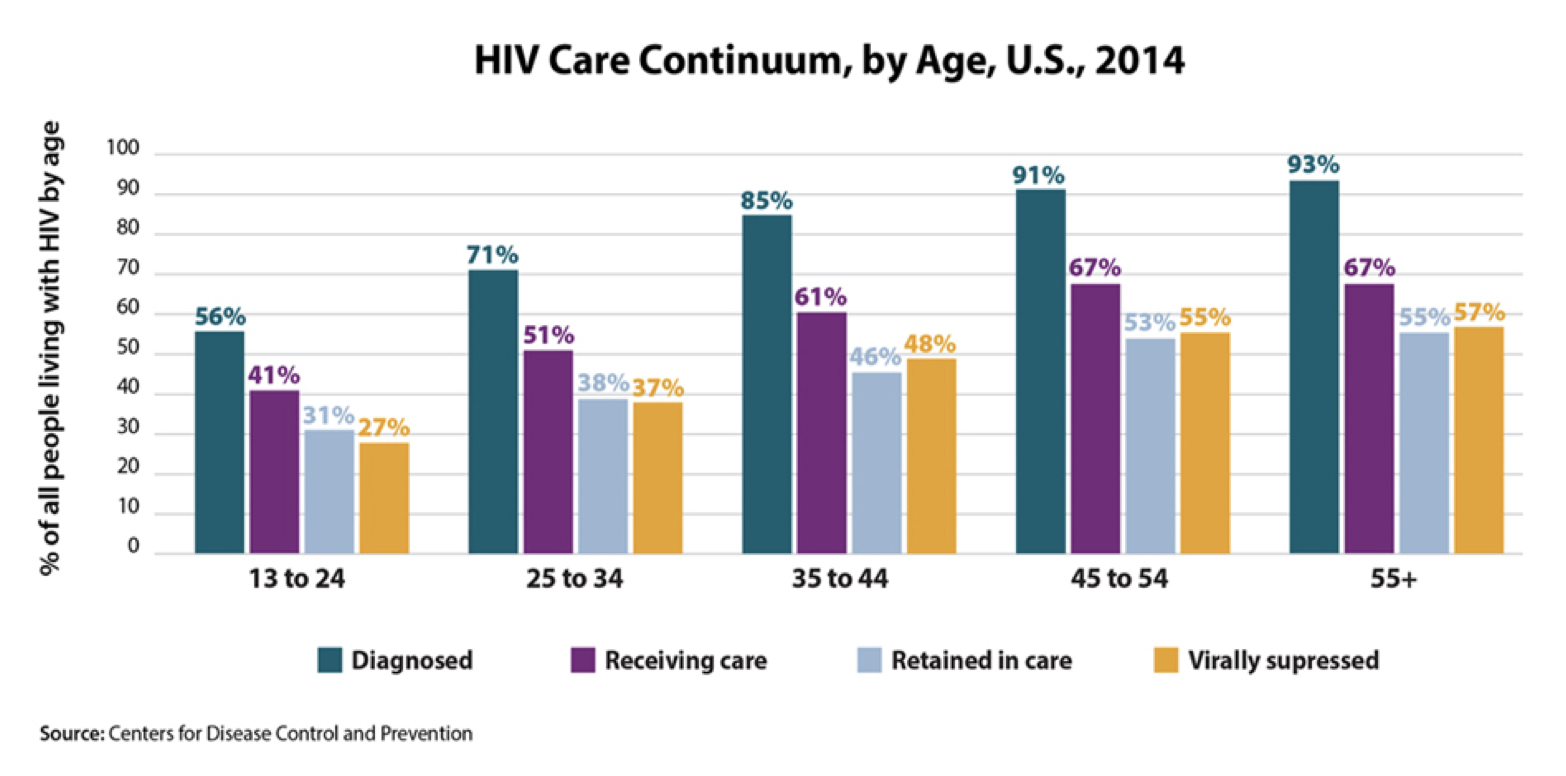
HIV Care Continuum, by Age, US 2014

So much information, so little time. This year’s CROI featured lots of research focused on women, hepatitis C, tuberculosis, anal cancer, and a host of other issues that will continue to be analyzed and reported over the next several months. My initial brain dump to frontline staff at APEB was intended to share information that they might find useful in their work with members of our community now. We’ll continue to develop workshops and presentations and events that attempt to keep folks armed with the latest information available and prepared for what’s coming next. Somewhere between “now” and “next,” we have a lot of work to do!
4/18 Webinar: Introducing Oral PrEP

At CROI 2018 we heard stories, saw new data, and had lots of questions about early PrEP rollout. Please join AVAC and partners from Jilinde in Kenya and PZAT in Zimbabwe for an upcoming webinar on Wednesday, April 18, 9am ET to explore valuable resources for people working to deliver oral PrEP. See below for some of the tools and resources we will explore and discuss during the webinar. Check them out and come with your questions!

Click here to register!

  • Country Updates and the Global PrEP Tracker provide the status of PrEP.
  • A Framework For Scaling Up PrEP features step-by-step guidance for introducing PrEP into new settings.
  • PrEP Resources aims to be a central repository for materials currently being used by programs—in areas such as global guidance; national policies and guidelines; M&E; training curricula; advocacy; implementation; and demand creation.

All of these materials (and many more) can be found on PrEPWatch.org, the clearinghouse for oral PrEP efforts across the globe. Questions? Reach out to us at [email protected], we want to hear from you!

Px Pulse Podcast: What’s next for the dapivirine ring

The newest episode of AVAC’s Px Pulse podcast is up, bringing you critical updates on the dapivirine vaginal ring.

Download the episode via iTunes or at www.avac.org/px-pulse.

In March, initial results from the two open-label trials of the dapivirine vaginal ring (HOPE and DREAM) showed that adherence and efficacy improved over the earlier Phase III trials. Open-label studies, unlike Phase III studies, do not use a placebo, and all participants know they are using an intervention with evidence of a certain level of HIV protection. The ring is also advancing along the pathway to licensure. In other words, there’s much to discuss about this female-initiated HIV prevention option.

What do these data mean? What’s important to know about how and where the ring might be approved for use? If approved, where and when could women access the ring? And what do women who use the ring say about it?

In this episode, Zeda Rosenberg of the International Partnerships for Microbicides, which developed the ring, explains the latest findings and spells out how, when, where and if the ring might become an available tool. A trial participant and community leader in Uganda, Ruth* pulls back the curtain on the ups and downs of using the ring, and a Ugandan investigator with the REACH study, Carolyne Akello of the Makere University-Johns Hopkins University Research Collaboration, explains the importance of this new trial that will explore the potential of both this monthly vaginal ring as well as daily oral PrEP for young women.

Listen for a nuanced take on the data, what questions remain—and what it means for advocacy!

*Last name withheld for confidentiality.