VMMC: Progress to Date Gives Me Hope; Funding Commitments Give Me Chills!

Angelo is a Program Manager at AVAC.

[Editor’s Note: It’s been a busy few months. We are happy to finally share this blog, which includes references to events from last quarter, but reviews progress on VMMC and details the still-new framework to operationalize VMMC. Look for a forthcoming blog on VMMC commitments at the recent PEPFAR COP reviews.]

A presentation by the World Health Organization (WHO) earlier in the year brought good news about voluntary medical male circumcision (VMMC), telling a story of lives saved—many, many lives. Facing a room full of VMMC experts, Dr. Buhle Ncube of WHO’s Africa Regional Office scrolled through a series of slides and highlighted a breathtaking number:

“More than 450,000 new HIV infections are projected to be averted by 2030 as a result of male circumcisions conducted in 14 priority countries even if programs stopped circumcising today.”

VMMC is a subject I care deeply about, and I spend many hours of work at AVAC on efforts to help accelerate its scale-up as part of combination prevention. These lives saved by VMMC represent a success and an opportunity. The opportunity had brought us to this meeting. Dr. Ncube’s presentation was part of the WHO’s February meeting to operationalize a new framework on VMMC.

Held in Durban, South Africa, the WHO brought together more than a hundred VMMC experts from fifteen priority countries (South Sudan was added recently) for the meeting. Attendees included Ministry of Health officials, WHO, UNAIDS, UNICEF and other UN staff, civil society, funders and implementers. The goals: to reflect on progress and impact to date; to discuss critical factors that explain the progress; and to explore new ways to address the challenges programs are facing. Funding for the VMMC programs in the priority countries was a big part of the conversation at the meeting, and unfortunately, I left the meeting with more questions than answers about aligning the new ambitious targets with real funds.

VMMC is one of the most powerful and cost-effective HIV prevention options currently available. Studies from 2006 showed that it reduces a man’s risk of acquiring HIV from a female partner by up to 60 percent, increasing to around 75 percent over time.

In 2007, WHO recommended that VMMC be scaled up in countries with high HIV prevalence and low levels of male circumcision. Although uptake was slow at the beginning, scale-up in most of the priority countries intensified as funders and implementers recognized that demand creation was as important as creating supply. UNAIDS and WHO set an ambitious goal of circumcising 80 percent of males in those countries by 2015, which would amount to about 20.3 million procedures, which would avert 3.4 million new HIV infections and save US$16.6 billion in future healthcare costs.

Participating in the deliberations at the Durban meeting gave me hope but also left me with chills. The successes show the power of this new tool, but scaling up this intervention depends on securing the political will to fund it. Those funds and the political will they require have not arrived.

Impressive progress
Although the original goal wasn’t realized, progress made is unprecedented in healthcare delivery—11.7 million males were circumcised by the end of 2015; increasing to more than 14 million by the end of 2016, about 69 percent of the original goal of 20.3 million procedures.

“The largest impact is from South Africa with an estimated 218,000 new HIV infections projected to be averted by 2030,” said Dr. Ncube. WHO further estimates that the goal of 80 percent coverage would avert another 470,000 new HIV infections by 2030 if VMMC rates can be sustained among 10- to 29-year-olds by 2020. This is worth taking a pause and celebrating!

Going forward with ambition
In 2016, UNAIDS released a new five-year strategy, and it contains an even more ambitious goal—27 million additional circumcisions by 2021. To align with this new strategy, WHO developed a new vision for scaling up VMMC called VMMC 2021. As civil society, we’ve often called for ambition, and we commend WHO for this boldness.

Wait a minute? Where is the funding to meet the ambitious goals?
This is what gives me chills! Achieving the new global target will require about five million procedures per year—double the current annual numbers. Moreover, the new VMMC 2021 framework calls for an alignment with the UN Sustainable Development Goals (SDGs), particularly Goal 3 (Good Health and Well-being); Goal 5 (Gender Equality); and Goal 17 (Partnerships).

“We must do things differently. We have to look at new institutional arrangements and widen global health architecture,” urged WHO’s Julia Samuelson.

This is a big shift that will definitely require a huge amount of resources. Yet the reality on the ground in countries is already dire. The truth is, ambitious targets that are not tied to funding are not very helpful. AVAC works with country-level coalitions to track both investment and progress towards national VMMC goals, and we see some consistent issues that impact progress toward targets. Each of these countries rely on PEPFAR as the major source of funding. In one place progress speeds along, in others it drags. Entire country programs like Malawi struggle widely. The task before us is not unachievable, but it’s huge.

So, where do we go from here?
As civil society, we welcome these new targets and approach. But, to meet them, more ambitious, more diverse and more predictable funding commitments are urgently needed from international donors and country governments. The new framework looks good on paper, but with no funding commitments to match those ambitions, we’re setting ourselves up to fail. And we can’t afford to fail.

So, I challenge PEPFAR to commit more resources for VMMC in the Country Operational Plans (not via PEPFAR Central Funds, which are highly unpredictibale, and subject to the discretion of bureacrats and politicians).

But we also need other donors to step up and join PEPFAR. So I also challenge country teams developing Global Fund concept notes to allocate more funds to VMMC. Sometimes civil society colleagues who are engaged in the Global Fund application process assume that VMMC has been fully funded by PEPFAR – but this is not the case.

Finally, I challenge country governments to take more ownership and commit more domestic finances to VMMC. Growing up, my teachers always told me that charity begins at home. Can we model this for the health of our people?

Slides and other key resources from the meeting available at this link.
Trump’s Budget Would Cut Promising Research and Live-Saving Interventions for HIV

AVAC’s Executive director Mitchell Warren today released the following statement on the proposed 2018 budget from the Trump Administration:

President Trump’s 2018 budget request delivered to Congress yesterday would be a disaster for people living with HIV and for those at risk of HIV infection here in the US and around the world.

The budget, entitled “A New Foundation for American Greatness,” would, in fact, devastate health, development and research programs that are hallmarks of America’s profound commitment to advancing knowledge and saving lives at home and abroad. AVAC stands in solidarity with many partner organizations in calling on Members of Congress to restate the long-standing bipartisan support for a comprehensive domestic and global AIDS response.

No HIV treatment, prevention or research program supported by the US government is left untouched in the proposed budget. Critical global and domestic health, development and poverty programs also face devastating cuts. Evidence has shown us that the HIV pandemic is driven by poverty, gender inequality and violence, as are virtually all disease outbreaks. The spectrum of proposed cuts in this budget create conditions where HIV and other health threats will thrive, as America’s superb research and implementation capacities are hobbled and unable to respond.

  • The US PEPFAR program and the Global Fund to Fight AIDS, Tuberculosis and Malaria—to which the US is a major contributor—together provide the bulk of funding for HIV prevention, treatment and care programs in sub-Saharan Africa and other parts of the developing world. Both would receive significant cuts of approximately 15 percent in this proposed budget. These proposed reductions would have a disastrous and deadly impact on the fight to bring the AIDS epidemic to a conclusive end, as would cuts in related areas including family planning, reproductive health, and scientific research.
  • The proposed budget cuts USAID’s global health programs by a devastating 50 percent, and eliminates long-term investments in critical vaccine and microbicide research.
  • A $7 billion cut to the NIH includes a $1.1 billion cut to NIAID–almost a quarter of that Institute’s budget – which would likely have a devastating impact on HIV research overall, research and development of vaccines and other new prevention options, and scientific innovation.
  • Cuts to the CDC, the elimination of NIH’s Fogarty International Center, cuts to Medicaid and the Ryan White Program and other devastating and irrational cuts to the budget make it clear that this is nothing less than an assault on the health of citizens everywhere—in the US and abroad.

The budget proposal asserts the US government will continue treatment for “all current HIV/AIDS patients” under PEPFAR. PEPFAR has succeeded by increasing the number of people on treatment every year and providing critical funding for primary prevention programs. Increasing the number of people on treatment every year has contributed to the ambitious global goal of curbing the epidemic and of moving toward universal access to HIV treatment, a fundamental human right. Simply maintaining current treatment rolls is poor science and a poor investment of US resources. We know an increase in antiretroviral treatment (ART) programs with a parallel unstinting investment in additional HIV prevention programs, including voluntary medical male circumcision, condom programs and oral PrEP, will have significant impact on the pandemic. The proposed budget approach, which threatens prevention as well as treatment, will not.

The US government is the largest funder of HIV and global health programs and research. After years of prudent investment, we have seen amazing dividends in lives saved, families kept together, communities revitalized and economies boosted. Global health and HIV programs have enjoyed bipartisan support throughout the previous Bush and Obama Administrations. We call on the Congress to remember why these programs have been consistently supported and ensure they are reinstated in the 2018 budget.

Advocacy in Uncertain Times: A call to action

It’s almost here! HIV Vaccine Awareness Day (HVAD) is upon us. This Thursday will mark the day’s 20th anniversary and cap off AVAC’s month-long “vaccine immersion”. On Thursday, we will host the final webinar in our series, featuring Julie Ake of the US Military HIV Research Program. (Update: link to the recording.)

HVAD comes amidst a week when advocates for health and human rights are aghast at a new US guideline on expansion of the Global Gag Rule—a policy that is anti-woman and anti-public health, and that will now impact many more recipients of US funding. As AVAC states in a blog, we are committed to the rights and health of girls and women worldwide, and stand strong with our allies in this fight.

Our HVAD resources are designed for allies everywhere to use in the fight for rights-based, science-forward, sustainable solutions to the epidemic. They include our updated HVAD toolkit, which features our HVAD call to action, Advocacy in Uncertain Times, a new publication on HIV vaccine advocacy and priorities for the field—required reading for HIV prevention and vaccine advocates alike!

HVAD 2017 Toolkit

  • Advocacy in Uncertain Times: A call to action—AVAC’s report for HVAD on the state of the HIV vaccine research and development field, including key priorities for advancing research and sustaining support. (Click here to download all graphics from this report.)
  • HIV Vaccines: Key Messages for HVAD 2017—Bullet points on today’s pressing issues; great for informed audiences who need compelling outreach messages.
  • HIV Vaccines: An Introductory Fact Sheet—Part of AVAC’s basic fact sheet series, a two-pager of basic information and research updates; great for distribution to lay audiences.
  • HIV Vaccines: The Basics—Introductory PowerPoint slide set with basic concepts, an overview of research status and recent developments; great for use by research representatives and vaccine stakeholders for presenting information to wider audiences.
  • Vaccine Science for Busy Advocates: bNAbs—a one-pager reviewing highlights, next steps and key terms; great for lay audiences who are looking to understand complex technical issues.

Missed any of the previous webinars in the series? Visit www.avac.org/hvad for the slides and recordings.

And HVAD is active on social media this year! Follow the hashtags #HIVVaccineAware and #HVAD2017 on Twitter and Facebook for more messages and resources this HVAD.

At AVAC, we thank you for your work and partnership today and every day. We’re committed to ending the AIDS epidemic, and that means finding an HIV vaccine. We couldn’t do it without you.

AVAC Statement on the Expanded Global Gag Rule

Today the Trump Administration took steps to implement a policy change that will endanger the lives of millions of adolescent girls and young women living in countries supported by US global health development aid. The State Department released a communication on the expansion of the “Global Gag Rule” — also known as the Mexico City Policy. The updated policy applies not only to US global health assistance for family planning—as have previous iterations of the Global Gag Rule—but to all US global health assistance.

The expansion has been erroneously rebranded as “Protecting Life in Global Health Assistance.” This policy is not life-saving; it is the opposite. This expanded rule will force clinics to close and women to lose access to contraception, HIV prevention and maternal health care, resulting in more unintended pregnancies and more unsafe abortions. It will prevent advocates, community health workers and others from sharing important information with women and girls most at risk.

Today’s announcement makes it crystal clear that the new administration does not value the lives of women and girls. US government funding and support for service provision and research and development under long-standing bipartisan leadership from both the legislative and executive branches has saved millions of lives and helped advance human rights for girls and women in Africa. It is infuriating to see Donald Trump roll back advances in health and human rights for women and girls with the stroke of a pen.

We know that because of the George W. Bush administration’s use of the Global Gag Rule many women and girls in developing countries were unable to access family planning and health services and some of them died because of that. With the present “youth bulge” in Africa, there are, in some countries, double the number of young people than there were when the epidemic began. Many of these young people are more concerned about pregnancy prevention than they are about HIV prevention; they need comprehensive services for both HIV and family planning. Today there are millions of girls and young women seeking access to contraception, HIV prevention and treatment and other health services. The Trump administration has just closed the doors to clinics offering comprehensive services that will save their lives and the lives of their children.

AVAC and our partners in Africa will do all that we can to help ensure that lifesaving programs and information for women and girls continue. And we will continue to speak out against the immoral and anti-public health decisions made by this administration.

Reminder: PLOS Medicine call for papers

PLOS Medicine has an open call for papers for the Special Issue: Advances in HIV Prevention, Treatment and Cure publishing in late 2017 and guest edited by Drs. Linda-Gail Bekker, Steven Deeks and Sharon Lewin. Submit by June 9th. For more information click here.

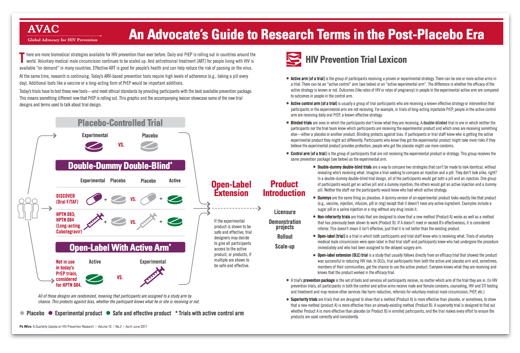
New Px Wire: Trial design in the era of PrEP

Our new issue of Px Wire offers an advocate’s guide to some new types of biomedical prevention trial designs.

Next-generation PrEP products include long-acting injectable ARVs (which are also being tested for treatment in people living with HIV). How do you find out if injectable PrEP is better, or as least as good as, daily oral PrEP? The new trial designs hold possible answers.

In this info-rich Px Wire, you’ll find a handy summary of long-acting PrEP trials, a lexicon of key terms for the “post-placebo era”, and a handy illustration for looking smart while you explain “double-dummy double-blind”.

AVAC’s Month-Long Vaccine Immersion Continues: Webinar series, cheat sheets and more! 

[UPDATE:] Recordings of webinars already held are now available below.

Join us in our month-long “deep dive” into the dynamic field of HIV vaccine research with the next installment in our HIV Vaccine Awareness Day webinar series coming up this Thursday—a review of the NIH’s Vaccine Research Center with Barney Graham. And read on for links to key resources, including quick references and a recording of our first webinar.

Webinar series lineup:

  • Friday, April 28: Ad26 Mosaic Program—Janssen’s Maria Pau discusses preparations for the next efficacy trial.
    YouTube / Audio / Slides
  • Thursday, May 4: The History—and Future—of the NIH’s Vaccine Research Center with Barney Graham.
    YouTube / Audio / Slides
  • Monday, May 8: Building on (and Building!) Success—Status of HVTN 702 with Fatima Laher.
    YouTube / Audio / Slides
  • Thursday, May 11: “Plan B”-NAb? An Overview of Antibody Research with Lynn Morris.
    YouTube / Audio / Slides
  • Thursday, May 18: An Overview of Vaccine Development from Julie Ake of MHRP.
    YouTube / Audio / Slides

Last Friday, the series launched with an overview from Janssen’s Maria Pau on the Ad26/Mosaic vaccine program—notable both for its science and for active leadership from industry. Two of the upcoming webinars will fill advocates in on bNAb research. Broadly neutralizing antibodies—bNAbs—are anti-HIV proteins now being tested for efficacy as HIV prevention through direct “passive” infusions. The upcoming discussions will help answer burning questions for HVAD 2017:

  • Which bNAb candidates should we be watching in the coming years?
  • What do bNAbs mean for HIV vaccine research? Are these current trials, testing direct infusion of bNAbs, a pathway to a new product or a way to advance the HIV vaccine field—or both?
  • What will current large-scale efficacy trials of vaccines and bNAbs tell us?

We know not everyone hears bNAb and immediately understands the term. This year, AVAC has updated our series, Vaccine Science for Busy Advocates, to provide quick, clear explanations, with a focus on topics corresponding to our webinars. Click here to access Busy Advocates: bNAbs. Download it, review the terms and be ready with your questions on May 4 and May 11.

There’s a lot to know. But the research is promising, and we need steady hands on deck to ask smart questions and sustain support. Continue with us over the next several weeks on the countdown to HVAD to play your part.

Funding Opportunity: Innovation for HIV Vaccine Discovery (R01)

Purposes: To support high risk/high impact, early discovery research on HIV vaccine approaches; a Go/No-Go approach to funding high risk research significantly different from most R01 projects; and encourage involvement of investigators new to the HIV vaccine field to build interdisciplinary approaches. For more information, click here.

Webinar with WHO on hormonal contraception and HIV

[UPDATE:] Slides, audio and the recording is now available on YouTube.

You’re invited to join a webinar with the World Health Organization (WHO) on the newly released guidance on hormonal contraceptive eligibility for women at high risk of HIV.

This webinar builds on a March 10 webinar on this topic, which featured advocates and clinicians putting the guidance in context. A recording of that conversation is available here.

We hope you’ll join for this chance to hear from Dr. James Kiarie, coordinator of the Human Reproduction Team at WHO. Dr. Kiarie will present the new guidance and give updates on next steps, and be available for questions and answers. As always, feel free to send questions in advance to [email protected].

CROI 2017: A View from My Seat at the Table

The annual Conference on Retroviruses and Opportunistic Infections (CROI) is an annual gathering where advocates and researchers learn where the science on HIV is taking us. The findings can be both grand and granular. They answer questions, raise new ones or both. And not all of those questions are strictly about science. Two of AVAC’s partners have been reflecting on what they took away from the conference, insights that inform our thinking long after the sessions end and results are published.

Rob Newells is an Associate Minister at the Imani Community Church in Oakland, California, and serves as Executive Director for AIDS Project of the East Bay—a community-based organization serving the most vulnerable and marginalized communities in Alameda County since 1983. He was a 2011 Fellow of the Black AIDS Institute’s African American HIV University Community Mobilization College and has been a biomedical HIV prevention research advocate with AVAC’s US PxROAR group since 2012.

There are conferences that I attend where I can be “Rob Newells, Executive Director for AIDS Project of the East Bay (APEB).” The Conference on Retroviruses and Opportunistic Infections, more commonly known as CROI, is not one of those conferences. At CROI, the ED hat comes off, and I’m purely a community advocate again. This year, that was even more true than in previous years. As I looked around the room of Community Educator Scholars (a program that supports advocates attending CROI) as we gathered for our first early morning breakfast of the week, I immediately noticed that I was the only African American man at the table. There were two African American women (one Scholar and one member of the Community Liaison Subcommittee) and several Africans (shout out to my brothers Ntando, Simon and Supercharger), but no other Black men from the United States. It wasn’t the first time that I’ve been the only one, and I know it won’t be the last, but—if I’m being honest—I was both disappointed and stressed by it. I felt a lot of pressure to be the eyes and ears for my community in a way that I hadn’t felt in previous years.

From a community perspective, CROI is the most boring meeting I attend. It’s 4,000 science and research geeks talking to each other about what they’ve been doing locked away in their labs for the last few years. Most of the news that gets reported after CROI is for science and research geeks, and those reports usually miss the things that I find interesting or that I think my community would find interesting, useful, and relevant. So, in an attempt to rectify that shortcoming, I attended all of the plenary sessions and a bunch of the oral abstract sessions and even took my time to talk to presenters during the poster sessions. I took lots of notes and pictures of slides, and when I returned home (after another conference the following week) I talked it all through with my staff. It took a while longer for me to organize my thoughts into a coherent presentation that I could use for the community report-back I coordinated at the Alameda County Public Health Department on National Women and Girls’ HIV/AIDS Awareness Day. This is some of what I shared.

CDC’s oral presentation on HIV Incidence, Prevalence and Undiagnosed Infection in Men Who Have Sex with Men gave us good news and bad news. The good news is that the percentage of undiagnosed HIV infections decreased for all racial/ethnic groups between 2008 and 2014. (That tells me we’ve been doing a better job of testing.) The bad news is that there was an increase in HIV incidence among Latino MSM and MSM between the ages of 25 and 34. (Annual infections among Black MSM dropped from 10,100 in 2008 to 10,000 in 2014. I don’t see that as anything to write home about, but a decrease is a decrease, right?)

Anal Cancer
I had my third or fourth high resolution anoscopy (HRA) just before CROI, so I was particularly interested in a few of the abstracts related to anal cancer. (There were seven posters and four oral abstract presentations on anal cancer this year, so I wasn’t the only one interested.) While anal cancer is fairly rare overall, men living with HIV who have sex with men are 60-190 times more likely to get anal cancer than the general population. We know that certain types of HPV are responsible for most anal cancers, and most MSM living with HIV have HPV of one type or another. What we didn’t know was what we should be doing about it. What I took away from CROI 2017 was that anal cancer screening should start at 30 to 35 years old for MSM living with HIV. Insured folks like me should get an annual HRA. Unfortunately, HRA is not the most cost-effective prevention tool, and resources to perform the test are limited worldwide. Additionally, patients who rely on the Ryan White AIDS Program or Medicare for coverage have to settle for a digital rectal exam (exams where the doctor inserts a gloved, lubricated finger into the anus to feel for unusual lumps or growths) to detect anal cancer because an HRA isn’t covered. As fun as a digital rectal exam may sound, it’s not that effective. HRA detects the most cancers. (I know from personal experience. I asked my primary care physician to refer me for an anal pap smear and HRA a few years ago. He didn’t find anything suspicious with the digital rectal exam, but he gave me the referral anyway. The HRA found a stage 4 pre-cancerous lesion which was removed during the procedure. Thank you, Kaiser Permanente.)

Antibodies
Bridge HIV in San Francisco is one of the sites for the AMP (antibody mediated prevention) Study, and I know people in my community who are enrolled so I paid attention. Antibodies are a big deal in HIV research. My takeaway from CROI was that the current study won’t produce a home run that will work for everyone. Researchers hope to have an understanding about whether or not antibodies can work for prevention, but as public health intervention it is cumbersome, involving monthly clinic visits and transfusions. And no matter the results from AMP, vaccines based on neutralizing antibodies are still a long way off.

Cure Research
There were two things I found interesting in the cure research presented this year. The first was that people on effective antiretroviral therapy are not producing new HIV-infected cells. Cells proliferate before they die off. That means that earlier detection and treatment results in fewer proliferating cells with less diversity and smaller reservoirs. That might make HIV easier to target and cure. The other thing that caught my attention was that estrogen blocks RNA replication. That discovery leads to at least two pathways to cure: Can we block estrogen to bring latent cells out of hiding (the “flush and kill” strategy), or can we increase estrogen to keep RNA blocked (the anti-proliferation model)?

Drug Use and MSM
Over the past few years, I have heard from friends in Oakland and Atlanta that there was an increasing problem with crystal meth use among Black MSM. I’ve had conversations with many of my colleagues about the increasing mention of PnP (Party and Play) on dating/hook-up app profiles. For years, the common assumption has been that meth is for white boys, but apparently more and more black men are going that route. There were a couple of posters about drug use and MSM that I totally expected to confirm that for me. The first, from CDC, looked at drug use by MSM in 20 cities across the United States. Surprisingly, they didn’t see an increase in meth use. They saw an increase in prescription opioid use among Black MSM between 2008 and 2014. But just two steps away, the very next poster from George Washington University noted a drastic increase in crystal meth use among Black MSM in Washington, DC, over the same time period. I totally expect to see more research in this area.

Pre-Exposure Prophylaxis (PrEP)
What I heard coming from Seattle about pharmacist-managed PrEP was intriguing. Being able to avoid the cost of a clinic visit could greatly increase access and uptake. I contacted my agency’s pharmacy partner when I got home to find out if they had the ability to order labs and prescribe Truvada for PrEP without patients having a clinic visit. (They can, and we will.)

And there was good news for women. Apparently, there was some confusion after all of the talk about good and bad bacteria in the vaginal microbiome at AIDS 2016. That was in relation to vaginal microbicides. Oral PrEP doesn’t go through the vagina, so the vaginal microbiome has no effect on blood and tissue levels of the drug. Oral PrEP works for women. Period.

There were a few other abstracts dealing with community cohort care for adolescents, HIV testing incentives, and text messaging interventions for PrEP users that were interesting enough for me to mention to the folks at home, but if I’m being honest, I was looking for something else.

CROI 2017 was the first conference in an entire year where I didn’t hear anything from the HPTN-073 team. Instead we heard from a team at Emory University, but what I heard only annoyed me. I don’t need another study that tells me how Black MSM don’t use PrEP. The study led by black men for black men (HPTN-073) showed us what works. Emory presented yet another study that showed us what doesn’t work. They studied Black MSM aged 16 to 29 in Atlanta. Participants were offered risk reduction counseling, condoms and lube, and non-incentivized oral PrEP. After viewing a brief education video from WhatIsPrEP.org, the men who expressed interest were scheduled to see a study clinician to initiate PrEP.

The study results indicated that 56 percent of the men expressed interest but 39 percent of those never showed up for the initiation visit with the clinician. Of the ones that did come back, only 35 percent initiated PrEP. The study team’s conclusion was that, “even after amelioration of structural barriers that can limit PrEP use,” PrEP uptake was suboptimal. What structural barriers, you ask? Only lack of health insurance was addressed. (As if that’s the most pressing structural barrier Black MSM face in the United States.) When I asked about what else was done to engage these men based on what we know from HPTN-073, I was told that there is really “no hard, a priori evidence that more aggressive interventions are needed” for Black MSM.

I sat down so that I wouldn’t come off as the angry Black man, but when 79 percent of the participants in HPTN-073 accepted PrEP after a series of counseling sessions that combined service referral, linkage and follow-up strategies to address unmet psychosocial needs (part of what that team calls C4, or client-centered care coordination), I would argue that the need for more aggressive interventions is obvious. A study led by black men told us how to work with black men. Apparently, someone needs to fund more “For Us, By Us” studies so that we have a body of evidence showing what works because I’m tired of hearing what doesn’t work.

There were no exciting results from large efficacy trials at this year’s CROI like there have been for the last several years. It was back to basic science. That means the conference was even more boring than it normally is. But when I returned to Oakland and put my E.D. hat back on, I realized that I had the power to implement some of what I learned without waiting for studies to be published or government agencies to catch up to the science which could take years. I had the power.

In addition to client-centered care coordination and pharmacist-managed PrEP, we are in the process of adding an optional SMS intervention to the PrEP program at APEB, and we’ve started working with La Clinica de la Raza—a local community-based organization that prioritizes Latino populations—to support efforts to address the increasing HIV infection among Latino MSM. That’s why I go to CROI. That’s why I’m grateful to the scholarship committee for supporting my attendance and to AVAC for always providing what I need in order to stay on top of new developments in biomedical HIV prevention research. That’s why I wish I wasn’t the only African American man at those daily 7am breakfast meetings.

…cue Solange’s “F.U.B.U.”