Respect the Data, Respect the People: Day 5 at AIDS 2016

We’ve rounded the corner here in Durban. With just one full day to go, we’re drilling down into the foundation of the global effort to defeat HIV, which rests on two fundamental imperatives: Respect the Data, Respect the People.

Respect the Data, Part 1

We gathered at 7am this morning for a satellite session on hormonal contraception (HC) and HIV, put together by the WHO’s Reproductive Health and Research Department. The program provided an update on ECHO, a randomized trial looking at the impact of three contraceptive methods (the copper IUD, Jadelle implant, and the injectable progestogen-only method DMPA or Depo Provera) on HIV risk. The main event, though, was a presentation by Chelsea Polis, a senior research scientist at the Guttmacher Institute. Polis presented results of the latest systematic review of observational data regarding contraceptive use and HIV risk. Systematic reviews, explained in depth here, look at all existing data on a topic and apply strict criteria to identify high-quality studies. These high-quality studies are then examined as a group to see what sorts of conclusions they support.

Two prior systematic reviews of the data on hormonal contraception and HIV concluded that some studies show evidence that DMPA increased women’s risk of acquiring HIV, while others do not. There was, in short, official uncertainty. The latest systematic review has a different conclusion—an association exists between DMPA and heightened risk. Dr. Polis said, “Newer data are increasingly concerning and converging around HR 1.2-1.6.” In lay-person terms, “1.2-1.6” means that an HIV-negative woman using DMPA would have a 20–60 percent increased risk of acquiring HIV compared to an identical HIV-negative woman who was not using DMPA. This is the first time that a systematic review on DMPA has moved out of the realm of uncertainty and taken the additional step of estimating the risk of infection. (It’s important to remember that overall risk of HIV for many women is quite low and that there are only some communities—largely in East and Southern Africa—where DMPA use and HIV prevalence are both high enough to warrant concern. In addition, in a companion systematic review of hormonal contraception and ART, DMPA seems to have no negative interactions with ART and may be one of the better contraceptive choices for women living with HIV.)

What’s next? AVAC and collaborators will push WHO and other stakeholders to respect the data. Partners like the International Community of Women Living with HIV-Eastern Africa (ICW-EA) will be front and center as the group that anchors collective action in Africa on hormonal contraceptives, organized through the HC-HIV Advocacy Working Group.

Current WHO guidance is based on the previous systematic reviews. Women at risk of HIV who choose DMPA should no longer be counseled about uncertainty. Now counseling must reference the new findings of an increased risk associated with DMPA. As we, and others, have said for years, whenever and wherever women receive this kind of counseling, alternative, comparable and long-acting methods must also be available for them to choose. This range of choices, also known as contraceptive method mix, is a must-have. Now more than ever.

Respect the People, Part 1

Many African advocates follow the HC-HIV question closely—attending WHO consultations, participating in the ECHO trial’s Global Community Advisory Board, and educating and informing their own communities. These advocates expressed surprise to learn the WHO satellite program results were released without a single panelist from civil society. This led to an eleventh-hour invitation for civil society to attend—which we did, in force. A mobilizing flyer called for advocates to “make some noise”. We have to assume that this flyer is what caused the session organizers to include a slide we haven’t seen anywhere else at the conference reminding participants to show “respect”. This slide was nowhere in evidence at yesterday’s plenary when Dr. Aaron Motsolaedi was interrupted. We heartily agree that everyone in the HIV community has a right to be heard, and that right means all stakeholders should receive timely invitations to share their views, informed opinions and valued input. A slide like this isn’t the way to create that environment. We look forward to WHO’s proactive engagement with African women who are impacted by this issue and working on it with urgency, all the more so now that powerful new data is reshaping what we know about the risks.

Respect the Data, Part 2

The single most important data point from AIDS 2016 is undoubtedly from the funding analysis that shows an unprecedented decline in resources for global AIDS. Representing the work of the Resource Tracking for HIV Prevention R&D Working Group, AVAC has provided preliminary findings to this critical field of inquiry in an oral abstract. Our findings show investment in biomedical HIV prevention research and development has declined significantly, from US$1.25 billion in 2014 to US$1.18 billion in 2015. Funding is down in nearly every sector (except industry) and for almost every prevention option. Resource tracking holds great value for advocates. AVAC also collaborated with FCAA, TAG, MSMGF, CEGAA Health GAP staffer, former AVAC fellow and superstar Maureen Milanga on a workshop titled Advocates Guide to Resource Tracking. Panelists shared their diverse projects on resource tracking, and Maureen stunned with her incredibly insightful perspective as an advocate. She has found ways to use RT data to demand changes and accountability from government bodies. We put together a guide to resource tracking for all you activists looking to get into the RT game!

Respect the People, Part 2

Cure research is incredibly complex. As a field of research it seeks to rid the body of HIV completely or send the remaining traces of virus into a perpetual state of inactivity—without ART. Doing this requires multi-stage protocols of potent products, some with intense side effects. Also, people who participate in cure studies usually stop ART regimens—exchanging proven strategies that preserve health and provide prevention benefits for partners in favor of experimental and unproven strategies. How should these trials be designed and conducted, and how should they engage participants and other stakeholders?

At a session today on Community Engagement in HIV Cure-related Research, AVAC’s Jessica Salzwedel provided a look at how to apply the Good Participatory Practices Guidelines for HIV Prevention Research. A key take-home from the session was that communicating concepts behind cure research, even the concept of cure itself, is complicated. A lot of work will need to go into translating all this for multiple communities and in multiple languages as cure trials roll out in more and more countries.

Respect the People and the Data

Today’s program also featured a tribute to Dr. Ward Cates, a tremendous scientist, advocate and friend to many of us in the HIV prevention arena. For everyone who knew him—and everyone who touched the projects he worked on—Cates showed us what it means to deeply respect people and data. AVAC’s annual report, Big Data, Real People, is dedicated to Ward. We remain inspired by him, and miss him every day.

Friday at the Conference

And if you’re still keen on more coverage after this update, head straight to www.aidsmap.com/aids2016, the official scientific news reporter from the conference. The aidsmap team has been churning out great articles covering the myriad studies presented here.

The Global Village finished up its fun and dynamic programming today, but there are still some intriguing sessions on tap for Friday. And don’t miss the closing session where the rapporteurs do the party trick of the week—distill a five-day conference into a 90-minute session.

  • 11:00 – 12:30 – Why Do We Need Prevention Justice in the Era of Bio-medical Interventions?, Session Room 13
  • 11:00 – 12:30 – Prepped for PrEP, Session Room 1
  • 11:00 – 12:30 – HIV Prevention in Women, Adolescents and Girls, Session Room 11
  • 14:15 – 17:15 – Rapporteur & Closing Session, Session Room 1

Keep following on social media and stay tuned for a final wrap-up tomorrow!
I Bleed, I Rise: Day 4 at AIDS 2016

Hello again! It’s day four of Durban week. Some folks may be starting to feel saturated with talk and facts. You may have missed lunch or a session you wanted to get to. Maybe, just maybe, you feel a little short-tempered with the conference hub-bub or the problems of the world, but a source of fresh energy coalesced on today with a galvanizing message: I bleed, I rise.

I bleed, part 1

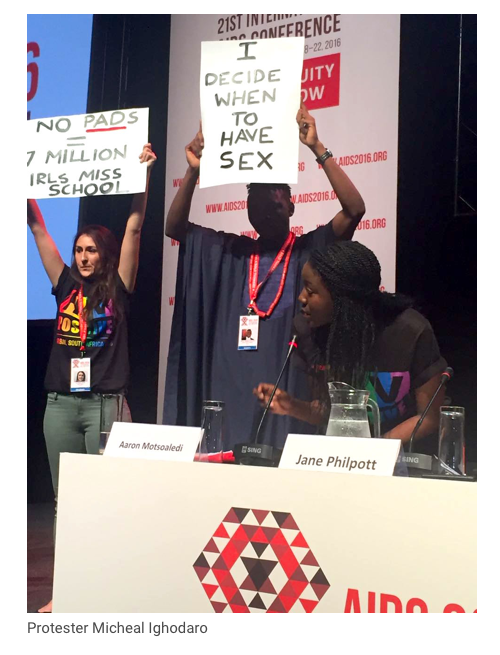
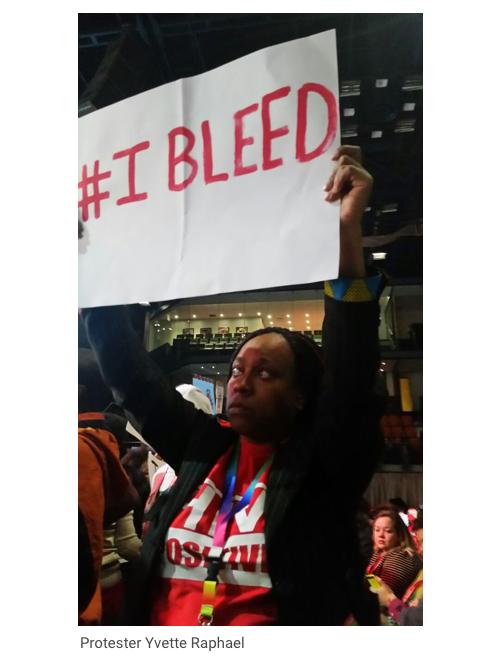
That’s one of the signs that young activists held up during a powerful demonstration during the morning plenary session. The protest, directed at the South African government, involved singing, signs and a strong call for South Africa to provide condoms and sanitary napkins in all of its schools. That such an actionable demand is being made in 2016 is a reminder of both the work that remains, and the impact of simple things that can be solved quickly if people in power heed the voices of young activists.

I rise, part 1

AVAC’s own Micheal Ighodaro was among the plenary speakers on the stage when the action took place and the only speaker to express solidarity—rising with the protesters and holding a sign over his head. The reward for this action? An IAC employee raced over to ask him if he could hurry the protest along. Micheal, up on his feet with the other young people, did not comply.

I bleed, part 2

The people who talk about leaving no one behind ask people like me to be polite, to stay calm, to grieve quietly, while my brothers and sisters are dying or imprisoned. Our bodies are seen as an abomination or deserving of HIV—and you still want to know the source of my rage. I cannot decorate this pain for you, I cannot make a beautiful homage, and I cannot invoke hope and prayers. I cannot smile. I need to see action now, today…” Micheal Ighodaro, Plenary Speech, July 20, International AIDS Conference 2016

These words need no additional explanation. We have posted the complete text of Micheal’s speech here and we urge those who weren’t there in person to watch the webcast when it becomes available.

Later in the day, Micheal and Nigerian comrades held a unique session in the Global Village that combined dance and discussion to promote the right of African gay men, other men who have sex with men and transwomen to access PrEP. The session opened with a video memorial to the 49 people killed in the mass shooting at Pulse, an LGBT nightclub in Orlando, Florida. The Global Village truly lived up to its name as LGBT people and their allies from every corner of the world shared in a moment of mourning for this loss.

I rise, part 2

Micheal’s plenary drew a standing ovation. We were proud to be there.

Prevention advocacy was also on the rise in amazing sessions across the conference today including a session on women’s prevention, moderated by AVAC’s Manju Chatani-Gada. Courageous women raised their voices to share their experiences using the dapivirine vaginal ring in the ASPIRE study in South Africa, using PrEP as part of the SAPPH-IRe demo study in Zimbabwe and using PrEP outside research settings in South Africa. They also answered questions about accessing it through the private sector. Women-controlled prevention is too good and important not to share in detail.

“I miss my ring,” Thobile—one of the participants from the ASPIRE study—said emphatically when asked if she would be joining the open-label study (HOPE) that has just begun inviting back participants from the study. She went on to say she did not feel it when she was having sex, and said she felt good wearing it. Mrs. Shabalala talked about her husband’s support and his involvement in her decision to join and stay in the trial. He waved at us from the audience and invited questions.

Bathabile, a sex worker, who had been part of the SAPPH-Ire demo study, said many sex workers did not take up PrEP initially “because they did not really understand what it was all about. The informed consent form was confusing and I had to ask people to translate it for me. But then I got it.” She talked about the stigma sex workers experience, and her initial distrust of the intent of the study. But she wanted to try it, she said, and has benefited from ongoing support.

Another woman at the session, Buhle, said she “recently rediscovered her sexual freedom as a young, African women on PrEP”. She spoke about her experience educating her physician about PrEP. Her doctor had no idea what PrEP was, confusing it for PEP. Buhle went onto the CDC website in her doctor’s office and they walked through the site together. She said her physician warned her repeatedly that the side effects would be too awful to bear. Buhle took it anyway. Six months later, she says adherence is easy. Now Buhle wants to see the use of PrEP normalized so that her friends will accept it too, and get the same benefits she does. “Make it funky to use,” she said. That’s what would work for her friends.

We need to hear more of this and all the time. It’s the only way to move beyond the numbers and the PowerPoints and reach real people in the real world.

I rise, part 3

As an antidote to any creeping impatience during tomorrow’s conference, we offer this poem by the great African-American poet Maya Angelou.

Still I Rise

Maya Angelou

And still I rise
You may write me down in history
With your bitter, twisted lies,
You may tread me in the very dirt
But still, like dust, I’ll rise.

Does my sassiness upset you?
Why are you beset with gloom?
‘Cause I walk like I’ve got oil wells
Pumping in my living room.

Just like moons and like suns,
With the certainty of tides,
Just like hopes springing high,
Still I’ll rise.

Did you want to see me broken?
Bowed head and lowered eyes?
Shoulders falling down like teardrops.
Weakened by my soulful cries.

Does my haughtiness offend you?
Don’t you take it awful hard
‘Cause I laugh like I’ve got gold mines
Diggin’ in my own back yard.

You may shoot me with your words,
You may cut me with your eyes,
You may kill me with your hatefulness,
But still, like air, I’ll rise.

Does my sexiness upset you?
Does it come as a surprise
That I dance like I’ve got diamonds
At the meeting of my thighs?

Out of the huts of history’s shame
I rise
Up from a past that’s rooted in pain
I rise
I’m a black ocean, leaping and wide,
Welling and swelling I bear in the tide.
Leaving behind nights of terror and fear
I rise
Into a daybreak that’s wondrously clear
I rise
Bringing the gifts that my ancestors gave,
I am the dream and the hope of the slave.
I rise
I rise
I rise.

Thursday at the Research Literacy Networking Zone

In addition to having a Help Desk (have a question about prevention research or looking for a resource—stop in!) and a comfortable space to rest your feet, come check out all the programming in the RLNZ (Global Village, Booth 606). See Thursday’s schedule below:

  • 11:00 – 12:30 – What is Health Research and Development and Why Should Advocates Advocate for Increased Funding for Health R&D (PATH)
  • 12:45 – 13:45 – How is that Rectal Revolution Coming? Update on Global Rectal Microbicide Research (IRMA)
  • 14:15 – 15:15 – Engage Yourself: Responsible and Responsive Science (AIGHD)
  • 15:30 – 16:30 – Ask the Researchers: Vaccine Research (HVTN)
  • 17:00 – 18:00 – The PROUD Study: A video documentary and discussion (Nicholas Feustel, georgetown media)

A Few Sessions We’ve Starred

See below for a highly selective list of sessions for all the data geeks out there!

  • 11:00 – 12:30 – Financing the Response to HIV: Show Us the Money, Session Room 1
  • 11:00 – 12:30 – Targeting Reservoirs for Cure, Session Room 7
  • 11:00 – 12:30 – Treat Early and Stay Suppressed, Session Room 12
  • 14:30 – 15:30 – Using Funding Data to Advocate for Global and Domestic Resources in the Critical Push Towards the End of AIDS, Global Village Room 2
  • 14:30 – 16:00 – The Use of Economic Interventions to Promote HIV Prevention and Treatment Objectives, Session Room 12
  • 14:30 – 16:00 – The Future of Chemoprophylaxis: New Concepts, Session Room 6

Follow along in real-time on Twitter, and look for the next update on our blog tomorrow!

The Vagina Dialogues – Day 3 at AIDS 2016 

We head into day three of the Durban Diaries a little deafer than we were before from the unceasing din of the Global Village—a beat that breaks down into equal parts information, activism and celebration of all the shapes and sizes and colors of our lives. Between the pink-peacock-feather-clad dancers in the condom area and the music of Ugandan singer Moses Supercharger on the Global Village mainstage, it’s a feast for all five senses, and a reminder of the beauty of the bodies we live in every day.

Over in the main conference building, the beauty of those bodies was in and out of focus today in a series of sessions focused on women, HIV risk and HIV prevention. At its best, the dialogue was led by and for women and centered on rights, realities and engaged discussion on the whole body, from head to toe and heart to mind. In some fascinating sessions, the vagina seized center stage and all but lost the head and heart that go with it. Today, in our update, we’ll try to put the pieces together and so, of course, the theme is: The Vagina Dialogues.

The morning’s plenary featured a number of powerful women who reminded delegates of the role of gender in the global response to the epidemic. Eminent Kenyan scientist and advocate Elizabeth Bukusi, of KEMRI, reminded the audience that, “HIV operates in a gendered world and it thrives because of that.”

What exactly is going on in that gendered world? Some insights came from a special session, New Evidence: Why Do Young Women in Africa Have High Rates of HIV Infection?. It started out with a presentation on the “direction” of transmission in a South African community—in other words, who is passing on the virus to whom, by gender and age-bracket. By sequencing viruses and grouping them according to their genetic relatedness, researchers established that the majority of young women [16–24 years old] are acquiring HIV from significantly older men—an average of 11 years older, in fact. The age disparity between male and female partners decreases as young women age. But many of them are getting HIV from older male partners so that by the time they are 24, they are also in a position to transmit HIV to their male partners, setting up a cycle that looks like this.

The session also presented data drawn from women who participated in the CAPRISA 004 trial of a 1% microbicide gel. This investigation explored the presence of specific vaginal bacteria (the flora that live in all women’s vaginas) and how it might increase HIV risk and affect the absorption of the tenofovir gel. The good news is that there is no evidence these findings apply to the use of oral PrEP.

This session provided great food for thought including this comment—voiced in the follow-on session on women’s rights and health: “We heard all about vaginas. But vaginas are attached to people…” The challenge will be to put these important scientific findings into practice in ways that explore young women’s practices in relation to their vaginal health, and their whole bodies—all while treating and PrEPing as needed.

Speaking of vaginas, another study presented today focused on new analyses of data from the ASPIRE dapivirine vaginal ring study. While initial data were presented at CROI, new analyses showed that individuals with high levels of adherence achieved extremely high levels of protection.

Back in the Global Village, no surprise here, women’s bodies and lives were fully present in all sorts of sessions; a vibrant discussion in the Women’s Networking Zone ensued from a project documenting the experiences and perspectives of women living with HIV and undergoing treatment. Women at the session, who were primarily from sub-Saharan Africa, found the findings from this project personally resonant and were eager to obtain the full report as an advocacy tool. Download the four-page summary here.

Wednesday at the Research Literacy Networking Zone

In addition to having a Help Desk (have a question about prevention research or looking for a resource—stop in!) and a comfortable space to rest your feet, come check out all the programming in the RLNZ (Global Village, Booth 606). See Wednesday’s schedule below:

  • 11:00 – 12:30 – Safer Conception for HIV-affected Individuals and Couples: Synopses of Findings (HIVE)
  • 12:45 – 13:45 – Addressing Known Causes of Poor Participation by Black MSM in HIV Prevention and Treatment Research (APEB, PxROAR)
  • 14:00 – 15:00 – Advancing PrEP Advocacy Opportunities and Challenges in Settings Where it Has Been Approved and Where it Has Not (IRMA)
  • 15:30 – 16:30 – Hope vs. Hype in Reporting HIV Cure Research (AVAC, TAG, UNC)
  • 17:30 – 18:30 – Ask the Researcher: Preventive HIV Vaccine Research (HVTN)

A Few Sessions We’ve Starred

See below for a highly selective list of sessions for all the data geeks out there! Check them out in-person or find them on the webcast archive the following day.

  • 8:45 – 10:55 – What is our goal?, Session Room 1, Wednesday’s plenary features AVAC team member Micheal Ighodaro speaking on the role of young people leading in the response
  • 11:00 – 12:30 – Making PrEP Real for Those Who Need It Most: Optimization Strategies, Session Room 1, Data from IPERGAY and HPTN 073 and Partners Demo studies and SEARCH test and treat study in Uganda and Kenya
  • 13:00 – 14:00 – Accelerating the Decline of the Burden and Incidence of HIV in Sub-Saharan Africa Special Session, Session Room 1
  • 13:00 – 14:00 – Circumcision: Where to, How to, Who to?, Session Room 5, Oral poster discussion on VMMC uptake, barriers, new devices and more
  • 13:00 – 14:00 – Prevention for Women: The Need for Multidisciplinary Approaches, Session Room 8, Oral-poster session including additional qualitative data from FACTS 001, preferred PrEP formulation in ASPIRE sub-study, vaginal bacteria and its relation to increased risk of HIV, and more

Follow along in real-time on Twitter, and look for the next update in your inbox tomorrow!

Long Waits and Long Queues: Hurry Up! – Day 2 at AIDS 2016

It’s Day 2 of the daily updates… and the conference has just barely begun with the official opening on Monday evening. Nevertheless, delegates have already covered a lot of ground—taking to the streets for a vibrant, sun-baked, song-filled March for Health.

Not everything is in motion, though. Long queues to undergo security screening are keeping people standing in place or, at best, shuffling along. While shuffling ourselves, we overheard an activist wondering why there wasn’t a “fast track” lane for people living with HIV. Perhaps the queue slowed down for US Global AIDS Ambassador Debbi Birx, who participated in the march—and raced into a press conference 15 minutes late. The security lines do have an upside though… they’ve provided our theme for today: “Hurry up!”

Hurry up, Part I

Two consecutive sessions on voluntary medical male circumcision (VMMC) started the day off. The first introduced the new UNAIDS Strategic Framework for VMMC—which recommends positioning VMMC in the context of a comprehensive platform of services for adolescent boys and young men. This shifts VMMC away from a campaign-based model that provided a basic package of services at the time of the procedure—but didn’t seek to use the procedure to anchor people to a broader health platform. Given the absence of youth-friendly health services for adolescent boys and girls (not to mention those individuals who don’t fit into gender-binary categories!)—this is a welcome recommendation. But it’s not clear what this shift will cost or how it will impact the goal of roughly doubling VMMCs annually from 2.5 million to five million in order to meet the global target. The sole presenter who addressed cost indicated that Swaziland’s approach to providing VMMC within a program of comprehensive services for young men cost about US$180 per procedure, compared to less than US$100 for a standard approach. Moving to the UNAIDS-recommended model is going to cost money, and the money is not on hand. At the same panel, a representative from the GFATM reported that six VMMC priority countries requested a total of US$9 million for VMMC from dedicated funds during the last round. However, an additional US$65 million for VMMC was in the “above allocation” wish-list—e.g., money they wanted but weren’t likely to get. So—the model is changing, costs could be rising, and the money is missing. That’s the challenge for delivery of the most effective HIV prevention available for HIV-negative men today. It needs to be resolved. Fast. Hurry up.

Hurry Up, Part II

A lively discussion took place in an afternoon session on HIV prevention for pregnant and breastfeeding women. Participants considered PrEP, including daily oral TDF/FTC, which is available today, as well as emerging strategies like the vaginal dapivirine ring and perhaps long-acting injectable ARVs. At issue was the best way to offer PrEP to HIV-negative women in antenatal settings. Does additional safety information need to be gathered even though there are years and years of experience using TDF/FTC-containing regimens in pregnant women living with HIV? Or should daily oral PrEP be part of antenatal services offered to women who are at substantial risk? Opinions were heated and diverse. Could over-crowded, under-resourced and under-staffed antenatal clinics accommodate the required counseling associated with PrEP initiation and successful follow-up? Was it ethical to hold off on offering PrEP for women who would definitely receive ART if they returned with an HIV-positive result? “There is some deep level of inequity, of sexism…” one participant opined. “If men could get pregnant this would be a really different discussion.” The questions standing in the way of routine provision of PrEP for women at risk in ANC clinics need to be addressed ASAP. Hurry up.

Hurry Up, Part III

The session on fast track prevention targets also got our attention. As seen in the Lancet HIV, global targets will fail to control HIV if the rate of new infection continues to march along at current levels. There’s been too little investment, focus and commitment on prevention. The scale of the effort has been too small and the quality of implementation uneven. The UNAIDS–Lancet Commission on Defeating AIDS—Advancing Global Health reported that updated UNAIDS targets to reduce new infections below 500,000 by 2020—a 75 percent reduction from 2010 requires a full complement of prevention and treatment strategies scaled to reach a significant percentage of high-risk populations. Prevention advocates are pushing program targets for a worldwide plan that could spell the difference between success and failure. Hurry Up!

If you don’t want to read the whole the Lancet HIV piece see how Peter Piot and Mitchell Warren cast it here.

Hurry Up, Part IV

AVAC has been closely following the development of DREAMS, the PEPFAR-led, public-private partnership focused on adolescent girls and young women. AVAC was present in force and cheered on former AVAC Fellow Anna Miti, who served as the moderator at today’s update on the DREAMS partnership. One highlight, PEPFAR and DREAMS Partners announced the winners of their Innovation Challenge Fund, which is handing out a total of US$85 million to 56 groups. The call for applications encouraged groups to cover priority areas not fully addressed in the ten country work plans. The news is in and some of it is exciting: of those awarded, nearly half have never received PEPFAR funding. The organizations cover six main focus areas, including community capacity strengthening and keeping girls in school. Just four of the grants (7 percent of the total) are focused on PrEP—and it is not clear that all of these four are involved in providing services. The majority of the organizations are in Kenya, South Africa, Uganda and Tanzania. While 36 of the organizations are small in revenue, several on the list are large international NGOs and it remains to be seen what resource allocation will look like across the 56 organizations. DREAMS has an essential goal—reduce the incidence of HIV in adolescent girls and young women by 40 percent in 2017. Nothing could be more important and we support it 100 percent. Hurry up!

And here’s a look at some of what tomorrow will bring:

Tuesday at the Research Literacy Networking Zone

In addition to having a Help Desk (have a question about prevention research or looking for a resource—stop in!) and a comfortable space to rest your feet, come check out all the programming in the RLNZ (Global Village, Booth 606). See Tuesday’s schedule below:

  • 11:00 – 11:45 – Understanding HIV Prevention Research and Clinical Trial Process (WRHI)
  • 11:45 – 12.45 – Breaking Down Silos-Implementing GPP Across Diseases and Research Phases (AVAC, WRHI)
  • 13:00 – 14:00 – CUREiculum & Gene Therapy (Martin Delaney Collaboratory CAB)
  • 14:45 – 15:45 – Ask the Researchers: Antibodies for Prevention & Treatment (HVTN, PxROAR)
  • 16:00 – 16:45 – A Conversation about HIV with Emilio Emini, Director of HIV, Gates Foundation
  • 16:45 – 17:45 – PrEP Prepositions 4 Prevention (DTHF, WRHI)
  • 17:45 – 18:30 – AVAC Advocacy Fellows Info Session (AVAC)

A Few Sessions We’ve Starred

See below for a highly selective list of sessions for all the data geeks out there! Check them out in-person or find them on the webcast archive the following day.

  • 11:00 – 12:30 – PrEP: New Drugs, New Questions, Session Room 11, Data on maraviroc as PrEP, dapivirine ring and rilpivirine long-acting injectable
  • 11:00 – 12:30 – Progress in HIV Vaccines and the Road to the Clinic, Session Room 5, Review of P5, the AMP Study, Janssen’s ad26/MVA and new HIV vaccine concepts
  • 13:00 – 14:00 – Late Breaker Session, Data from the HVTN 100 vaccine trial, SAPPH-IRe PrEP demonstration project in FSWs in Zimbabwe, ATN 113 PrEP demonstration project in young Black men in the US and Truvada as PrEP utilization data in the US
  • 14:30 – 15:30 – New Evidence: Why Do Young Women in Africa Have High Rates of HIV Infection?, Session Room 1

Follow along in real-time on Twitter, and look for the next update in your inbox tomorrow!

Prevention Must be at the Forefront to Meet Global HIV Goals

In advance of the AIDS 2016 conference, AVAC Executive Director Mitchell Warren and Director of the London School of Hygience & Tropical Medicine Peter Piot co-authored a call inSTAT for an expanded focus on a comprehensive approach to HIV prevention. Alongside a fully-funded effort to provide treatment for people living with HIV, a range of prevention options are essential to defeat HIV and must be developed and delivered. This theme echoed again and again at Durban.

Read Prevention Must be at the Forefront to Meet Global HIV Goals for a succinct case for prevention.

Magical Thinking and Surge Pricing: AIDS 2016 update—Day 1 

Hello from the other side—also known as “Conference Land”. The streets in and around the International Conference Center in Durban are thronged with badge-wearing delegates, the Uber taxi prices are surging, and there are already piles of publications scattered across the floor of some of the session rooms where the pre-conferences have taken place. And all this means that there are already things to report, even though the official meeting only starts tomorrow. We can’t be exhaustive, only selective. In this update we offer a quick take on some of the day’s events, focused on the theme of “magical thinking”.

(And read on for more on what you can expect in each of our daily updates from Durban.)

Magical thinking that hurts

UNAIDS in its Prevention Gap report and the Kaiser Family Foundation in its report on the financing of the response have both identified the first drop in HIV funding in five years. There is US$7.2 billion funding gap in the price tag set for achieving the 90-90-90 goal. At a civil society dialogue session with UNAIDS head Michel Sidibe, Amanda Banda of Médecins Sans Frontières challenged Dr. Sidibe not to indulge in “magical thinking” that characterizes global leaders who claim that ending AIDS is possible in the context of this dire funding trend. Tomorrow, beginning at noon, thousands more will voice the same challenge at the March for Health: Quality treatment for all. AVAC will be there—join us!

Magical thinking that excites

At the UNAIDS workshop on the 90-90-90 targets, Nittaya Phanupak of the Thai Red Cross presented on a PrEP and “test and treat” initiative designed by and with key populations, particularly MSM. This multi-pronged effort includes use of MSM social networking sites to promote PrEP and allow visitors to the site to book appointments for testing, PrEP and/or ART. Seventy-six percent of the people who booked appointments online showed up in person. The program also allows for supervised self-testing via video conference—think a Skype chat with a trained counselor—that is reaching more first-time testers and finding more new HIV-positive individuals than traditional clinic-based testing. Okay, so this isn’t magic. But it’s major in terms of meeting people where they are.

Blogging from AIDS 2016

Check out the myriad voices covering the conference, in real-time, across a range of issues at the conference. Read WhatsUpHIV.

Daily updates

Each day you can expect quick updates and links to blogs on prevention activism, links to the great science coverage from NAM and sounds of the conference from the “Truth Booth” to give a flavor of what’s going on from the plenaries to hallway chats. We will also provide a preview of the next day’s events in the Research Literacy Networking Zone (RLZN) as well as some of the sessions we’ve starred on our calendars for the following day.

Monday at the Research Literacy Networking Zone

In addition to having a Help Desk (have a question about prevention research or looking for a resource—stop in!) and a comfortable space to rest your feet, come check out all the great programming in the RLNZ (Global Village, Booth 606). See Monday’s schedule below:

10:00 – 11:00 – Communicating Complex Science Clearly (WRHI)
11:15 – 12:15 – One Woman, Many Voices (AVAC, ICW EA, WRHI)
12:30 – 13:30 – Stories in Sisterhood: Using Digital Storytelling to Enhance Knowledge and Intent to Use PrEP (Texas Woman’s University)
14:00 – 15:30 – Understanding Cure Research (IAS)
16:00 – 17:30 – Regulatory Pathway for HIV Prevention Products: The Dapivirine Ring (IPM)

[The full program and session details are available to download here.]

Follow along in real-time on Twitter, and look for the next update in your inbox tomorrow!

Invitation to Endorse the Final Community Consensus Statement on Access to HIV Treatment and its Use for Prevention: The Next Cornerstone for Patients’ Rights

On the eve of the Durban International AIDS conference, European AIDS Treatment Group and a number of partners launched a global Community Consensus Statement on Access to HIV Treatment and its Use for HIV Prevention, available here and now for endorsement. The Statement places the right of the person with or at risk of HIV to access ARVs for treatment or prevention in the way they want and in a way that enables them to use it successfully.

This is an updated Statement and shows the evolution in knowledge around the use of ARVs for both treatment and prevention. Since the first version, launched two years ago, there is further evidence showing that:

  • Treatment improves health outcomes for everyone living with HIV regardless of CD4 count
  • People with HIV who are on ART and virally suppressed are non-infectious
  • If HIV-negative people take ARVs approved for prevention (PrEP) consistently, they are protected from virtually any risk of HIV infection

In addition to the progress in science around ARVs for treatment and prevention, activism and policy advances over the last two years is also reflected in the Statement. In particular, the sections on ARV access and PrEP are new.

Sections include:

  • The right to ART for people who are HIV-positive
  • Access to ART for people who are HIV-positive
  • Preventing HIV transmission
  • PrEP for people who are HIV-negative
  • Prevention policies for all

This final version was shaped by global community input with more inclusive, wider authorship than the original. As a result, it is shorter and less technical, with the aim of easier engagement and uptake.

The end goal is to see this final Statement included at the core of every HIV treatment guideline and program with the potential to become a cornerstone of patients’ rights. The more people who authorize it, the more likely it is to be adopted. Many thanks for individual and organizational sign-ons.

New! AVAC Report 2016 Big Data, Real People: The annual state of prevention advocacy

If you’re packing for Durban, we hope you’ll pause right now and add to your bag AVAC’s annual state of the field, Big Data Real People. The full PDF, Executive Summary and graphics are available here.

As always, AVAC Report is our annual advocacy analysis, with an agenda that spans the next 12 months—and beyond. We’ve designed it be a clear, succinct, actionable statement of the strengths and weakness of HIV prevention data today—and we hope you’ll join us in amplifying these messages at next week’s gathering.

Even if you’re not heading to Durban, we hope that this year’s Report will top your packing list for the journey through the next 12 months of advocacy and action.

In the Report, we argue that the state of HIV prevention data collection in 2016 is poor. One part of the solution lies in the adoption of “HIV Prevention Data Dashboards”. This tracking tool could bring the same specificity and accountability to non-ART prevention services that the “treatment cascade” of diagnosis, initiation, retention and virologic suppression does for antiretrovirals for people living with HIV.

The world cannot even pretend that ending AIDS is possible without action on non-ART prevention. We need to roll out what we have, continue R&D on what we still need, as well as scale up ART for all people living with HIV. That’s what the new UNAIDS Prevention Gap report says. That’s what AVAC has said for years. That’s what we hope you’ll say in Durban and over the coming year.

Here’s the Report, a roadmap for the coming year. Please read it, join us on the journey, let us know what you think!

Join AVAC at these AIDS 2016 Prevention Sessions

Another brief update in the run-up to Durban (you can find our previous resources on navigating prevention research and activism here). In this one: how to find AVAC—which we hope you’ll do to amplify messages, add experience and share the work of bringing prevention to the forefront of the meeting.

A full run-down of AVAC at Durban 2016 is here—this includes our presentations, satellites, workshops, booth and Global Village work (and for the full prevention roadmap, click here). We will also be providing daily updates on prevention activism and developments at the meeting—with a guide to what to watch out for the next day. These will be via the Advocates’ Network and also tweeted out from @hivpxresearch.

Below is a very brief selection of highlights by strategy and issue. Scroll down for some key places to find and learn more about AVAC and partners, and let your voice be heard!

Advocacy in Action

  • July 18, 12:00 – 3:00 PM: Look for us at the March for Quality Treatment for All – come raise your voice for prevention and signal a “code red” for the HIV response.
  • July 19, 17:45-18:30 (Research Literacy Networking Zone): AVAC Advocacy Fellows Info Session – come learn more about this fellowship opportunity for emerging and mid-career advocates.
  • Ongoing: “Truth Booth” (Booth 572 in the Global Village) – a recording booth to capture diverse voices of the conference.

Combination Prevention and “Ending AIDS”

  • What will it take to reach the Fast Track Prevention Targets: What, Who and How, Monday, July 18 14:45-16:45 (Session Room 5)
  • Right things, right places, right now: Setting the right targets, Tuesday, July 19 11:00-12:30 (Session Room 10)
  • Oral presentations in the Financing the Response to HIV: Show Us the Money session, Thursday, July 21 11:00-12:30 (Session Room 1)

Cure

Towards an HIV Cure: Engaging the Community, Saturday, July 16 9:00-12:10 (Session Room 11)

HIV Vaccines

  • Vaccines are Needed to Conclusively End HIV/AIDS and TB, Monday, July 18, 8:00-10:00 (Session Room 1)
  • Ask the Researchers: Talking About the Use of Antibodies for HIV Prevention, with the HVTN, Tuesday, July 19 14:15-15:45 (Research Literacy Networking Zone, Global Village booth 606)

Hormonal Contraception and HIV

One Woman, Many Choices, Monday, July 18 11:15-12:15 (Research Literacy Networking Zone, Global Village booth 606)

Key Populations

Long-acting Injectable ARVs for Prevention (and Treatment)

Marketplace for Rings, Pills, Jabs and Other Things: Understanding new biomedical interventions to reduce HIV risk from development to delivery, Wednesday, July 20, 14:30-17:00 (Session Room 3)

Microbicides

HIV Prevention Landscape for Women: A look at new & emerging prevention options including PrEP, vaginal rings and new products in development, Wednesday, July 20, 13:00-14:30 (Global Village Session Room 1)

PrEP

  • PrEP Implementation Meeting, Sunday, July 18 9:00-17:15 (Hotel Elangani, Tugela room, Maharani Tower)
  • What do we need to do to access and deliver PrEP?: Tapping into unheard voices of end-users and providers to support country level advocacy and equitable access, Tuesday, July 19, 14:30-17:00 (Session room 7)

Prevention Options for Women

HIV Prevention for pregnant & breastfeeding women: Long overdue. But is it time to deliver?, Monday, July 18 14:45-16:45 (Session room 12)

Research Literacy

Throughout the Conference at the Research Literacy Networking Zone in the Global Village, click here for complete program.

VMMC

Voluntary Medical Male Circumcision as Primary HIV Prevention: Maximizing Our Investment and Considerations for Sustainability, Monday, July 18, 10:15-12:15 (Session Room 11)

Be Heard: A preview of prevention activism in Durban

With less than a week to go until the International AIDS Conference, here’s the next in AVAC’s series of brief updates to prepare. In this one… prevention activism at Durban. What, where, why and how. We hope you’ll find this useful and thought-provoking whether you’re coming to an IAC for the first time—or whether this is familiar ground.

What does prevention activism mean in 2016?

As it was in 2000, access to antiretroviral treatment for people living with HIV will be one important theme for this year’s meeting. That 35 years into the HIV epidemic, less than half of the 37 million who need ART are on treatment means that access continues to be a major issue.

Prevention activism starts with this premise and adds loud, specific, targeted demands for funding, programs and research for the things we know, and need, as combination prevention. This means male and female condoms and condom-compatible lubricant, comprehensive harm reduction, PrEP, VMMC, structural and rights-based interventions, and R&D for additional options. The world won’t end AIDS without targets, accountability and action around these interventions—and action won’t happen without activism.

Why is activism needed?

Because there are major, glaring gaps in HIV prevention worldwide. UNAIDS just took a stand on this with its first Prevention Gap report that highlights numerous places where we are failing. Just 2 percent of the people who need PrEP, according to UNAIDS’ target of 3 million by 2020, have access to it today—a situation similar to ART access around the last Durban conference. Also this week, WHO reported that the number of voluntary medical male circumcisions performed in 2015 declined by 20 percent from 2014. A month ago, UNAIDS put out its annual progress report which noted that there has been no decline in the number of new cases of HIV worldwide in the past five years.

This because public health systems are broken; there are not enough health workers; prices of new medicines and technologies are still high; and supportive policies and funding for community-led programs should be priority for any program implementation but this is hardly the case.

How should it happen at the meeting?

Anywhere that there is a conversation about ending AIDS, prevention activism is needed. You can do it by sporting a message—look for AVAC’ers and allies with prevention “red alert” stickers like the one in this message. You can also do it by speaking up.

Here are some questions to ask specific speakers and stakeholders?

  • UNAIDS leadership: How will you help lead the world to less than 500,000 new infections per year by 2020 and fill the gaps in your new report?
  • PEPFAR leadership: What will it take to get PrEP offered to adolescent girls and young women in all of the countries where you are implementing your DREAMS program, and how will you ensure that the newly-announced initiative for key populations has true impact?
  • National leadership: How are country targets and budgets aligning with global targets – for prevention, for key populations and for human rights?
  • Session chairs: Where are the voices of the people leading the fight? Those most highly burdened and underserved, including young women, should be front and center of the conversation, leading with their voices and not being talked about from the podium.

Where should it happen?

It’s time activists shaped the International AIDS Conference to ensure these issues are raised and rhetoric matches action. Community needs to set a new global agenda in its response. Activists could start by showing up, grabbing a sign, marching, demanding answers of decision-makers, meeting with media, blogging and being counted. See you in the streets!

Activities

  • Activist Strategy Session: An all-day strategy workshop led by MSF, TAC, ITPC and Health GAP to strategize treatment for 30 million people with HIV by 2020; Sunday, July 17 at 8:30am – 4:00pm; The Royal Hotel, 267 Anton Lembede St, Durban, 4001
  • Activist Meeting: Join TAC, Health GAP, SECTION27 and MSF to discuss the Treatment for All march and other actions for AIDS 2016; Sunday, July 17 at 6:30pm – 8:30pm; The Royal Hotel, 267 Anton Lembede St, Durban, 4001; RSVP here; [email protected]
  • Red Card Actions: A group of organizations are printing red cards to hold up in conference sessions when speakers are using rhetoric that is not matched by action. These will be handed out to activists at the beginning of the week.
  • Treatment March: Join TAC and Health Gap March for Quality Treatment for All; Monday, July 18 at 12pm–3pm; Meet: King DinuZulu Park; [email protected].
  • No Sterilization March: Join ICW and ICWEA and others for March Against Coerced & Forced Sterilization of Women Living with HIV; Tuesday, July 19 at 12pm; at the AIDS 2016 Conference.
  • Responding to UNAIDS’ Session: From Commitments to Action: Implications of the 2016 UN High Level Meeting on Ending AIDS; Join MSMGF in action planning in response to the UN High Level Political Declaration, Wednesday, July 20 at 1pm – 2:30pm; at the MSM Networking Zone, Global Village, Booth 617.
  • Code Red: Demand a New Era in the AIDS Response; Global Call to Action by TAC, Health Gap and +SECTION 27; endorse Call to Action here.
  • HIV Prevention 2020: A framework for delivery and a call to action; read the Lancet’s latest issue for a worldwide plan to reduce HIV incidence.
  • Activism for Hepatitis C Drugs: Join ITPC in calling on drug company Gilead to stop blocking the the registration of sofosbuvir so it can be used in combination with daclatasvir; and to stop threatening generic drug production in Morocco, Tunisia and Egypt. For details, contact [email protected].
  • Indian Government Crack-down on Activist Organizations: Activist discussion hosted by Canadian HIV/AIDS Legal Network, Health GAP and Lawyers Collective on Potential against government attacks civil society organizations and detrimental effects on intellectual property in India. For information on actions, contact [email protected].
  • Global Fund Replenishment: International Civil Society Support (ICCS) and Global Fund Advocates Network (GFAN) are organizing a number of actions/events focused on targeting key donor countries regarding contributions to the Global Fund. There will be a Call to Action during the press conference on Wednesday, July 20 to launch the Cost of Inaction report. For more information, contact ICCS.

P.S.

Check out the HIV Prevention Roadmap of relevant sessions and activities at the conference, and the Research Literacy Networking Zone in the Global Village—a destination we hope will be on your path through a busy conference week.

And take a look at this slide set that gives background and detail on Durban activism past and present in context—including the organizers, “asks” and timing of upcoming marches.