UNAIDS Profiles Six PrEP Pioneers, Uncovering Strategies, Concerns, Motivations and More

Succinct yet informative interviews with six leading PrEP advocates highlight the many steps of the process from research to rollout where they are gaining ground. The international group featured in this UNAIDS Community Advocacy Update discusses the history of PrEP advocacy and next steps in translating WHO’s 2015 recommendation of daily oral tenofovir-based PrEP as an option for those at substantial risk of HIV acquisition.

The advocates profiled in the update include Brian Kanyemba of the Desmond Tutu HIV Foundation in South Africa and a 2011 AVAC Fellow; Sally-Jean Shackleton of the Sex Workers Education and Advocacy Taskforce (SWEAT) in South Africa; Midnight Poonkasetwattana of the Asia-Pacific Coalition for Male Sexual Health (APCOM) in Thailand; Bathabile Nyathi from the Centre for Sexual Health & HIV/AIDS Research (CeSHHAR) in Zimbabwe; Pedro Goicochea from Peru and now at the Forum for Collaborative HIV Research; and AVAC Executive Director Mitchell Warren in the United States.

APHRODITE seeks people with HIV

NIAID’s new APHRODITE clinical research trial seeks to determine if an experimental drug called CC-11050 is safe, well-tolerated, and effective in reducing inflammation in people with HIV. This Phase 1 study is being conducted at the NIH Clinical Center in Bethesda, Maryland. Participation involves about 7 visits over about 6 months. Read more at: http://www.clinicaltrials.gov/ct2/show/NCT02652546.

News from HIV Research for Prevention 2016 (HIVR4P)

Abstract submission, registration, and scholarship applications are now open for HIV Research for Prevention (HIVR4P) 2016. Plan now to join us for HIVR4P 2016, 17–20 October 2016, Sheraton Grand Hotel, Chicago, USA.

The 2016 International AIDS Conference, can we help you?

As the Regional Community Partner for AIDS 2016, ARASA is committed to assisting civil society and community members to attend the conference, host activities or workshops and facilitate presentations. Although ARASA has no funding for registration, accommodation or travel costs, a dedicated staff member will be able to assist with all registration and abstract, scholarship, Global Village and Youth Programme applications.

Plenary Line Up

See the plenary line up for AIDS 2016 here.

Letter to President Obama: Don’t stall HIV/AIDS research funding

Organizations from across the US—nearly 140 of them—penned a letter to President Obama urging that the NIH budget (responsible for 68 percent of the global public sector HIV prevention research budget) include the US $100 million increase for HIV/AIDS research for FY2016 promised by the President in March of 2015. Noting that now is a time to prioritize, not cut HIV/AIDS research, the letter highlights the potential for research advances to help “end the scourge of HIV/AIDS”, a priority the President himself called out in his recent State of the Union speech.

This letter and a companion letter, signed by over 500 researchers supporting HIV research funding, are available to download here.

Contribute to the AIDS 2016 conference programme!

Be part of the world’s premier gathering where science, leadership and community meet for advancing all facets of collective efforts to treat and prevent HIV. Submit an abstract and share your research. Submit a workshop that will promote knowledge transfer, skills development and collaborative learning. Submit an activity for the Global Village and Youth Programme. Programme submissions are open until 4 February 2016.

Call for contributions

The United Nations Secretary-General’s High-Level Panel on Access to Medicines is calling for contributions by interested stakeholders that address the misalignment between the rights of inventors, international human rights law, trade rules and public health where it impedes the innovation of and access to health technologies.In particular the High-Level Panel will consider contributions that promote research, development, innovation and increase access to medicines, vaccines, diagnostics and related health technologies to improve the health and wellbeing of all, as envisaged by Sustainable Development Goal 3, and the 2030 Agenda for Sustainable Development more broadly.

Sweet 16: HIV Advocates to Watch in 2016

AVAC joins My Fabulous Disease Blogger, Mark King, in his recognition and praise for the promise of 16 diverse HIV leaders. His list includes Cassie Warren and Nick Feustal who—in addition to being leaders in the great work described in Mark’s piece—are also members of AVAC’s PxROAR program.

As Mark puts it, “They come from nearly every corner of the world. They are engaged in local communities and on the international scene. They include mothers, artists, a fugitive, a performer, and a drug smuggler. They are speaking out, acting up, and in some cases risking their personal safety and liberty.”

We are grateful to have Cassie and Nick as part of our partner network and look forward to working with them and all of you in what should be an exciting 2016. Cheers!

Read the full piece here.

Develop, Demonstrate, Deliver: Model shows AIDS vaccine is essential to conclusively end epidemic

ARV-based HIV prevention implementation is on a roll, with WHO recommending daily oral PrEP as an option for all people at substantial risk of HIV acquisition—and also calling for immediate offer of treatment to all people living with HIV. TDF/FTC (brand-name Truvada) is now approved for HIV prevention as PrEP in France, Kenya, South Africa and the United States—with more countries sure to follow in 2016.
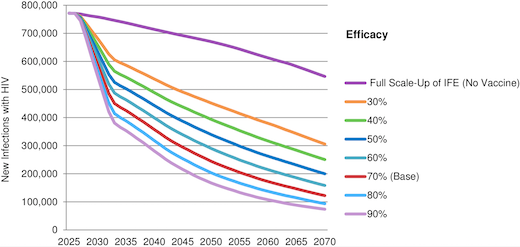
Vaccine Efficacy Modelling

These advances may lead people to ask whether the world still needs an AIDS vaccine as part of the strategy for ending the epidemic? And will a vaccine be needed in five or ten years time—the likely timeframe for results on today’s leading candidates to end the epidemic? For prevention advocates who don’t want to settle for a limited set of options, and who understand the potential revolutionary impact of a vaccine, a new modeling analysis, published this month in the open-access journal PLoS ONE, provides some clear answers to this question.

The paper, Exploring the Potential Health Impact and Cost-Effectiveness of AIDS Vaccine within a Comprehensive HIV/AIDS Response in Low- and Middle-Income Countries, was authored by IAVI, Avenir Health and AVAC, with financial support from USAID.

It looks at the potential impact of an effective AIDS vaccine in the context of expanded coverage of early treatment, PrEP and other existing strategies reflected in the UNAIDS Investment Framework Enhanced (IFE). The IFE, published in 2014, assumed scale-up of ART according to WHO 2013 guidelines along with VMMC and the potential introduction of PrEP, and an AIDS vaccine. [Note: the 2013 WHO guidelines indicated treatment for individuals with a CD4 count of 500 or less; the updated guidelines released in 2015 indicate offering treatment to all HIV-positive individuals, regardless of CD4 count.]

The paper reflects that if UNAIDS IFE goals were fully achieved, new annual HIV infections in LMICs would decline
from 2.0 million in 2014 to 550,000 in 2070. A 70 percent efficacious vaccine introduced in 2027 with three doses, strong uptake and five years of protection would reduce annual new infections by 44 percent over the first decade, by 65 percent the first 25 years and by 78 percent to 122,000 in 2070. Vaccine impact would be much greater if the assumptions in UNAIDS IFE were not fully achieved. An AIDS vaccine would be cost-effective within a wide range of scenarios.

This paper suggests that even a modestly effective vaccine would reduce infections significantly and be cost-effective, even as other interventions are broadly implemented. This confirms what AVAC and others have often said before: no single option will or can end the epidemic.