February 26, 2026
AVAC’s continued coverage of CROI summarizes key themes from the final two days of the conference, including the vital importance of choice and steps needed to make choice a reality. See AVAC’s summary of the first two days of CROI here.
Day 3: From Innovation to Impact
Day 3 kicked off with a Community Breakfast Club focused on prevention science: From Innovation to Impact. Moderated by Adaobi Olisa of Root to Rise and AVAC’s Clinical Trial Design Academy, the conversation previewed data on PrEP, and panelists Renee Heffron from University of Alabama, Brian Minalga from the Office of HIV/AIDS Network Coordination (HANC), and Linda-Gail Bekker of the Desmond Tutu HIV Centre and AVAC Board member emphasized that scientific breakthroughs only matter if they reach communities and are implemented equitably, inclusively and at scale.
Progress and Challenges in STI Prevention and Treatment
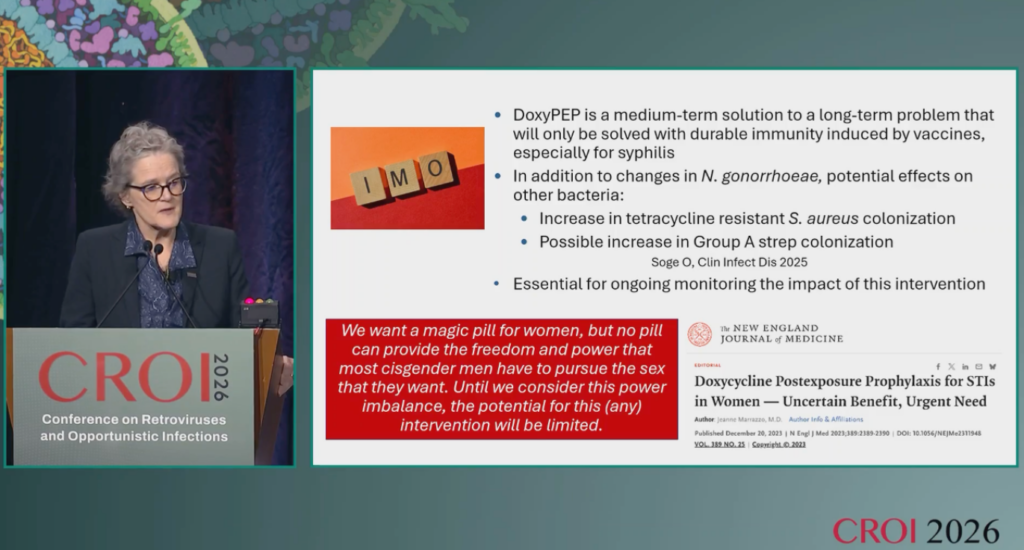
In a plenary session, IDSA CEO and AVAC Board member, Jeanne Marrazzo, highlighted advances and challenges in STI treatment and prevention. While DoxyPEP reduces syphilis among gay, bisexual, and other men who have sex with men and transgender women, the effect is not seen across all U.S. populations, and incidence of congenital syphilis continues to rise. Resistant gonorrhea remains a pressing challenge, but two newly approved antibiotics offer new treatment options. Marrazzo called for increased efforts to address structural barriers putting cisgender women at higher risk for STIs and for innovation in diagnostics, antimicrobials, and vaccine development. Read coverage of her plenary in AJMC.
Expanding Access, Improving Inclusivity
Echoing Marrazzo’s plenary, various sessions underscored the need to address structural and scientific barriers to expand choice and deliver person-centered solutions to meet the needs of people and communities.
- Gabriel Chamie presented data from the SEARCH study, a community health intervention pairing digital tools with tailored in-home HIV services provided by trained community health workers that reduced HIV incidence by 70%. The findings underscore the power of bridging communities and health systems through technology and locally driven care.
- In a Malawi study presented by Deborah Hoege, people initiating long-acting injectable cabotegravir had higher continuation rates than those on oral PrEP (61% vs. 21% at month 1; 41% vs. 7% at month 5).
- Rena Janamnuaysook shared how community-generated data from the Tangerine Clinic was used to advocate for gender affirming services in Thailand’s national health insurance program, reinforcing the power of community leadership, data, and policy advocacy to increase access to services for trans and gender diverse individuals.
- Gabby Chromhout presented Azaphile pediatric ATI trial findings that about one-third of children treated as young as age 3 achieved remission. The data point to the critical importance of early ART initiation, potential sex differences in control, and the remarkable capacity of pediatric immune systems.
- Gilead presented trial design and dose modeling for a new study testing once-yearly lenacapavir for PrEP. PURPOSE 365 is a single-arm, open-label study that will enroll 300 people who would benefit from PrEP. Based on population pharmacokinetic (PK) modeling, a dose of 3000 mg delivered intramuscularly was chosen, including 600 mg of oral loading doses on Days 1 and 2.
- Andrew Hill highlighted the stark gap between PrEP need and access and suggested that more than 40 people must be reached with PrEP to prevent a single HIV acquisition – but that only 122 countries reached this 40:1 target. Only 2.3 million people are currently on oral PrEP, far below UNAIDS targets, and injectable cabotegravir and lenacapavir represent just 2.9% and 0.9% of use, respectively.
- Edith Namulema presented findings from a study that trained taxi drivers to offer self-testing kits to friends, family, passengers, and other contacts. Over 12 months, they distributed 2,474 kits, of which 97% were successfully used. This helped identify new cases and connect people to care, reinforcing that community networks can expand HIV prevention.
Advances in Cure Research
- Jeff Murray presented a promising new IL-15 molecule designed to target CD4 cells. In animal models, pairing this agent with bNAbs delayed viral rebound longer than comparators, but clade diversity questions mean cautious optimism as this advances toward human trials.
- Katie Fisher highlighted the power and limits of autologous antibodies. In participants who achieved control in a bNAb study, strong autologous neutralizing antibodies and CD8 responses initially suppressed rebound virus. However, viral escape emerged after ~2 years, reinforcing that durable remission will likely require layered, combination immune strategies.
- Brad Jones presented research showing how properly guided T-cell responses could gradually reduce viral reservoirs, offering a promising path toward HIV control and potential cure.
- Check out the recording from Monday’s Community Breakfast Club on cure at CROI.
Day 4: New Tools, New Approaches
Focus on Long-Acting Treatment
The final CROI Community Breakfast Club highlighted advances in long-acting HIV treatment. As moderator Sean Hosein of EATG noted, “while long-acting therapy may not be for everyone, it gives choice to many people.” Panelists highlighted sessions, demonstrating that science is moving fast. Community activist Shari Margolese noted that access is not keeping pace: “as a community we need to get much angrier about the fact that we can’t get access to the drugs.” Francois Venter of Ezintsha in South Africa warned that the field risks celebrating breakthroughs that never reach communities. He noted that without action, “we might be sitting here again in 10 years’ time” with innovation benefiting only a tiny fraction of people.
Subsequent CROI presentations included a range of long-acting treatment options in early development including a new injectable HIV-1 capsid Inhibitor, VH-499, which was found to be safe and generally well tolerated in its first human trial, suggesting that it could be dosed as infrequently as twice a year; GS-3242 data demonstrating a favorable safety profile, antiviral activity, and PK data supporting possible dosing interval of 3 months; and tolerability and PK data on VH-184 supporting long-acting dosing.
Progress in HIV Vaccine Design
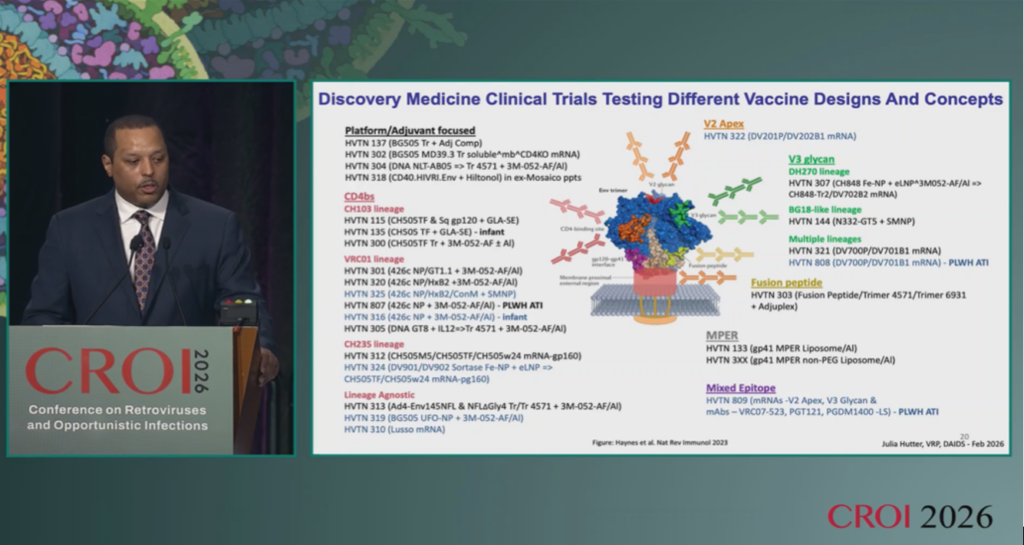
Kevin Saunders of the Duke Human Vaccine Institute delivered a plenary on the HIV vaccine research landscape. He outlined the germline targeting and discovery clinical trials that dominate the field, reminding the audience that developing broadly neutralizing antibodies (bNAbs) is a formidable scientific challenge. But progress is happening, and clinical and animal data shows it is possible to initiate and hone specific protective bNAb responses. He shared progress in developing CD8 T-cell inducing vaccines – there is consensus that a successful vaccine will ultimately need to induce both bNAbs and T-cells. He capped off his talk by describing how AI and machine learning are being used to identify mutations and sequences necessary for the germline targeting approach.
Looking Forward: Heading in the Right Direction
As John Frater noted at the start of CROI 2026, this year’s conference is about the incremental steps that push boundaries and are “building out that evidence that gives confidence and strength to say we are moving in the right direction.” From innovative delivery models to advances in vaccine design, the science presented this week delivered exactly that.
Seeking more CROI coverage? Be sure to check out our friends at Aidsmap.