May 8, 2026
The US administration again blocks key vaccine safety and effectiveness data; a hantavirus incident underscores growing strain and fragmentation in the global health system; and Zambia rejects a “trade for aid” deal tying health assistance to geopolitical and economic interests—with implications for HIV programs and global health cooperation.
Continued Suppression of Vaccine Science
The US Administration continues to block publication of key vaccine safety and effectiveness data. This week, officials at the US Food and Drug Administration (FDA) stopped publication of studies on COVID-19 and shingles vaccines including the analyses of millions of US patient records that found no new major safety concerns associated with COVID-19 vaccines and confirmed the established safety profile of the shingles vaccine. Despite already being accepted by peer-reviewed journals and/or undergoing the standard scientific review, FDA officials reportedly ordered some studies withdrawn and refused to approve conference abstracts for others.
This follows last week’s decision by US Centers for Disease Control and Prevention (CDC) leadership to block publication of a Morbidity and Mortality Weekly Report (MMWR) showing that COVID-19 vaccines reduced hospitalizations and emergency visits by roughly 50% among healthy adults. Despite passing rigorous internal scientific reviews, the report was withheld over “methodological concerns”.
IMPLICATIONS: At a time of reduced vaccine confidence, suppressing findings on safety and effectiveness risks continues to fuel rising vaccine misinformation and hesitancy. And the continued politicization of vaccine science that prevents publication of validated research undermines trust and limits access to evidence that should be used to support vaccination strategies and policy. Taken together, communities that stand to benefit the most from vaccines may delay or forgo receiving vaccinations for themselves and/or their families.
READ:
- FDA Blocked Publication of Research Finding Covid and Shingles Vaccines Were Safe—New York Times
- FDA stopped publication of studies showing COVID, shingles vaccines were safe—The Hill
- Aluminum in vaccines not linked to autism, other health problems, study finds—CIDRAP
Hantavirus Amid a Fragmenting Global Health System
News of hantavirus infections aboard a cruise ship this week comes amid broader concerns about weakening global health security. Reporting on the incident underscores how even localized health threats are unfolding in a fragmented coordination environment, while analysis in The Lancet warns that the role of key institutions like the World Health Organization (WHO) are increasingly contested, citing concerns about transparency, financing, and “institutional drift”. At the same time, broader global health commentary highlights fragmentation, declining funding, and shifting geopolitical priorities as pressures threatening multilateral cooperation. Together, these dynamics are raising urgent questions ahead of the World Health Assembly later this month about whether governments will pursue meaningful reform or continue operating within a system that is increasingly complex, underfunded and politically fragmented.
IMPLICATIONS: Pandemic preparedness and outbreak response require strong surveillance, transparent data sharing, and international coordination, which are core functions of multilateral institutions like the WHO. As confidence in and support for these institutions dissipates and as financing recedes and becomes more conditional, the ability to detect and respond to emerging health risks is limited. Without reforms to strengthen WHO’s core scientific and coordinating role, clarify mandates across institutions and secure more stable and independent financing, the global health system risks becoming less and less effective, leaving countries more vulnerable with more frequent disease outbreaks.
READ:
- Hantavirus Response Shows How Trump Cuts Have Compromised US Preparedness—New York Times
- 3 Dead of Suspected Hantavirus Infections on Cruise Ship, WHO Says—New York Times
- What Is Deadly Hantavirus and How Did It Spread on a Cruise Ship?—Bloomberg
- WHO Worth Fighting For: Authors Make the Case for Ambitious Reform—The Lancet
- No One Wins If Multilateralism for Health Loses—Think Global Health
Trade for Aid: Zambia Rejects Deal with US
Zambian government officials rejected a proposed bilateral Memorandum of Understanding (MoU) with the US offering up to $2 billion over the next five years under certain terms, including access to sensitive health data and to the country’s critical minerals. The deal was rejected due to the “incorporation of terms that the Zambian government considers unacceptable.” Ghana and Zimbabwe are also reported to have rejected bilateral MoUs.
These decisions come alongside the broader shift in US global health policy, with new Global Health Security and Diplomacy (GHSD) implementation guidance outlining an “America First” transactional approach that prioritizes bilateral agreements, co-financing, and alignment with US strategic interests. Scripps News reports on this “trade for aid” theme, raising concerns that access to HIV treatment and prevention could hinge on geopolitical and/or commercial interests.
IMPLICATIONS: The Zambian bilateral MoU experience illustrates the dangers of the country-by-country, transactional model for global health and foreign assistance, which effectively will make it harder to see and measure the true scale of the HIV epidemic in the wake of funding cuts and politicization of health. Referring to the recent PEPFAR data that was released last month, AVAC’s Mitchell Warren notes that “we’re [already] seeing a decrease in people accessing prevention services, and we’re seeing a decrease in those accessing the community-based programs that were really critical because those programs have been taken offline.” This “thinning at the margins” described in HIV programs signals a deeper risk: even as treatment numbers hold, the erosion of prevention and community services could lead to increased infections over time and destabilize the effectiveness of the global HIV response.
READ:
- Zambia blasts the US over a $2 billion health deal in exchange for critical minerals—Associated Press
- As Defunded HIV Programs Thin, Uneven Resilience Emerges—Think Global Health
- Trump’s New Foreign Aid Model Sparks Feud With Zambia—New York Times
- Trump administration ties health aid to trade deals, raising fears over HIV treatment access—Scripps News
- America First Global Health Guidance Launches Fee-for-Service Coup Against CDC—Emily Bass Substack
- Africa looks inward as global health funding dries up—Devex
- Money Matters: Who funds global health — and by how much?—Devex
What We’re Reading
- Targeted termination of scientific grants and minoritised researcher status in a national survey: a cross sectional analysis—The Lancet Regional Health Americas
- NIH grant cuts disproportionately hit minority and female scientists—Nature
- Trump’s war on science takes a disturbing turn—Daily KOS
- Arrest of Fauci’s former aide sparks political persecution concerns—Chemistry Now
- It’s burning down there: How shame is keeping SA girls from looking after their sexual health—Bhekisisa
- Immigration changes are driving foreign researchers to leave the US — or not come to begin with—STAT
- Use of Gilead’s HIV prevention shot rises, but US insurance gaps remain—Reuters
- For Michael Chancley Jr., PrEP advocacy is both a personal and professional matter—Managed Healthcare Executive
- Supreme Court gives abortion pill mifepristone a 1-week reprieve from a major change—NPR
- Pandemic Talks Extended – But Colombia Appeals for New ‘Method’ to Settle Differences—Health Policy Watch
- First AI tool to detect suspicious peer reviews rolled out by academic publisher—Nature
- Where Bullets Fly, Malaria Kills—Forbes
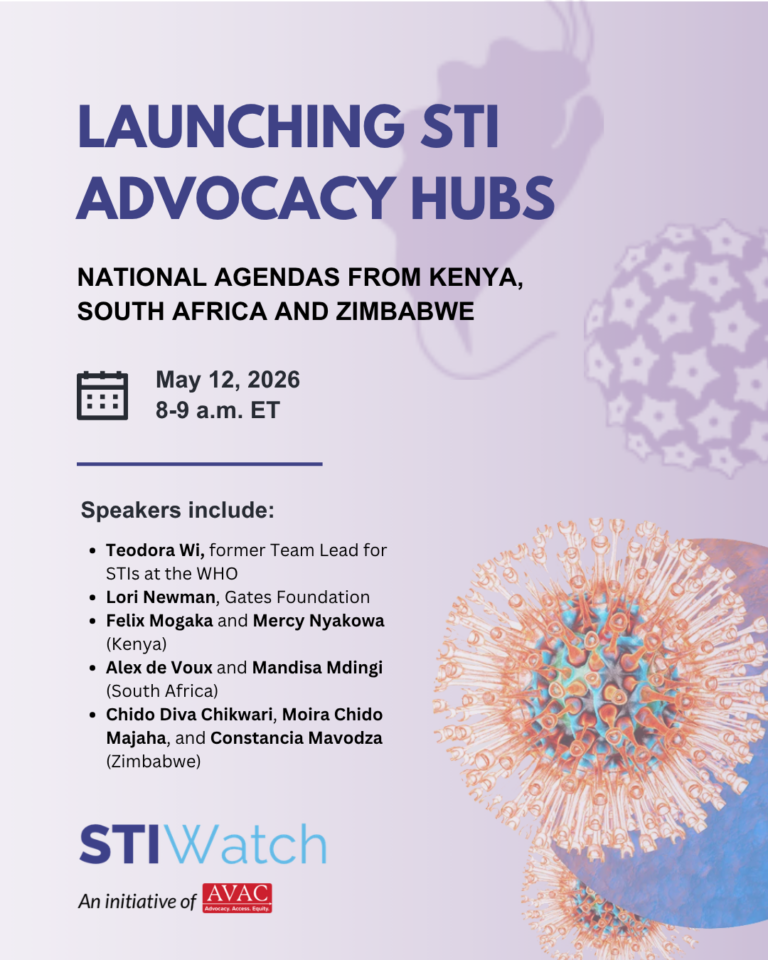
Join AVAC and partners for the launch of STI Advocacy Hubs and the introduction of new country-led advocacy agendas from Kenya, South Africa, and Zimbabwe. This webinar will highlight the key challenges shaping STI prevention, diagnostics, and care in each country, and outline priority actions to strengthen national responses.
Resources
- PEPFAR Country Impact Factsheets (2025)—amfAR
- PxWire Volume 16, Issue 2—AVAC