May 22, 2026
The hantavirus outbreak and now emerging Ebola crisis are exposing major gaps in pandemic preparedness and global health cooperation; the future of the World Health Organization (WHO), multilateralism and the HIV response is being debated at this week’s World Health Assembly (WHA); while the US government continues to deconstruct its public health leadership.
Emerging Ebola Crisis Exposes Major Gaps in Pandemic Preparedness
The growing Bundibugyo ebolavirus outbreak (Ebola) in the Democratic Republic of Congo (DRC) and Uganda is testing global outbreak preparedness and response coordination, which continue to be dismantled and unfunded. Representatives of Uganda’s government said they were unaware of the US Department of State’s announcement that the US government would fund up to 50 Ebola treatment clinics in Uganda, signaling many concerns about coordination, collaboration and communication between governments and international partners. According to the WHO, the outbreak has resulted in more than 500 suspected cases and 130 deaths. Experts believe the virus may have circulated undetected for weeks or months in areas with weak health infrastructure and high population movement. Unlike the previous Ebola strain (Zaire), which circulated during the 2014 outbreak, there are no approved vaccines or therapeutics for the Bundibugyo strain. The global health community is urging stronger surveillance and expedited clinical trials to prevent emerging threats. “We need to urgently roll out appropriate clinical trials with appropriate candidate vaccines,” Prof. Helen Rees, Executive Director of Wits RHI, told colleagues at a closed meeting of vaccine researchers convened by WHO. WHO Director-General Tedros Adhanom Ghebreyesus defended the global response timeline, noting WHO deployed teams, supplies and emergency funding within days and argued the current outbreak demonstrates why countries still need WHO leadership and international health regulations.
IMPLICATIONS: The Ebola outbreak is testing all aspects of an increasingly fractured global health infrastructure. The Global Preparedness Monitoring Board warns the world is “moving backwards” on pandemic preparedness, with more frequent and severe outbreaks unfolding amid weakened surveillance systems, increasing funding cuts, decreasing trust in multilateralism and growing geopolitical tensions. Former US health officials are raising concerns that reductions in US global health engagement, including the dismantling of USAID, cuts to outbreak-response infrastructure and withdrawal from WHO, may already be undermining international coordination and delaying detection and response efforts. As Nicholas Enrich, former global health lead at USAID and author of Into the Wood Chipper, shared on AVAC’s webinar Wednesday: “What we’ve lost is the experience and systems and expertise that gave us the element of speed, and there’s nothing more important in an outbreak like this than the speed and conviction to respond…people will continue to die when they wouldn’t necessarily have to if we were able to use the tried and true system that USAID had in place.”
The current situation also illustrates the consequences of divestment in vaccines and in scientific research and development for pathogens likely to affect certain geographies and/or populations until outbreaks emerge. WHO’s insistence that response timelines have been appropriate reflects broader tensions over what constitutes a sufficiently rapid response in an era when weakened systems, misinformation, conflict and population displacement make containment increasingly difficult. Experts seem to agree that both the Ebola and hantavirus outbreaks show that pandemic preparedness cannot be about responding to a crisis once it begins, it must be about sustaining the scientific infrastructure, coordination mechanisms and financing needed before they occur as lives are on the line. Additionally, the presence of emerging global health threats further constrains programs and public health systems that are contending with elevated HIV, tuberculosis and other infectious diseases – which may need to divert resources and capacity to manage.
- Uganda Says It’s Not Aware of Ebola Clinics Promised by US—New York Times
- Disease outbreaks such as Ebola and hantavirus are more frequent and deadly as world “moves backwards,” report warns—BMJ
- Ebola responders say aid cuts by Western nations left them ill-equipped for outbreak—Washington Post
- Vaccine experts debate options to combat outbreak of unusual Ebola strain—Science
- This Ebola Outbreak Will Be Hard to Contain—The Atlantic
- After a critique from Rubio, WHO defends work on Ebola response—STAT
- Ebola Outbreak Rages After Trump Gutted Global Health Safeguards—The Intercept
- Head of WHO Defends its Response to Ebola Outreach—New York Times
- Infectious diseases such as hantavirus and Ebola becoming more frequent and damaging, say experts—The Guardian
- First hantavirus, now Ebola: What two outbreaks reveal about global preparedness—STAT
- ‘We’re not ready’: US lags on pandemic preparedness after Covid, experts say—The Guardian
- With no approved vaccine for Ebola outbreak, experts weigh testing a long shot—STAT
- Race begins to trial Ebola drugs amid current outbreak—Nature
- Trump Decimated Our Global Health Network. Then Ebola Hit—The Bulwark
World Health Assembly Debates Future of WHO and Global HIV Response
The World Health Assembly (WHA) opened in Geneva this week against the backdrop of the hantavirus and Ebola crises and amid uncertainty over the future of global health governance, financing and multilateral cooperation. The world is facing “difficult, dangerous and divisive times” WHO DG Tedros warned in his opening remarks. Much of the discussion focused on reforming the “global health architecture” as WHO confronts major funding shortfalls following the US withdrawal and reductions in foreign assistance. Leaders called for stronger multilateralism, more equitable representation for countries in the Global South and reforms that would build a more responsive and resilient system. HIV is also high on the agenda, with discussions focusing on preparations for the 2026 UN High-Level Meeting on HIV/AIDS and how to sustain progress toward ending AIDS by 2030. UNAIDS and other leaders are emphasizing sustainable financing, country ownership, HIV prevention, community leadership and equitable rollout of long-acting prevention tools like lenacapavir as countries navigate major shifts in global health financing and governance.
IMPLICATIONS: As the future of the global health architecture is being debated and reshaped, the world is simultaneously confronting emerging infectious threats, rising nationalism and shrinking global health aid. Uncertainty around how and when this new architecture will take shape risks abrupt transitions that could further destabilize HIV and broader health programs. In addition, ongoing tensions around pandemic preparedness, pathogen-sharing agreements and WHO reform underscore how difficult rebuilding consensus and coordination may be in a fragmented geopolitical environment. The future of global health and the HIV response will depend not only on access to scientific innovations, but on the political will of countries to invest in multilateral institutions, financing and collective action.
- Tedros: ‘We Live in Difficult, Dangerous and Divisive Times’—Health Policy Watch
- Communities and parters provide solutions to the United Nations to sustain the gains in the HIV response—UNAIDS
- [Watch] UNAIDS: Delivering equitable, people-centered, and stigma-free HIV services across the continuum—APHA
- [Watch] The HIV Endgame: Can the World Deliver on Lenacapavir?—Devex
Leadership Turmoil Continues at NIAID as RFK Jr. Reshapes US Health Advisory Body
Health leadership inside the US government continues to decline. Jeffery Taubenberger reportedly stepped down as acting director of the NIH’s National Institute of Allergy and Infectious Diseases (NIAID), and at a time when the world faces another Ebola outbreak. Taubenberger’s departure, if confirmed, would follow the removal or reassignment of several senior NIH officials and leave the institute without permanent leadership. Health and Human Services (HHS) Secretary, Robert F. Kennedy Jr. (RFK Jr.) also fired the chair and vice chair of the US Preventive Services Task Force (USPSTF), a panel of experts responsible for recommending which preventive services health insurance providers must cover under the US Affordable Care Act.
IMPLICATIONS: There is growing concern about the broader effort to politicize or restructure the USPSTF in ways similar to RFK Jr.’s attempted overhaul of the CDC’s Advisory Committee on Immunization Practices (ACIP), where replacement members later advanced major changes to federal vaccine recommendations. These new developments are further testament to the dismantling of long-standing scientific leadership and advisory infrastructure across US public health agencies. The uncertainty surrounding NIAID leadership is especially significant given the institute’s central role in infectious disease research, HIV science, outbreak preparedness and pandemic preparedness and response.
- Acting head of NIH’s infectious disease institute reported to have stepped down—STAT
- Exclusive: NIH ousts infectious-disease leaders as COVID scientists face US charges—Nature
- RFK Jr. fires leaders of group that determines what insurers must cover—Politico
- Kennedy Fires Leaders of Key Health Task Force—New York Times
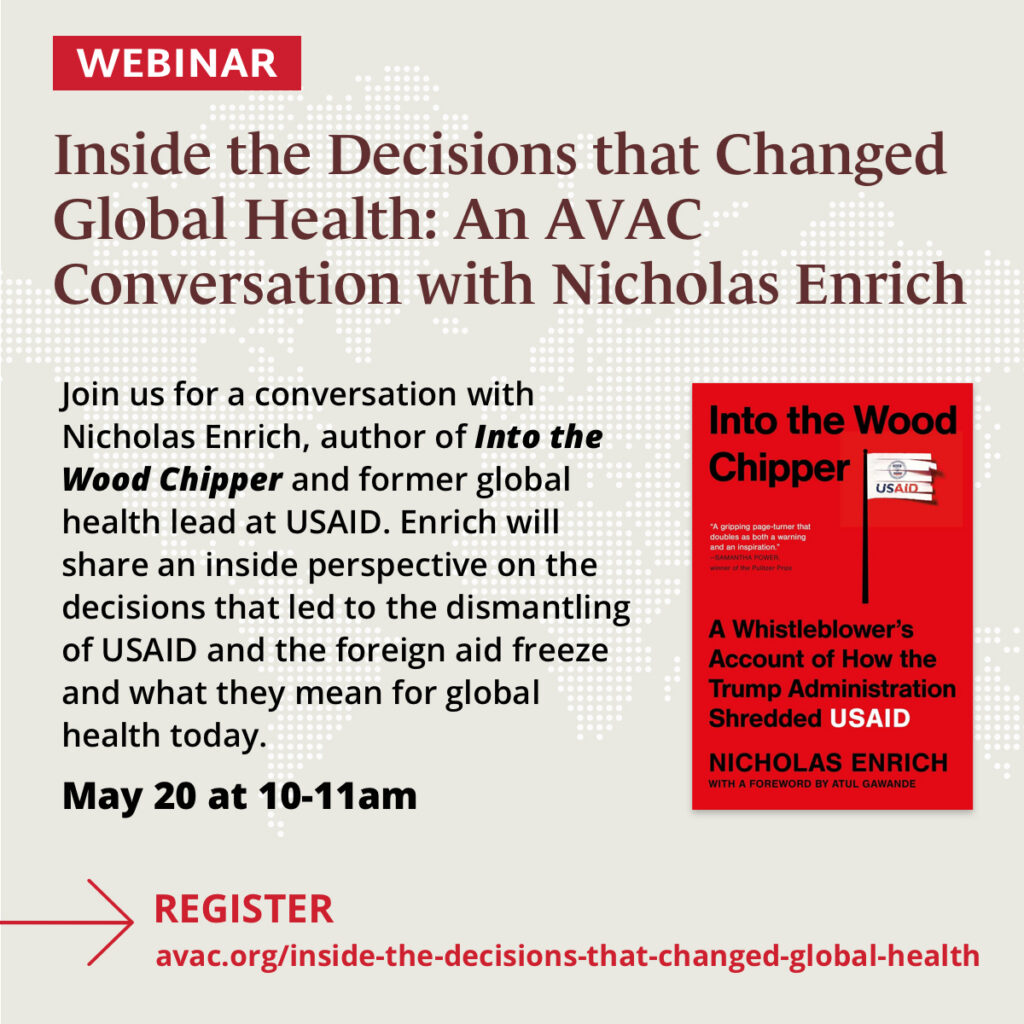
AVAC hosted a timely conversation with Nicholas Enrich, Into the Wood Chipper and former global health lead at USAID, and Rosemary Mburu of WACI Health on the dismantling of USAID, the foreign aid freeze and their reaching impacts on global health systems, HIV prevention and communities around the world.
What We’re Reading
- The HIV prevention jab scientists hoped for is finally here. Now comes the hard part—Bhekisisa
- An HIV-free generation is closer than you think—Vox
- Treatment Action Group Demands End to Political Meddling in NIH Grants—TAG
- African Leadership Drives HIV Prevention Access—AVAC
- How BillionScale Health plans to scale breakthrough technologies—Devex
- Democrats demand answers on USAID closeout process—Devex
- New US humanitarian funds shielded from expanded Mexico City Policy—Devex
- What the End of Aid Looks Like—
- NIH behind in filling top roles, with 15 of 27 institutes led by acting directors—STAT
- FDA’s Analysis of Child Deaths After COVID Shot Released by Senator—MedPage Today
- Dark times ahead at the FDA—STAT
- Senator Bill Cassidy Is Out. He’s Taking the Science With Him.—MedPage Today
- How Low Can America Go?—MedPage Today
- Imagining otherwise for better health: a Lancet Commission on activism and health—The Lancet