May 29, 2026
A commentary by eight former US Centers for Disease Control and Prevention (CDC) directors urges the US Department of State to reform PEPFAR, not dismantle it; the growing Ebola outbreak in Central Africa and ongoing hantavirus concerns underscore the risks abrupt changes pose to global health security; and a proposed new US federal grant regulation could significantly expand political influence over scientific funding decisions and research priorities as additional barriers to scientific collaboration and transparency emerge.
Former CDC Directors Warn of Risks to Global HIV and Outbreak Response
Eight former CDC directors warned in a STAT opinion piece that the US Department of State’s proposed restructuring of the nearly 23-year CDC-PEPFAR relationship could dismantle key elements of the US’ overseas global health security infrastructure. Many laboratory systems, surveillance networks, trained health workers, and community engagement capacity being used in the current Ebola response were built through decades of HIV and PEPFAR investment. As PEPFAR faces restructuring, the authors warn that HIV services and outbreak preparedness and response capacity could erode simultaneously. They further argue that requiring countries to purchase CDC technical assistance services through new bilateral agreements risks weakening the CDC’s international presence, including surveillance and response systems, and could undermine long-standing relationships of trust with ministries of health that support HIV programs, pandemic preparedness and outbreak response. In response, as reported by Politico, the Department of State disputed claims that PEPFAR or CDC’s overseas operations are being dismantled, arguing that countries could continue purchasing CDC services under the new model and that CDC funding “could very well increase.” The Department also emphasized CDC’s ongoing role in responding to Ebola and hantavirus outbreaks.
IMPLICATIONS: The former directors’ warning echoes growing concern across the public health community that the rapid restructuring of PEPFAR could destabilize HIV programs, complicate the transition to country ownership, and fracture global disease surveillance and outbreak-response systems built through decades of US investment, just as the Ebola outbreak in Central Africa and hantavirus cases underscore the importance of coordinated international health security systems. While there is broad stakeholder agreement about the importance of increasing country ownership and transitioning away from donor dependence, the accelerated pace and structure of the proposed changes could destroy technical expertise and relationships before sustainable alternatives are in place.
READ:
Ebola Response Strained by Aid Cuts
News outlets this week are reporting on how cuts to USAID, and disengagement of the US in the global health ecosystem, may have already delayed and impaired surveillance and response efforts in the Democratic Republic of Congo and Uganda to the rising Ebola crisis. These reports come as the US Administration announced plans to establish a quarantine and treatment facility in Kenya for US citizens exposed to Ebola, rather than transporting them to the US as in past outbreaks. This reflects a major shift away from policies to repatriate US citizens exposed to Ebola overseas to secure, contained, treatment facilities within US borders that were implemented during the 2014-2015 Ebola epidemic in West Africa. Meanwhile, scientists are racing to identify treatment and prevention countermeasures to the Bundibugyo strain, which has no approved vaccines or therapeutics.
IMPLICATIONS: The emergence of the Ebola crisis compounds the growing disruptions seen over the past year, including the effects of funding cuts, reduced multilateral cooperation, strained surveillance systems and rising nationalism. These developments are placing global health security and international cooperation on emerging infectious disease threats in a more precarious position than at any point in the past decade. Ravaging USAID, CDC and WHO-linked infrastructure risks undermining the speed, trust and coordination needed, government-to-government, to prevent and contain outbreaks early. Public health officials warn of the ethical and operational challenges with the modified quarantine and treatment policies noting it could discourage health workers from volunteering in outbreak zones, and further strain international capacity and coordination.
- The Ebola and Hantavirus Outbreaks Offer an Ominous Warning—TIME
- The Ebola species rapidly spreading has no vaccines. Here are the options—Devex
- Should we care about faraway outbreaks of infectious disease?—Globe and Mail
- Why the Ebola and Hantavirus Outbreaks Have Confounded Scientists—New York Times
- Mandates or Markets? Geopolitical Rift Impairs Pandemic Preparedness as Crisis Funds Hit ‘Dangerous Lows’—Health Policy Watch
- This is what happens when you defund Ebola prevention—Vox
- DRC is no stranger to Ebola outbreaks. Why isn’t there a vaccine or treatment to help now?—CNN
- How funding cuts to USAID are impacting the Ebola outbreak in DR Congo—NPR
- Ebola response hobbled by US withdrawal from global health—The Hill
- These Researchers Would Be in Africa Fighting Ebola—but Trump Cut Their Funding—Wired
- Africa CDC Chief Condemns Ebola Travel Restrictions And Broken Aid Promises—Health Policy Watch
Growing Barriers to Scientific Collaborations and Transparency
New policy developments this week threaten open, international and collaborative science that has defined global health research. Science reports that some NIH institutes are requiring advance permission for inclusion of co-authors affiliated with foreign research institutions—no official policy has been communicated. Meanwhile, new proposed legislation introduced in the US Senate, Securing Innovation and Research from Adversaries Act, would prohibit research collaborations between US and Chinese scientists at federally funded institutions. At the same time, the US Administration is proposing expansive nondisclosure agreements (NDAs) for all federal workers that could further limit communication and information sharing across government agencies. Adding to concerns, a proposed new Office of Management and Budget (OMB) regulation that applies to all federal grants would require review by senior political appointees and explicitly states that “peer review remains advisory and does not replace agency discretion,” raising fears about growing political influence over scientific funding decisions and research priorities.
IMPLICATIONS: HIV research, outbreak response, pandemic preparedness and scientific discovery have historically depended on international collaborations and networks of scientists, shared datasets, multinational trials, robust peer review and open scientific exchange. These policy developments speak to the current trajectory of an increasingly securitized and nationalistic approach to science and research. Restrictions on collaboration, increased political oversight of and interference in grantmaking, and limits on scientific communication could weaken trust and reshape how science is conducted. These policies continue an overall trend by the current administration to politicize science and defund critical research based on ideology.
- White House to Tighten Grip on $1 Trillion in Federal Grants—Bloomberg
- Trump administration proposes NDAs for all federal workers—Washington Post
- US researchers face new restrictions on publishing with foreign collaborators—Science
- Lawmakers propose banning all US-Chinese research collaborations—Science
- US agencies aren’t ready for the rising cost of making research papers free, report warns—Science
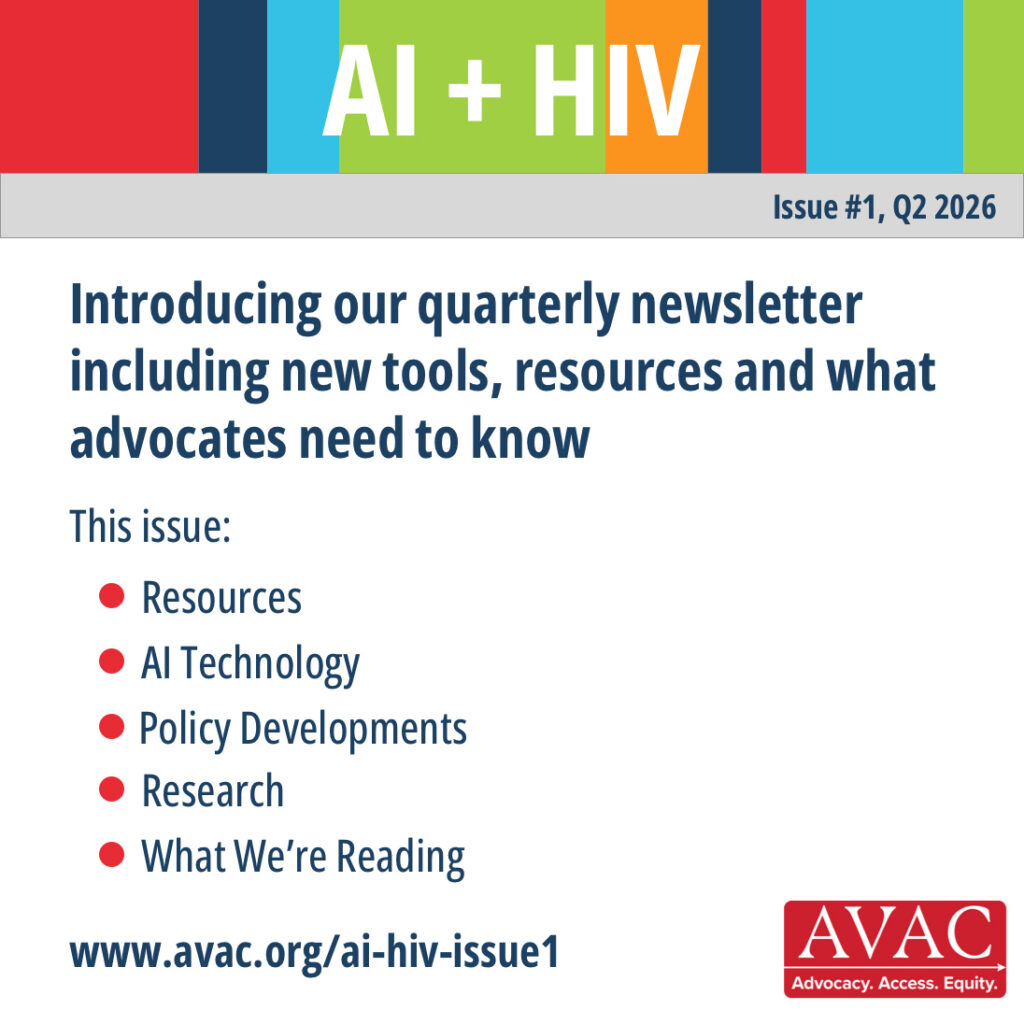
Introducing AVAC’s Quarterly AI + HIV Newsletter
This new resource will provide advocates and the global community with the information and resources to engage with AI in ways that strengthen equity, protect individuals and communities and ensure that technological innovation advances the HIV response rather than undermines it.
What We’re Reading
- Exclusive: State Department Shifts All US-Funded Health Commodity Procurement to Global Fund’s Wambo Platform—Emily Bass Substack
- The US cut billions in health aid for Africa. We went there to see the impact.—WUSA9
- MIT president: Why so many optimistic scientists are losing heart—STAT
- US voters support HIV/Aids relief – will Trump’s cuts backfire in the midterms?—The Guardian
- WHO Executive Board Adopts Process for Election of Next Director General, With Powerful Role for Poor African States—Health Policy Watch
- EXCLUSIVE: World Health Assembly Declines to Recognize Argentina’s Withdrawal From WHO—Health Policy Watch
- Hantavirus Outbreak Revives COVID-Era False Health Claims—KFF
- It’s the end of science as we know it, and I feel fine—STAT
- The peer coaching program getting men back on HIV/AIDS treatment in South Africa—Gates Foundation