January 23, 2026
This week marks 365 days of disruption and chaos across global health, with many organizations and journalists reflecting on one year after the foreign aid freeze and what the future of global health looks like. This week also saw the US Congress beginning to reassert its role on health funding, ongoing US disengagement from WHO, and new reporting on the hepatitis B vaccine trial in Guinea-Bissau.
We are also watching closely for news of an expanded Global Gag Rule, that is reportedly coming out later today, just as this issue goes to press. It is anticipated that this new gag will include a dramatic expansion beyond abortion and now underscore the US administration’s war on gender, diversity, equity and inclusion. We’ll cover this in next week’s Global Health Watch; the struggle, most definitely, continues.
365 Days of Chaos and Disruption, What Comes Next for Global Health
This week marks one year since the US Presidential administration issued a deeply cruel executive order freezing foreign assistance, halting billions of dollars in already-approved funding under the bad-faith claim of a “90-day review”. What followed was not a brief pause, but a drawn-out, chaotic disruption that stopped life-saving work across the globe, shutting down valuable organizations, and harming lives, health, and livelihoods. And that was just the beginning of a year of chaos. Many organizations and media coverage noted a growing recognition that the past year’s disruptions to global health were not just destructive, but catalytic, forcing a reckoning with how systems are built and for whom. Reporting from Bhekisisa reflected on how the sudden halt in US HIV funding exposed deep vulnerabilities in over-reliance on external aid, while also accelerating conversations about domestic financing, integration, and sustainability in the HIV response moving into 2026. At the same time, analyses from Health Policy Watch, Science, Nature, and The Lancet laid bare the human and scientific costs of abrupt policy shifts, shuttered programs, fractured research networks, and lost trust, while underscoring that simply restoring old funding streams will not be enough to meet future challenges.
IMPLICATIONS: Together, these stories and analyses point to the need to rethink and rebuild with stronger country ownership, diversified and predictable financing, resilient research institutions, and governance structures that prioritize equity, accountability, and community leadership. Rather than recreating the same architecture, reimagined global health systems must be less dependent on external donors and political ideology. As Global Health Watch has tracked for 52 weeks, the path forward is not about returning to the pre-foreign aid freeze status quo, but about using this period of disruption to construct a more durable, equitable, and responsive global health architecture. As Canadian Prime Minister, Mark Carney, said so clearly at this week’s World Economic Forum in Davos, Switzerland, “Nostalgia is not a strategy.”
READ:
- Fighting for billions: The legal battle to keep US foreign aid alive—Devex
- [PODCAST] One year after Trump: The day HIV funding changed forever — and what came next—Bhekisisa
- US science after a year of Trump—Nature
- One Year Later: The Effect of US ‘Chainsaw’ on Global Health—Health Policy Watch
- Four paradigm shifts to shape an agenda for global health reforms—The Lancet
- Damage assessment: Which of Donald Trump’s changes are likely to last—and which will fade?—Science
Congress Steps Up In Defending Domestic and Global Health
The US Congress is beginning to reassert its constitutional role in shaping federal spending. The joint House and Senate FY26 funding bill released last week covering foreign operations would maintain funding for core global health priorities, including HIV, tuberculosis, malaria, polio, family planning and reproductive health, neglected tropical diseases, Gavi, and UN agencies such as UNAIDS, UNICEF, and UNFPA. This week, legislators rejected nearly $2 billion in proposed cuts to US domestic HIV and related programs through the Labor, Health and Human Services Education and Related Appropriations Act (LHHS), a “major victory” credited to sustained advocacy by people living with HIV, advocates, and service providers. The proposed bill largely preserves funding for domestic public health and biomedical research. As AVAC’s Suraj Madoori said in a statement, “These crucial wins for global and domestic HIV now require us to not hold back, and urge Congress to swiftly approve all the FY26 bills, push the President to sign them, and for us to ensure accountability in the administration to spend and implement this lifesaving funding as instructed by the people and those who represent us in Washington D.C.”
IMPLICATIONS: Together, these bills signal a return to a bipartisan appropriations process and, if enacted, provide a basis to push back against unilateral cuts by the administration. They also signal bipartisan pushback against attempts to cut health and scientific research investments. By rejecting the steep cuts proposed by the administration, they stabilize lifesaving programs and protect the research enterprise. The House passed the bills on Thursday, and the focus now shifts to the Senate, which must pass the bills by January 30. Then onto the President to sign, and, most critically, for the administration to actually spend all Congressionally appropriated funds.
READ:
- MAJOR VICTORY: Bipartisan FY26 Bills Reject Nearly $2B in Proposed HIV Funding Cuts—Save HIV Funding
- Beyond the Numbers: Three Policy Shifts in the FY26 Funding Bill Quietly Reshaping U.S. Global Health—Lights, Camera, Equity Substack
- Limit on multiyear funding of NIH grants is a sticking point in Senate budget talks—STAT
US Disengagement and the Future of WHO
This week also marks one year since the US announced its intended departure from World Health Organization (WHO). Debate over its future and the US’ role within it intensified as pressure from parts of the administration collided with growing concern over the consequences of disengagement. US officials and policymakers aligned with the “America First” strategy call for WHO to be fundamentally reformed or replaced. Analysts note that the US remains a formal member of WHO until debts are paid. Meanwhile, the US administration continues to withhold funding and delay payments, leaving millions of dollars in unpaid US obligations.
IMPLICATIONS: The current state, where the US remains technically engaged but substantively absent, poses serious risks for global health governance, disease surveillance and pandemic preparedness. As analyses from CSIS underscores, WHO reform is both necessary and possible, but meaningful reform requires constructive engagement, predictable financing, and political leadership, not abandonment.
READ:
- MAGA-backed researchers call for WHO to be ‘reformed or replaced’ on eve of US withdrawal—The Telegraph
- As U.S. prepares to exit WHO, it is stiffing the agency on a large bill—STAT
- The Future of the WHO—and How the United States Can Shape It—CSIS
- A US return to the World Health Organization could hinge on whether Trump approves of its next leader—Politico
Hepatitis B Vaccine Trial in Guinea-Bissau Undermines African Authority
Reporting this week is exposing a pattern of US actions that show deep disregard for African public health leadership, ethical research standards, and sovereignty. The US-funded hepatitis B vaccine trial in Guinea-Bissau is at the center of this. As we reported in previous weeks, the unethical trial would delay birth-dose vaccination for thousands of newborns despite overwhelming evidence, and WHO guidance, that immediate vaccination saves lives. According to Rolling Stone, the study was championed by US officials aligned with anti-vaccine ideology and advanced even as Africa CDC officials raised alarm and indicated the trial should be halted. At the same time, the US administration has been marginalizing Africa CDC more broadly, cutting engagement, undermining its authority, and sidelining African institutions in favor of unilateral decision-making. This is being reinforced, as The Guardian reports, by members of the US administration urging US diplomats to emphasize American “generosity” to African leaders even as USAID programs are shuttered and health funding withdrawn.
IMPLICATIONS: Together, these developments signal a dangerous erosion of respect for African expertise, autonomy, and ethical authority in global health. Pushing forward research designs that would withhold proven interventions—while dismissing objections from Africa CDC and African scientists—revives patterns of extractive and unethical research long condemned by the global health community. Undermining Africa CDC while advancing ethically dubious trials weakens trust, damages partnerships, and threatens progress against hepatitis B, HIV, and other diseases where Africa has led with scientific excellence.
READ:
- Trump administration to block aid from subsizing DEI and trans rights overseas—The Guardian
- Trump’s HHS Trashes Top African Health Organization as “Fake” and “Powerless”—Futurism
- Head of US Africa bureau urges staff to highlight US ‘generosity’ despite aid cuts—The Guardian
- HHS Gave a $1.6 Million Grant to a Controversial Vaccine Study. These Emails Show How That Happened—Rolling Stone
- Lipstick on a Pig: Why the Amended Hepatitis B Birth-Dose Trial in Guinea Bissau Remains Ethically Indefensible—BK’s Substack
- ‘Suspended or Cancelled’: Guinea-Bissau Health Minister Halts Controversial Hepatitis B Trial—Health Policy Watch
Read AVAC’s ‘One Year Later’ series
This five-part series reflects on the tumultuous events of the past 365 days across five global health issues: the erosion of US foreign aid; dismantling of the research enterprise; attacks on vaccine policy; and shifts in the global health architecture.
What We’re Reading
- US cuts to HIV programs in sub-Saharan Africa pose global risk, experts say—CIDRAP
- Trump dismantled USAID. Now these aid workers are running for office—Devex
- EU Parliament Backs Critical Medicines Act, Sparking Supply Concerns In Africa—Health Policy Watch
- A big announcement on AI in Africa—Bill Gates
- Multilateral paralysis is harming global health. Gavi’s ‘minilateralism’ can get us back on track—World Economic Forum
- Trump one year on: How six US researchers plan to protect science amid chaos and cuts—Nature
- Talking back: An unprecedented assault has forced the U.S. scientific community to rethink its advocacy tactics—Science
- The little-known vaccine panel that could have big consequences—STAT
- The near death – and last-minute reprieve — of a trial for an HIV vaccine—NPR
- When Trump Took a Whack at the C.D.C., Atlanta Lost Something, Too—New York Times
- What Does America’s Government to Government Collaboration for Health Look Like?—Emily Bass Substack
- Is the $364 million US-Lesotho Health MoU unconstitutional?—Newsday
- Africa pushes back on US health deals over data, power—SciDevNet
- Judge Orders Trump Administration To Restore $12M to American Academy of Pediatrics—The Hill
- Most Vaccine Hesitancy Can Be Successfully Overcome, New Lancet Study Finds—Health Policy Watch
- Pazdur warns that politics, ‘chaos’ are damaging FDA—STAT
- Gates Foundation unveils $9 billion budget and plans to cut staff—Associated Press
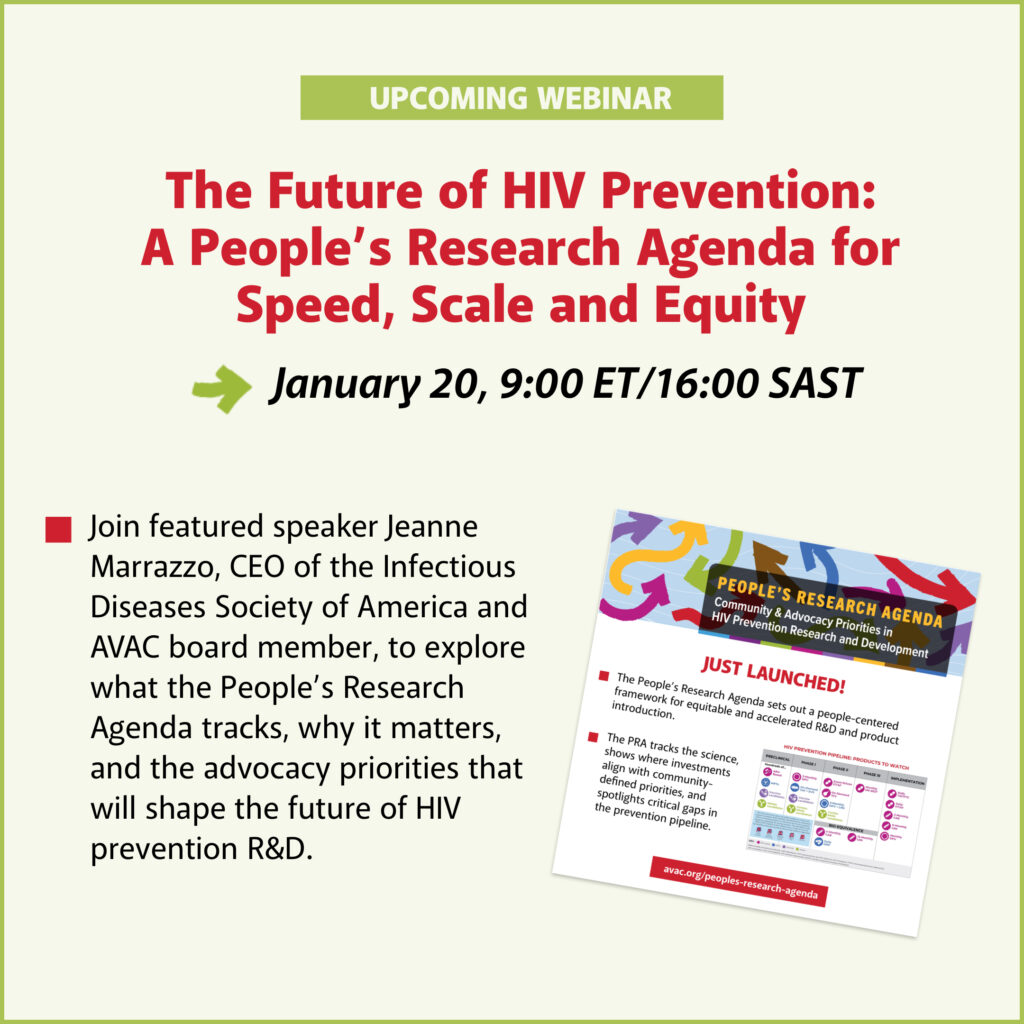
As new IDSA CEO, Jeanne Marrazzo warned in a webinar this week, rising HIV infections threaten progress, but “this is not a time to despair. It’s a time to fight.” Watch the recording and explore the 2025 People’s Research Agenda, which tracks the science, flags gaps, and centers community priorities to keep HIV prevention moving forward.