No Prevention, No End – AVAC launches new report and call to action

Today AVAC released No Prevention, No End, our 2018 annual report on the state of the field. Starting from the title—which humbly borrows the cadence of the call for an end to state-sanctioned violence against Black Americans, “No Justice, No Peace”—through to the closing words, “This is the worst possible moment for slowing down,” the Report is a call to action and guide for addressing the HIV prevention crisis that threatens progress in curtailing epidemics worldwide.

Click here to download the Report and individual sections and graphics; click here for a new episode of the Px Pulse podcast which covers the Report’s key themes and features lead author Emily Bass, AVAC’s Director of Strategy and Content.

UNAIDS named the prevention crisis in its July 2018 report, Miles to Go. It acknowledged that the scale-up of antiretroviral treatment, while essential, is insufficient as a prevention strategy. AVAC has been warning of an imbalance in approaches and investments across approaches, and calling for ambitious targets matched with political will, financing, timelines and more since the UNAIDS targets were first launched in 2014. (Check out AVAC Report 2014/5: Prevention on the Line for a summary of this critique of targets.)

In this year’s Report, we call out three core problems with primary prevention and the global HIV response, identifying the risks they bring and the path to a solution. Specifically, we focus on:

  • Investing in demand creation: The private-sector gloss on this term cannot obscure its essential role in making primary prevention work. Strategies that might save lives are condemned as unwanted or unfeasible when they’re delivered in programs that lack integrated demand-side thinking, which is a science and not a set of slogans.
  • Making informed choice central to HIV prevention: Programs that offer more than one option, along with a supportive environment for a provider and client to discuss risks, benefits and personal preferences aren’t a luxury but a necessity. The family planning field has metrics to measure choice; HIV should pick these up, with prevention programs leading the way.
  • Unstinting radical action: Progress in the global AIDS response is tenuous; so is the state of democratic institutions and the future of the planet. These interconnected issues require more bold action, including from countries that are aid beneficiaries, and from the citizens of those countries who unite to hold truth to power. In the HIV prevention context, this means accountability for primary prevention at every level, including research for next-generation options.

AVAC is launching this Report as many stakeholders in HIV prevention research gather in Madrid for the HIV Research for Prevention (R4P) conference. Visit our special R4P page to find us on-site and follow along from afar, to see how the themes of this year’s Report resonate in a global and wide-ranging discussion of HIV prevention research and implementation at a critical time.

HIV Vaccine Awareness Day 2018: Tools & more

HIV Vaccine Awareness Day, May 18, commemorates the vital and ongoing work to develop a vaccine against HIV. This work advances because of the ingenuity, courage and commitment of trial participants, host communities, funders, scientists and advocates. AVAC salutes the collective trust and sustained dedication to end the epidemic.

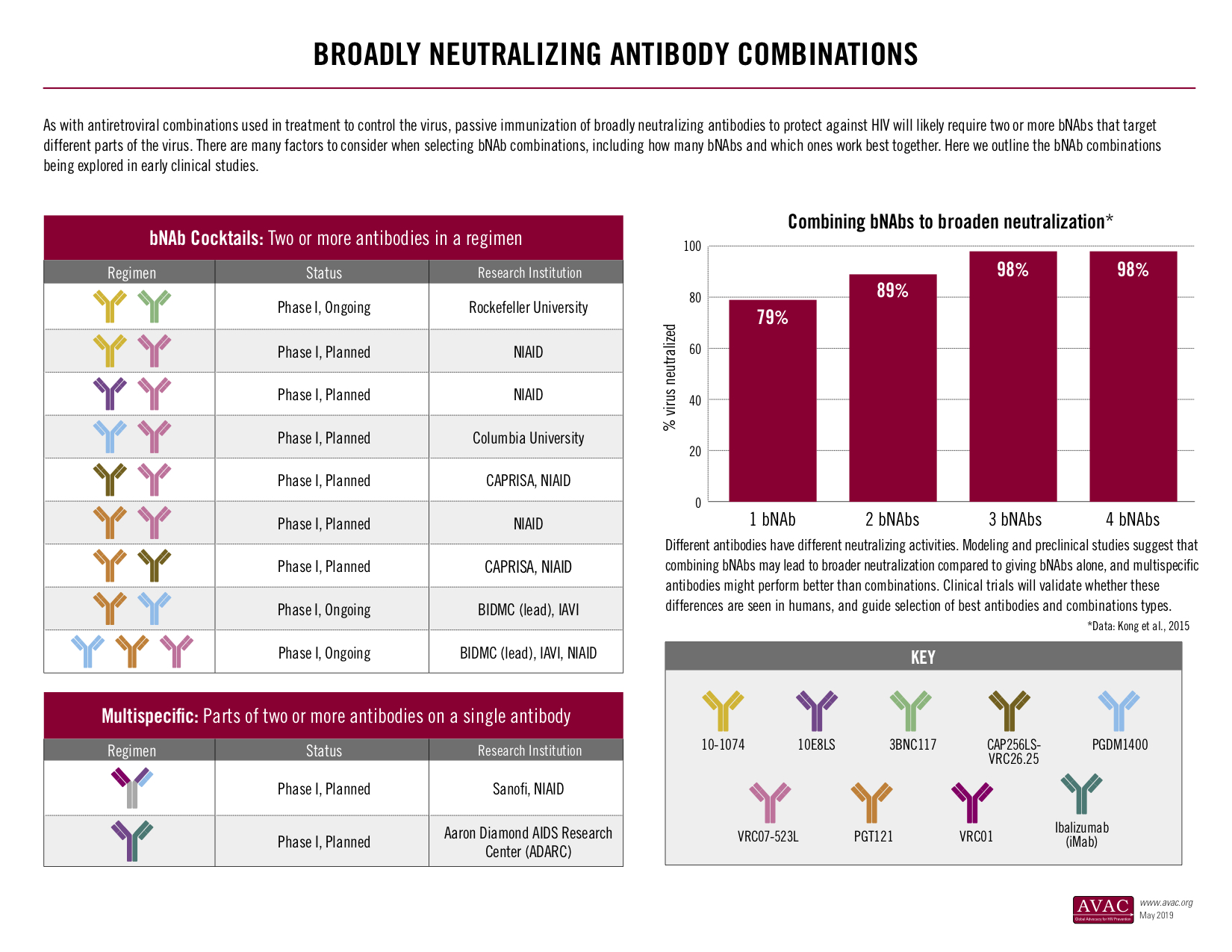
2018 is marked by great advances in research and important opportunities for advocacy. In addition to a host of tools AVAC updates annually to keep you current on this front, The Rise of Broadly Neutralizing Antibodies by AVAC founder and former Global HIV Vaccine Enterprise executive director Bill Snow offers a comprehensive look at antibody mediated prevention and its connection to vaccine research.

In case you missed it, check out the recording and slides from the May 17 webinar featuring Dr. Sandhya Vasan’s discussion on the legacy of RV144 and vaccine advocate Mark Hubbard’s take on today’s agenda for HIV vaccine advocacy.

The complete set of AVAC’s HVAD resources includes:

And add to the conversation on social media at #HIVvaccineAware and #HVAD2018.

The Rise of Broadly Neutralizing Antibodies

Bill Snow founded AVAC and is the former Global HIV Vaccine Enterprise Executive Director.

Research on broadly neutralizing antibodies (bNAbs) is taking the field of HIV prevention science in new directions, with implications for new prevention interventions and vaccine development. There’s much to know and much to learn about these powerful instruments of the immune system.

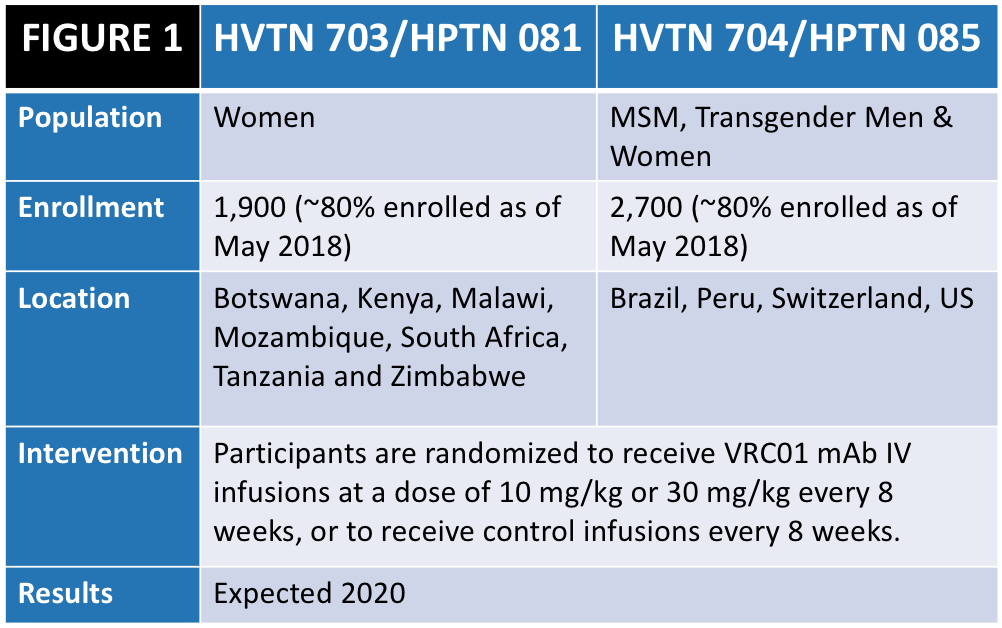
Since 2016, more than 2,700 men in Brazil, Peru, Switzerland and the US, and 1,900 women in Southern Africa have begun to enroll in clinical trials looking at antibody-mediated prevention, or AMP (see Figure 1). A collaboration between the HIV Prevention Trials Network (HPTN) and HIV Vaccine Trials Network (HVTN) (both funded by the National Institutes of Health), the AMP studies test the safety and efficacy of the broadly neutralizing antibody (bNAb) VRC01 when it is given every 8 weeks to reduce the risk of HIV infection. But how did this approach come about, why is it important and what may happen next with bNAbs for HIV prevention?


Click to enlarge.

What’s an antibody?

Antibodies are Y-shaped proteins produced by B cells to clear infected cells and pathogens in the bloodstream. B cells are part of what is known as the adaptive immune system, which mounts defenses aimed at specific invaders—like a cold virus or chicken pox or HIV. The innate immune system also defends against invaders, but its defenses are not so finely tailored to a specific pathogen. When a virus encounters the right B cell, the B cell begins cloning itself and produces antibodies designed to battle that virus. These antibodies circulate throughout the body looking for the virus, and they evolve continuously, becoming ever more precise and numerous.

The Antibody Hierarchy

Here are some terms that will help you follow this ongoing story:

  • Antibody: Proteins produced by B cells as a major part of the adaptive human immune defense against specific invaders.
  • Binding antibody: An antibody that attaches to a virus but doesn’t necessarily render it ineffective; can be driven by the innate immune system.
  • Monoclonal antibody: A bioengineered antibody made in a manufacturing facility by copying (cloning) one original antibody—selected for its potency and other characteristics.
  • Neutralizing antibody: Antibody that disables virus.
  • Broadly neutralizing antibody: An antibody that neutralizes many different genetic variants of HIV.
  • Passive antibodies: A dose of monoclonal antibodies that are infused or injected, rather than made by one’s own immune system.

Vaccines Efficacy Trials: A surge of activity

A picture of the status of vaccine trials since 2003: The four trials shown here represent an unprecedented number of late phase trials underway in vaccines research.

Prevention Research & Oral PrEP Rollout: The evolving context for HIV prevention research

Many of the current or planned prevention trials are taking place in countries where daily oral PrEP is available or will be soon. This infographic shows the status PrEP and the location of scheduled trials by country.

Vaccine and Antibody Trial Participant Recruitment, 2018

A global snapshot of total numbers of participants in trials by country.

US HIV Research: A family tree

This graphics shows a family tree representing HIV research in the United States. It appears in AVAC Report 2017: Mixed messages and how to untangle them.

Timeline for DAIDS HIV Trials Network Recompetition

This graphic looks ahead from 2017 through 2027 at the DAIDS HIV Trials Network Recompetition process. It appears in AVAC Report 2017: Mixed messages and how to untangle them.

Evolving Context for HIV Prevention Research (Map)

A global map showing selected HIV prevention research and oral PrEP status.

Advocacy in Uncertain Times: A call to action

It’s almost here! HIV Vaccine Awareness Day (HVAD) is upon us. This Thursday will mark the day’s 20th anniversary and cap off AVAC’s month-long “vaccine immersion”. On Thursday, we will host the final webinar in our series, featuring Julie Ake of the US Military HIV Research Program. (Update: link to the recording.)

HVAD comes amidst a week when advocates for health and human rights are aghast at a new US guideline on expansion of the Global Gag Rule—a policy that is anti-woman and anti-public health, and that will now impact many more recipients of US funding. As AVAC states in a blog, we are committed to the rights and health of girls and women worldwide, and stand strong with our allies in this fight.

Our HVAD resources are designed for allies everywhere to use in the fight for rights-based, science-forward, sustainable solutions to the epidemic. They include our updated HVAD toolkit, which features our HVAD call to action, Advocacy in Uncertain Times, a new publication on HIV vaccine advocacy and priorities for the field—required reading for HIV prevention and vaccine advocates alike!

HVAD 2017 Toolkit

  • Advocacy in Uncertain Times: A call to action—AVAC’s report for HVAD on the state of the HIV vaccine research and development field, including key priorities for advancing research and sustaining support. (Click here to download all graphics from this report.)
  • HIV Vaccines: Key Messages for HVAD 2017—Bullet points on today’s pressing issues; great for informed audiences who need compelling outreach messages.
  • HIV Vaccines: An Introductory Fact Sheet—Part of AVAC’s basic fact sheet series, a two-pager of basic information and research updates; great for distribution to lay audiences.
  • HIV Vaccines: The Basics—Introductory PowerPoint slide set with basic concepts, an overview of research status and recent developments; great for use by research representatives and vaccine stakeholders for presenting information to wider audiences.
  • Vaccine Science for Busy Advocates: bNAbs—a one-pager reviewing highlights, next steps and key terms; great for lay audiences who are looking to understand complex technical issues.

Missed any of the previous webinars in the series? Visit www.avac.org/hvad for the slides and recordings.

And HVAD is active on social media this year! Follow the hashtags #HIVVaccineAware and #HVAD2017 on Twitter and Facebook for more messages and resources this HVAD.

At AVAC, we thank you for your work and partnership today and every day. We’re committed to ending the AIDS epidemic, and that means finding an HIV vaccine. We couldn’t do it without you.