This graphic shows currently available options for HIV prevention, newly approved and recommended treatment, and those in development.
The HIV Prevention Pipeline
An “Innovation Pile-Up” in Next-Generation LA-PrEP is Possible
The HIV prevention market is headed toward a period of significant opportunity—and possible congestion—as a slate of new products are on track for continued development and potential introduction to the market in 2027 and 2028. Markets and policies must be built to support the products in the market already, so that new options can be rapidly deployed and deliver impact. Otherwise, the field will squander time and money, with epidemic control slipping further out of reach.
Merck’s alimatravir licensing deal receives mixed response
In July, Merck announced licensing agreements with seven manufacturers for generic production of its HIV drug alimatravir, though access and equity concerns remain. As AVAC’s Executive Director Mitchell Warren explained, AVAC hopes to see Merck pledge to reach at least 2 million people with alimatravir within the first year of product launch and 5 million within the first 2 years, and guarantee it will be available in LMICs within 3 months of first approval. “These targets are a bare minimum and entirely feasible. We need this to jump-start the scale of the market, drive down prices and, most importantly, deliver impact”, Warren said.
INCLUSION Global Study Details
Gilead, Unitaid and the US National Institutes of Health are funding 36 ongoing studies to investigate implementation outcomes, rapid initiation and real-life use of injectable lenacapavir (LEN) for PrEP in 9 countries. Gilead’s INCLUSION program (INCLUSION Global in Africa and Asia and INCLUSION-US in the United States) accounts for 26 of these studies. This table provides details on the INCLUSION Global projects planned for 2026-2028 in 7 LEN early adopter countries. For more details on all ongoing LEN implementation studies, see our map and visit the integrated study dashboard.
Long-Acting PrEP Generic License Coverage
This map shows country coverage under current voluntary licensing agreements for generic versions of three long-acting PrEP products: alimatravir (AMI), cabotegravir (CAB) and lenacapavir (LEN). The graphic reflects publicly announced licenses and does not indicate product registration, availability or access within countries. For more information, visit the PrEPWatch Long-Acting PrEP Status page.
Beyond AIDS 2026: AVAC’s Top 10
Our team compiled a list of AVAC’s top 10 takeaways from AIDS 2026. These topics sparked discussions and ideas among our team and AVAC’s larger partner network, and will carry our work well into the future.
1. The implications of US government cuts
The implications of the US administration’s efforts to dismantle its longstanding role as the global leader in the HIV response are coming into focus – and it’s not a pretty picture.
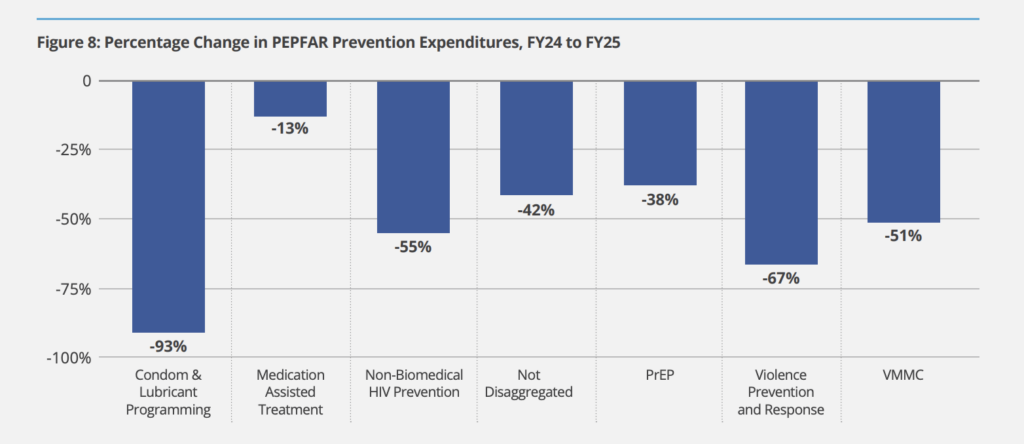
Credit: amFAR
First, amfAR released a report providing the first concrete detail on the impact of PEPFAR cuts: surveying 166 organizations in 46 countries, they found that nearly 2,000 service sites had been forced to shutter.
Almost no organizations were able to fill the funding gap with other donors. Services for key populations (KPs) were “decimated”: among implementing partners, 73% stopped at least one KP service and 67% stopped outreach services.
Prevention overall took a huge hit: almost half of respondents stopped activities like condom or PrEP distribution. Two-thirds reported interruption of PMTCT and nearly one in four stopped providing prevention of mother-to-child transmission services entirely. As AVAC’s Navita Jain told POZ, when foreign aid funding was frozen, “We were in year eight of a 10-year project, really getting momentum going and accelerating prevention research, and the cuts had a massive effect, with no guidance provided or a plan for a way forward.”
As widely reported, first by former AVACer Emily Bass, and then by most major media outlets, a US State Department official displayed a mislabeled map of African countries, with African government officials in the room. As Jirair Ratevosian said, the map “should never have made it onto the screen, especially during a presentation about partnerships with African governments,” but more importantly, it’s a disappointment “that this mistake became one of the conference’s biggest media stories. Because AIDS 2026 produced important science, serious policy analysis and real progress on issues ranging from PrEP delivery to global aid transitions.”
2. Prevention innovation includes speed, scale and equity…
One of the most exciting developments arrived days before the conference, when Merck/MSD announced seven direct licenses to generic manufacturers to produce their investigational monthly pill for HIV prevention, known as alimatravir, while Phase 3 clinical trials are still enrolling.
The announcement reflects responsiveness to advocates’ longstanding calls to accelerate access to PrEP options, and deep engagement with advocates throughout the clinical trial program. Since 2012, each successive PrEP introduction has gone faster than the previous one, yet the time to market and to public health impact remains too slow.
Granting licensing agreements to generic manufacturers while clinical trials are still enrolling, before it is known if the product is effective, should significantly reduce the time to market for the product. The current timeline gives the field ample opportunity to work with ministries of health, donors, communities, and Merck to plan for broad access to the monthly PrEP pill, which lends itself to innovative delivery models – from pharmacies to community-based distribution approaches.
3. …but too often, Latin America is still left behind

It is cruel irony that Brazil was host country to the conference, a key site for clinical trials of cabotegravir, lenacapavir and alimatravir, but has been left out of voluntary licenses for all three products.
While Merck/MSD shared information about a memorandum of understanding with Fiocruz to manufacture alimatravir for the region, the timing and next steps remain unclear: “Now is the time to plan for even speedier and wider access if alimatravir works,” said Access Bridge Executive Director Wawira Nyagah. “This must include pricing transparency from Merck and their generic licensees, accelerated investments by donors to design and implement integrated programs that offer the monthly pill as part of choice of product and service delivery models that actually reach people who need it, everywhere. This should be based on public health imperatives; not on World Bank country classifications or geographical location. Anywhere the HIV epidemic is increasing must be included, full stop.”
4. Innovative delivery and community involvement are expanding access…

AIDS 2026 showcased exciting models for HIV prevention service delivery that are removing barriers to access, reducing stigma and burden on healthcare systems. In São Paulo, vending machines delivering HIV tests, PrEP and PEP are available in subways, normalizing widespread access to HIV prevention.
Sri Lanka and the Ukraine have introduced mobile PrEP delivery programs, and in Kenya and South Africa, pharmacy delivery is reducing the load on health clinics following the drastic cuts to PEPFAR service delivery programs. The recently launched SCALE-IT project in Zambia is implementing a model for community-based delivery of PrEP options, including injectable PrEP, with more information expected soon. As we look ahead to alimatravir, the potential for a monthly PrEP pill opens the door to innovative delivery models. While alimatravir trials are still enrolling, AVAC has called on the stakeholders to ensure models are well-conceived and planned, adequately funded, and set up for success. With this timeline in hand, there’s no excuse for getting it wrong.
5. …but supply issues pose a serious threat to LEN rollout.
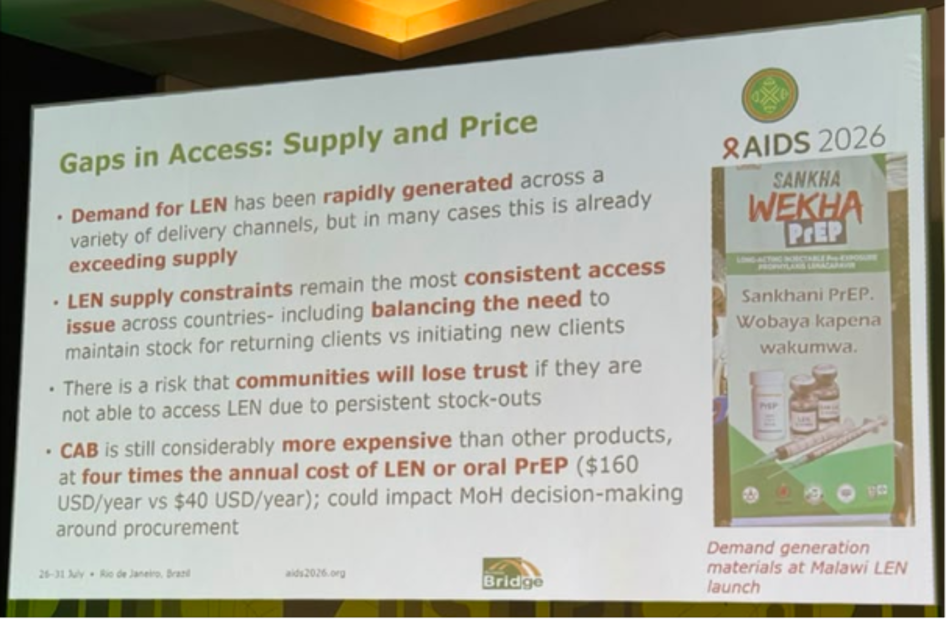
From countries across the globe, the same message echoed across AIDS 2026: there is demand for LEN now and the current supply is not enough. While recent commitments from PEPFAR and the Global Fund are encouraging, demand is rapidly outpacing supply across the globe – and there is an urgent need from donors to address bottlenecks and place more orders.
Access Bridge’s Nyagah reinforced this point: “People are being offered products that fit their lives, but the systems are not growing fast enough to supply it.” If supply issues are not urgently addressed, the field risks losing the demand, community trust, and current progress in LEN uptake that we have collectively worked so hard to achieve. For more on this topic, Jon Cohen’s recent piece in Science provides a deep dive into the challenges facing LEN rollout in South Africa and Zambia amidst the current political and funding landscape.
6. The urgency of vaccines: advancing the science, deepening our understanding
At a plenary session, Sandhya Vasan described why a vaccine is still needed, even with expanded PrEP options like lenacapavir, echoing AVAC’s recent commentary on the scientific challenges and emerging insights in the vaccine field and what’s in the research pipeline. Vasan highlighted long-standing partnerships with communities as foundational to vaccine research and vaccine confidence, as well as the need for continued investment and support for upstream vaccine research.
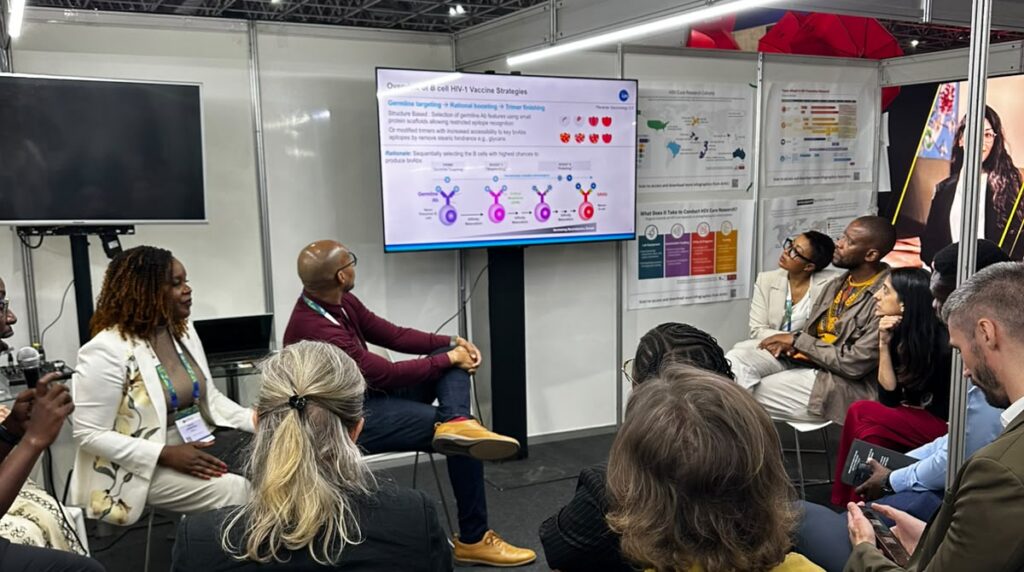
Community engagement was on full display at the HIV Cure & Prevention Research Networking Zone, where one of the best-attended sessions was the People’s Research Agenda Think Tank on HIV vaccines. AVAC’s resources on preventive vaccines and bNabs explain the science behind vaccine research.
In addition, the CAPRISA team announced results from the CAPRISA 012c Phase 2 trial examining a potential combination of two broadly neutralizing antibodies (bNAbs) as prevention. The trial found that a six-monthly combination of the CAP256 and VRC07 bNAbs was safe but did not provide protection against HIV acquisition in young women in South Africa and Zambia. As AVAC Executive Director Mitchell Warren noted, “We had hoped that combining two bNAbs in this study would provide greater protection than a single antibody, but sadly it did not.” Antibody research has always been about more than product development – research shared at the conference continues to deepen the understanding of HIV and the immune system and will continue to inform the next generation of vaccine and cure strategies.
7. Cure took another step forward
Two case presentations at the conference shared two more patients with HIV and cancer were cured following stem cell transplants for cancer treatment.
As AVAC’s senior program manager for HIV cure, Jessica Salzwedel says, “Thirteen people have now been cured via stem cell transplant. Every cure is an exciting step forward, but we must stay focused on the inequity of all 13 of these occurring in high-income countries – and ensure that our work expands access to cure information, research opportunities, and solutions.”
Cure strategies must go well beyond the science: efforts must include confronting the stigma of HIV and expanding research advocacy and engagement, especially in Africa. At pre-conference and conference sessions, along with a session at the HIV Cure & Prevention Research Networking Zone, attendees explored promising elements of the “kick and kill” strategy, gene editing technologies, the role of broadly neutralizing antibodies in “control” strategies, and how community members can get more involved.
8. Harnessing the power of AI for HIV while centering communities in the response
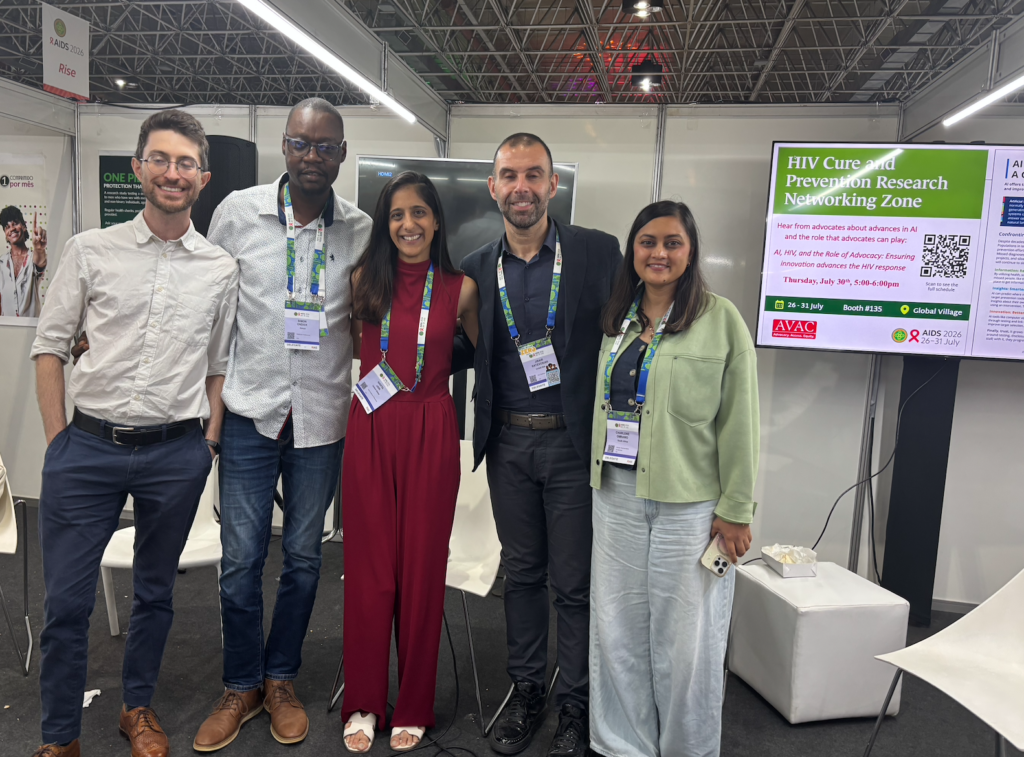
Many sessions explored the promise of AI to strengthen design and delivery of HIV programs, while highlighting potential pitfalls if we neglect to prioritize transparent regulatory frameworks and partnership with communities in the design, use, and oversight of AI systems.
ITPC Executive Director and AVAC Board member Solange Baptiste noted the urgency of approaches to AI that are human-centered: “We need a community governance layer built into the AI ecosystem…one that ensures communities help shape priorities, oversee the implementation, identify harms and hold systems accountable throughout the AI lifecycle.” The final plenary of the conference for the first time included a presentation on AI by Global Fund’s Izukanji Sikazwe, highlighting the dangers when the right innovations fail to scale and balancing the concept of AI as a partner with the risks AI can bring. For more insights from AVAC on the evolving discussions around AI, check out our quarterly AI and HIV Newsletter and Advocates Guide to AI and HIV Programs.
9. Partnerships power the HIV response by advancing community-centered priorities

As the field faces devastating funding cuts, strong partnerships between national, regional and global advocates are more important than ever. AVAC’s partnerships underpinned so much of the critical work discussed at AIDS 2026: to ensure key populations are not left behind, to advance community-led monitoring and community-based delivery, and translate choice into impact.
In each case, success was made possible by bringing together diverse stakeholders with the singular goal of developing innovative, community-centered approaches to the HIV response. As AVAC’s Warren reflected following the conference, “Communities are the leaders of AIDS programming. All over the conference they led plenaries, symposia, abstracts. These are not recipients, they are leaders who are driving the conversations.”
10. Communities are the heart of the AIDS response, and the Global Village is the heart of the AIDS conference.

In conversations, meet-ups, and protests coordinated across the Global Village, the power of advocates and coalition-based advocacy was a key theme of the conference. AVAC’s HIV Cure and Prevention Research Networking Zone brought delegates, researchers, advocates, and community members together for interactive discussions, expert-led sessions and networking conversations.
The Zone featured the “HIV Funding Saves Lives” quilt created by COMPASS and the Global Advocacy Data Hub to convey the impact of funding cuts on communities. Attendees signed the quilt, adding their voices to the demands for HIV funding to be restored. As advocates look ahead, connections built at the Networking Zone will strengthen for future coalition-based advocacy.
AIDS 2026: Rising Above to Meet the Moment
The World Must Act with Speed, Scale and Equity
By Mitchell Warren, Executive Director, AVAC
One of the most memorable moments for me at AIDS 2026 wasn’t a scientific presentation. It wasn’t a late-breaking abstract, or a standing-room-only session. It was a conversation with a ministry of health official from one of the first countries preparing to introduce lenacapavir (LEN) for HIV prevention. We weren’t discussing whether people wanted the product. We weren’t debating whether it worked. We were talking about running out.
Countries preparing for rollout of this groundbreaking prevention method – one that provides near-perfect protection from infection – are already worried they won’t have enough supply to meet demand.
For decades, the HIV field has worried about generating demand for prevention. At AIDS 2026 in Rio, we confronted a very different challenge: the demand is building. The question now is whether the world is prepared to meet it.
This was a conference defined by something arguably more important than any single scientific breakthrough. It was the recognition that as a field, we must confront the pressing challenge of political will and moral decision-making. As Raphy Landovitz asked in a stirring plenary session: do we have the courage, partnerships, and urgency to fight for science, which remains under attack?
After this week in Rio, I believe we absolutely have the courage, and the conference theme – Rethink. Rebuild. Rise. – provides a roadmap for how we turn it into impact.
Slides presented at AIDS 2026 by AVAC partner Access Bridge during a session on the promise of long-acting PrEP
First, we must rethink what success looks like. For years, success in HIV prevention meant developing new products to prevent new infections. Today, though, success means ensuring people can actually get the option that best meets their needs – how do we deliver this extraordinary range of options?
The range of HIV prevention options has grown in ways we only dreamed of a decade ago: beyond condoms which remain as essential today as they were at my first AIDS conference 30 years ago, we now have injectable PrEP which provides near-perfect protection in clinical trials and is becoming more widely available; a vaginal ring that provides a unique female-initiated option; and a monthly oral PrEP pill is in late-stage trials (and accelerated access planning).
But more options do not automatically mean more choice. Choice is not simply a shelf full of medicines. Choice is a health system capable of delivering them. It is procurement systems that can purchase multiple options instead of one. It is healthcare workers trained to welcome diverse individuals and counsel people without bias, rather than steering everyone toward the same intervention or the one the health provider thinks is best for them. It is financing that rewards access instead of rationing it.
In Rio, I heard government representatives, implementers, and community advocates ask operational questions about choice that would have sounded impossible just a few years ago. How do we effectively forecast demand and introduce multiple long-acting options? How can we ensure speed, scale and equity across environments, from rural clinics to urban hospitals? How can we simplify delivery and offer PrEP where people want it, and not just where systems want them?
We must think big. In a matter of months, a once-in-a-generation opportunity will present itself as generic lenacapavir becomes available, and this highly effective prevention option, hopefully, becomes more accessible. Governments, donors, manufacturers, and global procurement agencies should be planning for millions of people—not thousands—to access long-acting PrEP. Importantly, we also heard in Rio how the new interest in LEN is actually motivating people who had not come forward to test and are found to already be living with HIV. The novelty of LEN is becoming a catalyst for universally testing and connecting all people with the products and services they need – whether or not they are living with HIV.
The HIV response has always moved fastest when those most affected have shaped research questions, demanded accountability, challenged institutions, and insisted that innovation reach the people who need it most.
As countries begin introducing long-acting prevention, community leadership becomes even more important. Communities that trust delivery systems, prevention methods and messages are much more likely to accept new methods. And ultimately, it will be communities that tell us whether products are truly accessible, whether health systems are delivering meaningful choice, and whether equity is more than just a conference slogan.

The “HIV Funding Saves Lives” quilt, created by COMPASS and the Global Advocacy Data Hub to convey the impact of funding cuts on communities
Second, we must rebuild. Rio was also the first global AIDS conference that had data presentations about the impacts of the dismantling of USAID and the dramatic restructuring of U.S. foreign assistance.
Since then, prevention programs have been diminished, services for key populations have been interrupted, research has been halted, partnerships have been strained. Organizations have closed their doors. Communities are feeling those consequences every day. Jerop Limo, an AVAC advocacy partner and adolescent HIV programming expert, summed it up perfectly in the recent POZ piece on the impact of funding cuts, “People are disengaging from healthcare spaces and missing appointments. This is not the system we had, the one that was working.”
The release of UNAIDS’ United to End AIDS special report and a companion KFF-UNAIDS analysis show the challenge of translating scientific progress into the impact needed to end AIDS as a public health threat by 2030. The report shows HIV financing entering one of its most precarious periods in decades, with international assistance declining 18% between 2024 and 2025. Donor government funding fell by $2.1 billion in 2025—the largest annual decline since global HIV funding began scaling up. This is not just a warning. It’s not just a ‘cautious stabilization of where things are. It is an alarm bell that we have to change how we do what we do, and how we fund what we do, if we want to succeed.
As colleagues from Duke and Friends of the Global Fight underscore, rebuilding cannot mean returning to the systems that existed before.
We can’t go back, but we also can’t stay still. We have to build something new.
The good news is that new opportunities and promising signs are emerging. Countries are assuming greater ownership of their HIV responses. Regional institutions are stepping forward. New partnerships are forming, and new institutions are stepping up to lead.
Across conversations in Rio, there was broad consensus that sustainability of the HIV response cannot remain overly reliant on any one country government and the whims of its leadership. A broad coalition of countries, communities, philanthropy, industry, and global institutions working toward shared goals must equally share responsibility for the future of the HIV response.
In fact, hosting the conference in Brazil was a powerful reminder that political commitment to universal HIV services can achieve a lot. But even Brazil cannot introduce every new prevention technology without strong partnerships. Manufacturers must be willing to expand access, multilateral organizations must be willing to commit to volume guarantees and investments that meet demand, and donors must prioritize and be willing to invest in what’s required to ensure equitable rollout.
Raphy Landovitz’s plenary highlighted the critical choices the field has ahead of us to ensure we meet this moment.
Lastly, we must rise to meet this moment. After every setback, whether political or scientific, the global HIV community has found a way to turn adversity into action, setbacks into solidarity, and uncertainty into progress. That was on display more than ever in Rio, where we were reminded that disappointment also moves science forward.
One of the week’s significant scientific presentations came from the CAPRISA antibody study. The results were disappointing: the trial found that a six-monthly combination of two broadly neutralizing antibodies (bNAbs) was safe but did not provide protection against HIV acquisition in young women in South Africa and Zambia. Researchers concluded that while the antibody combination demonstrated strong potency in laboratory studies, it did not achieve antibody levels needed for protection in people.
With this study, we had hoped that combining two bNAbs would provide greater protection than a single antibody, but sadly it did not. But antibody research has always been about more than product development. The CAPRISA 012c study continues to deepen our understanding of HIV and the immune system, and will continue to inform vaccine design, cure research and the next generation of prevention strategies.
Every carefully conducted study answers important questions. Every unexpected result helps redirect investments toward more promising approaches. That is how scientific progress works.
AIDS 2026 convened at a pivotal time: we now have just four years until 2030—the deadline for global HIV targets and the Sustainable Development Goals.
By the end of this year, we should know whether long-acting PrEP is reaching people at scale. By the International AIDS Society conference in Geneva next July, we should know whether generic lenacapavir is expanding access, whether research investments are holding, whether community-led programs have been restored, and whether countries are closing the equity gap. If those indicators are moving in the wrong direction, we must change course in real-time.
The legacy of Rio will be determined by whether we seize this extraordinary moment. Even as we rethink and rebuild things, we must ensure that we center communities, follow their lead, and rise up to support the populations that need this work more than ever. And just like a well-conducted clinical trial, a conference should answer some questions and raise new ones:
Will donors and governments purchase enough lenacapavir to meet demand instead of limiting access? Will pharmaceutical companies accelerate voluntary licensing and affordable pricing so new innovations reach everyone, everywhere without years of delay? Will donors invest boldly enough to match the science? Will countries protect community-led organizations and programs for key populations, recognizing that these are not optional additions but essential pillars of an effective response? Will researchers continue pushing the boundaries of vaccines, antibodies, cures, and long-acting treatment, even when some studies disappoint?
The science has never been stronger, communities have never been more ready, and the need has never been more urgent. Rio reminded us that ending HIV is no longer limited by what we know, it is limited only by the courage to act.
AVAC and Access Bridge Applaud Monthly PrEP Pill Access Announcement; Call for Speed, Scale and Equity in Future Monthly Oral Alimatravir Introduction
AVAC and Access Bridge applaud Merck’s announcement today that it has granted seven direct licenses to generic manufacturers to produce their investigational monthly pill for HIV prevention, known as MK-8527, or alimatravir, while Phase 3 clinical trials are still enrolling.
The announcement from Merck/MSD reflects responsiveness to advocates’ longstanding calls to accelerate access to PrEP options. Since 2012, each successive PrEP introduction has gone faster than the previous one yet the time to market and to public health impact remains too slow.
In advance of the AIDS 2026 conference, Merck, known as MSD outside the US and Canada, today announced voluntary licensing agreements with seven manufacturers, including three in East and Southern Africa, to produce and market alimatravir for PrEP in 129 countries.
“Today’s news reflects truly positive momentum in future access to alimatravir for PrEP, if proven safe and effective,” said Mitchell Warren, AVAC’s executive director. “Granting licensing agreements to generic manufacturers while clinical trials are still enrolling, before it is known if the product is effective, should significantly reduce the time to market for the product. The timeline announced today gives us ample opportunity to work with ministries of health, donors, communities, and Merck to plan for broad access to the monthly PrEP pill. This option lends itself to innovative delivery models – from pharmacies to community-based distribution approaches. While trials are still enrolling, we have the time to collectively ensure models are well-conceived and planned, adequately funded, and set up for success. With this timeline in hand, there’s no excuse for getting it wrong.”
“Merck’s early access announcement represents significant potential time-savings, compared to the experience with cabotegravir (CAB) and lenacapavir (LEN) in both timeline for licensing, and inclusion of those with greatest need. With three generic manufacturers in Kenya, Uganda, and South Africa included, these agreements go beyond those put in place for CAB and LEN and help to ensure that countries with some of the highest HIV burdens and largest PrEP markets will be able to make the product locally, should alimatravir prove safe and effective in phase 3 trials,” Warren added. “But while these voluntary licenses are essential, they are not sufficient on their own to translate exciting science into public health impact. Ultimately, access is about far more than licensure alone.”
Merck has worked with communities and advocates throughout the development of alimatravir, as exemplified by community representatives helping conceptualize the design of the phase 3 trials, even before Merck spoke to regulators. “We’ve appreciated the partnership between Merck and advocates in the research process. We’re seeing that commitment to community priorities translate into product introduction and access steps. As advocates, we will continue to watchdog this space, ensure communities remain at the center of access planning as it moves forward, and ensure accountability among all stakeholders,” said Stacey Hannah, AVAC’s Director of Research Engagement.
Every step in the process of moving a product to market can and should go faster with alimatravir than it went with CAB and LEN. To ensure the monthly PrEP pill is introduced and broadly accessible with speed, scale, and equity, AVAC and Access Bridge call on the broad range of stakeholders ensure these critical actions take place:
- Merck/MSD, governments, and donors to commit to reach at least two million people with alimatravir within the first year of product launch and five million people within the first two years.
- Merck/MSD to agree to sell the product to any public health procurer or donor at a price no more than the price of generic daily oral PrEP and injectable lenacapavir.
- Merck/MSD to guarantee that alimatravir will be available in low and middle-income countries within three months of first approval; halving the timeline it took for LEN to become available.
- Merck/MSD to articulate a transparent and robust plan for ensuring affordable, equitable access to alimatravir in Latin America, with a specific priority on countries hosting the EXPrESSIVE 11 trial, and direct work with advocates to navigate country specifics where voluntary licenses are not in place.
- WHO to accelerate the guidelines development process.Merck/MSD to clarify its regulatory strategy and prioritize broad regulatory submissions in parallel with its FDA submission, working with the WHO’s Collaborative Registration Procedure, the EMA’s Medicine4All program, and the African Medicines Agency.
- Donors working with WHO and ministries of health to design and embed a robust implementation science agenda within programmatic rollout to answer critical questions, particularly about adherence, for this new, monthly method of prevention, as part of introduction.
- All stakeholders to create and plan now for innovative service delivery that continues to simplify PrEP, working with private pharmacies, community-based organizations, and other innovative service delivery efforts.
- National governments start to prepare ambitious and costed implementation plans, guidelines, and comprehensive programs to integrate alimatravir into existing HIV prevention programs.
“Today’s announcement shows that the HIV prevention field can learn and apply lessons in real time. LEN for PrEP is now in limited distribution in ten African countries within two years of proven efficacy; this was a huge step forward, but we as a field can still do better,” said Wawira Nyagah, executive director of Access Bridge. “Now is the time to plan for even speedier and wider access if alimatravir works. This must include pricing transparency from Merck and their generic licensees, accelerated investments by donors to design and implement integrated programs that offer the monthly pill as part of choice of product and service delivery models that actually reach people who need and can benefit from it, everywhere, based on public health imperatives, and not on World Bank country classifications or geographical location. Anywhere the HIV epidemic is increasing must be included, full stop.”
For more than a decade, AVAC has mapped the roadmap and timelines for moving PrEP products from earliest research stages to market. With each successive option, AVAC has flagged what is failing, where the global community is watching, where things are improving, and where there’s room to do better still. As a result of this work, the global community is executing better, faster, more inclusively, and more equitably with every new option. Learn more about AVAC’s work on alimatravir. AVAC and Access Bridge will continue to monitor the research, approval processes and product implementation of PrEP options at https://avac.org/prevention-option/prep/ and www.prepwatch.org.
Press Release
AVAC and Access Bridge Applaud Monthly PrEP Pill Access Announcement; Call for Speed, Scale and Equity in Future Monthly Oral Alimatravir Introduction
Contact: [email protected]
Rio de Janeiro, Brazil, 24 July 2026 — AVAC and Access Bridge applaud Merck’s announcement today that it has granted seven direct licenses to generic manufacturers to produce their investigational monthly pill for HIV prevention, known as MK-8527, or alimatravir, while Phase 3 clinical trials are still enrolling.
The announcement from Merck/MSD reflects responsiveness to advocates’ longstanding calls to accelerate access to PrEP options. Since 2012, each successive PrEP introduction has gone faster than the previous one, yet the time to market and to public health impact remains too slow.
In advance of the AIDS 2026 conference, Merck, known as MSD outside the US and Canada, today announced voluntary licensing agreements with seven manufacturers, including three in East and Southern Africa, to produce and market alimatravir for PrEP in 129 countries.
“Today’s news reflects truly positive momentum in future access to alimatravir for PrEP, if proven safe and effective,” said Mitchell Warren, AVAC’s executive director. “Granting licensing agreements to generic manufacturers while clinical trials are still enrolling, before it is known if the product is effective, should significantly reduce the time to market for the product. The timeline announced today gives us ample opportunity to work with ministries of health, donors, communities, and Merck to plan for broad access to the monthly PrEP pill. This option lends itself to innovative delivery models – from pharmacies to community-based distribution approaches. While trials are still enrolling, we have the time to collectively ensure models are well-conceived and planned, adequately funded, and set up for success. With this timeline in hand, there’s no excuse for getting it wrong.”
“Merck’s early access announcement represents significant potential time-savings, compared to the experience with cabotegravir (CAB) and lenacapavir (LEN) in both timeline for licensing, and inclusion of those with greatest need. With three generic manufacturers in Kenya, Uganda, and South Africa included, these agreements go beyond those put in place for CAB and LEN and help to ensure that countries with some of the highest HIV burdens and largest PrEP markets will be able to make the product locally, should alimatravir prove safe and effective in phase 3 trials,” Warren added. “But while these voluntary licenses are essential, they are not sufficient on their own to translate exciting science into public health impact. Ultimately, access is about far more than licensure alone.”
Merck has worked with communities and advocates throughout the development of alimatravir, as exemplified by community representatives helping conceptualize the design of the phase 3 trials, even before Merck spoke to regulators. “We’ve appreciated the partnership between Merck and advocates in the research process. We’re seeing that commitment to community priorities translate into product introduction and access steps. As advocates, we will continue to watchdog this space, ensure communities remain at the center of access planning as it moves forward, and ensure accountability among all stakeholders,” said Stacey Hannah, AVAC’s Director of Research Engagement.
Every step in the process of moving a product to market can and should go faster with alimatravir than it went with CAB and LEN. To ensure the monthly PrEP pill is introduced and broadly accessible with speed, scale, and equity, AVAC and Access Bridge call on the broad range of stakeholders ensure these critical actions take place:
- Merck/MSD, governments, and donors to commit to reach at least two million people with alimatravir within the first year of product launch and five million people within the first two years.
- Merck/MSD to agree to sell the product to any public health procurer or donor at a price no more than the price of generic daily oral PrEP and injectable lenacapavir.
- Merck/MSD to guarantee that alimatravir will be available in low and middle-income countries within three months of first approval; halving the timeline it took for LEN to become available.
- Merck/MSD to articulate a transparent and robust plan for ensuring affordable, equitable access to alimatravir in Latin America, with a specific priority on countries hosting the EXPrESSIVE 11 trial, and direct work with advocates to navigate country specifics where voluntary licenses are not in place.
- WHO to accelerate the guidelines development process. Merck/MSD to clarify its regulatory strategy and prioritize broad regulatory submissions in parallel with its FDA submission, working with the WHO’s Collaborative Registration Procedure, the EMA’s Medicine4All program, and the African Medicines Agency.
- Donors working with WHO and ministries of health to design and embed a robust implementation science agenda within programmatic rollout to answer critical questions, particularly about adherence, for this new, monthly method of prevention, as part of introduction.
- All stakeholders to create and plan now for innovative service delivery that continues to simplify PrEP, working with private pharmacies, community-based organizations, and other innovative service delivery efforts.
- National governments start to prepare ambitious and costed implementation plans, guidelines, and comprehensive programs to integrate alimatravir into existing HIV prevention programs.
“Today’s announcement shows that the HIV prevention field can learn and apply lessons in real time. LEN for PrEP is now in limited distribution in ten African countries within two years of proven efficacy; this was a huge step forward, but we as a field can still do better,” said Wawira Nyagah, executive director of Access Bridge. “Now is the time to plan for even speedier and wider access if alimatravir works. This must include pricing transparency from Merck and their generic licensees, accelerated investments by donors to design and implement integrated programs that offer the monthly pill as part of choice of product and service delivery models that actually reach people who need and can benefit from it, everywhere, based on public health imperatives, and not on World Bank country classifications or geographical location. Anywhere the HIV epidemic is increasing must be included, full stop.”
For more than a decade, AVAC has mapped the roadmap and timelines for moving PrEP products from earliest research stages to market. With each successive option, AVAC has flagged what is failing, where the global community is watching, where things are improving, and where there’s room to do better still. As a result of this work, the global community is executing better, faster, more inclusively, and more equitably with every new option. Learn more about AVAC’s work on alimatravir. AVAC and Access Bridge will continue to monitor the research, approval processes and product implementation of PrEP options at https://avac.org/prevention-option/prep/ and www.prepwatch.org.
***
About AVAC
AVAC is an international non-profit organization that provides an independent voice and leverages global partnerships to accelerate ethical development and delivery of effective HIV prevention options, as part of a comprehensive and integrated pathway to global health equity. Follow AVAC on BlueSky and LinkedIn and find more at avac.org and prepwatch.org.
About Access Bridge
Access Bridge is an independent, Africa-anchored organization advancing timely, sustainable, and equitable introduction of and access to HIV prevention and related health products. Incubated at AVAC and rooted in African leadership and global collaboration, Access Bridge leads a globally recognized portfolio of product introduction and access projects. Follow Access Bridge on LinkedIn and find more at healthaccessbridge.org and prepwatch.org.
Lenacapavir Implementation Studies
Ongoing and planned implementation studies for the lenacapavir as of July 2026. For product approvals, volumes, implementation, and price comparisons of long-acting PrEP, visit our dashboard on PrEPWatch.org.