Mitchell Warren, AVAC’s Executive Director, says that HIV programs adapting to steep funding cuts are drawing on service delivery innovations that were already underway before the cuts hit, not because of them. “The success stories right now are not the responses to the destruction of what had been. They are representing the kinds of programmatic iterations that, frankly, you could actually do even faster and better if we hadn’t broken the system.”
Mitchell Warren on HIV service integration amid cuts | AIDS 2026
The Human Pain Behind Global HIV Funding Cuts
At AIDS 2026, advocates reflected on the human impact of HIV funding cuts. Navita Jain, a Senior Program Manager at AVAC, explained, “We were in year eight of a 10-year project, really getting momentum going and accelerating prevention research, and the cuts had a massive effect, with no guidance provided or a plan for a way forward.”
Beyond science: the AIDS 2026 debate argues that curing HIV also involves confronting stigma.
Agência Aids reflected on the Beyond Science: What Does a Cure Mean for Our Community session held in AVAC’s HIV Cure & Prevention Research Networking Zone at the AIDS 2026 conference.
Pricing pivotal as HIV drug advances offer ‘choice’
Speaking to SciDev.Net, AVAC Executive Director Mitchell Warren commented on trial results of long-acting HIV drugs that expand choice in both prevention and treatment. While the results signal significant promise, success depends on pricing, integration, and delivery. “The field needs to move with even greater speed, scale and equity in translating these results into public health impact,” Warren said.
Nature Briefing
In Nature‘s daily Nature Briefing newsletter, AVAC’s Executive Director Mitchell Warren was highlighted as the quote of the day. “Our greatest scientific opportunity in my 35 years working in the field has been met by the most outrageous political and economic decision imaginable,” Warren said, referring to the promise of lenacapavir that has been threatened by cuts to foreign aid.
Mitchell Warren on the fallout from PEPFAR cuts | AIDS 2026
AVAC’s Executive Director Mitchell Warren spoke to Managed Healthcare Executive about the impact of the disruption in funding from the U.S. President’s Emergency Plan for AIDS Relief (PEPFAR). “We’re hearing about people who aren’t being tested and falling out of treatment. I think we’re beginning to see the enormity of bad decisions,” Warren said.
Potential Lenacapavir Supply, 2026-28
Lenacapavir has the potential to reach millions — and the momentum is building. Using the current oral PrEP market as a baseline, this graphic estimates what demand for LEN could look like through 2028 and shows how current donor commitments stack up against that opportunity.
AVAC Comment Submission on the White House OMB Proposed Federal Financial Assistance Rule
HIV Prevention Advocates Applaud South Africa’s Introduction of Lenacapavir for PrEP
Call on Donors and Governments to Accelerate Access to Deliver Actual Impact
In a landmark moment, South Africa today became the 9th African country to introduce lencapavir (LEN) for HIV prevention. South Africa’s introduction of LEN is especially significant given the country’s central role in shaping the regional HIV response and the global PrEP market. As the largest PrEP market in the world, South Africa’s leadership can help drive the demand, volume, market confidence and lower prices needed to accelerate equitable access across the continent and the world. HIV prevention partners AVAC, Advocates for the Prevention of HIV in Africa (APHA), and Access Bridge welcomed today’s news of increased commitments and support from the Global Fund, while calling for further ensure access is realized and impact achieved.
“Today is a breakthrough. Not only for our country and the African continent, which continues to carry some of the world’s largest HIV burdens, but for the global HIV response. Access to LEN allows us to reimagine prevention, especially for young people and adolescent girls and young women who need more choices that fit their lives. It is important to centre our efforts around girls and young women who need to be the focus of our efforts. We must move with urgency to ensure that everyone who could benefit from lenacapavir can do so,” said Yvette Raphael, Executive Director of Advocates for the Prevention of HIV in Africa (APHA) and co-chair of the African Women’s Prevention Community Accountability Board (AWPCAB).
“Today is a sign of what is possible when communities, governments, and partners work together. LEN will offer my generation the chance to protect their health with greater freedom and confidence. We must now make sure this innovation reaches the people who need it most—quickly, equitably, and without barriers. Today is exciting, but it is also a call to action for all of us,” said Lerato Morulane, APHA Ground Force coordinator.
During the launch event, the Global Fund announced that with additional backing from the Children’s Investment Fund Foundation (CIFF), it will scale-up support for South Africa’s LEN roll-out, increasing funding from $29M to nearly $70M to support this more ambitious effort. This contribution to the Global Fund goes toward their joint commitment with PEPFAR to ensure access to LEN for at least three million people over three years – a more solid start than with previous PrEP introductions, but still below the levels needed to deliver impact.
In July 2025, AVAC published a market assessment that the world could go much faster than existing commitments allow and reach at least 1.5 million people with LEN in just one year in low- and middle-income countries if resources were made available, and reach over seven million in three years, if resources were available.
“Lenacapavir has transformational potential for HIV prevention, and today’s launch is another step in the right direction,” said Mitchell Warren, Executive Director of AVAC. “But additional donor investments are urgently needed as the field is still nowhere near what the market can bear and what is needed for impact. A meaningful volume commitment of at least four million LEN users in two years is both possible and has the potential to unlock faster access, strengthen market confidence, and accelerate access to prevention for communities that need it most. Ultimately, LEN must reach more than five million people per year to have real impact, build a sustainable market, and drive prices down even further. Today’s announcement is progress, but we still need to go farther faster.”
LEN has been widely recognized as a transformative HIV prevention option, with the every-six-month injection providing highly effective protection. However, translating the scientific breakthrough of LEN into population-level access and impact requires coordinated action across many sectors, including financing, manufacturing, pricing, regulatory, and delivery.
“Today represents another important milestone, but now we need to roll up our collective sleeves and get to work,” said Wawira Nyagah, Executive Director of Access Bridge. “South Africa has an essential role to play in building the global market for LEN and driving the volumes needed to lower prices, strengthen supply, and accelerate access worldwide. To realize the full potential of this innovation, all stakeholders must work together with even greater urgency, ambition, and a commitment to speed, scale, and equity. The opportunity is in front of us; now we must seize it. To see LEN truly succeed, programs must be designed with communities at the centre and that commitments translate into real access for the people who need it. Access Bridge is working across countries in Eastern and Southern Africa to ensure countries are equipped to meet this moment.”
AVAC and Access Bridge have called on stakeholders to meet the current moment of scientific opportunity and public health need with bolder ambition. The past decade of PrEP programs have highlighted numerous lessons on how to get LEN rollout right as part of comprehensive HIV prevention programs so that today’s announcement translates into real-world impact. Key considerations include:
- Regulatory approval and normative guidance: Stringent regulatory reviewers have approved LEN and high-quality studies have been completed — this should speed the process for countries to introduce LEN at scale.
- Planning and budgeting: Pricing must be clear and transparent, and budgets must encompass the full range of activities needed to make PrEP successful.
- Stakeholder engagement & demand generation: Communities, the private sector, and other stakeholders must be engaged early and effectively to build trust and demand.
- Supply chain management: If there’s no product, there’s no program. Commitments need to be translated into orders, and orders need to be delivered consistently and without delay.
- Health service delivery: Providers who deliver PrEP services need guidelines, training and tools to enhance differentiated service delivery.
- Monitoring, evaluation and learning: To track project targets and provides insights for program improvement, and lessons for scaling future prevention products in the pipeline.
Today’s announcement builds on prior commitments from the Global Fund and PEPFAR, as well as investments from the Gates Foundation and Unitaid to accelerate development and access to generic LEN at lower prices. With generic LEN likely entering the market in the first half of 2027, now is the time to strengthen and grow the market with Gilead’s supply: the faster the market grows, the more infections that can be averted at lower cost.
“Commitments are important, but orders are essential. In Gilead’s own words, they can produce far more if orders are made,” said Warren. “Especially for 2027, clear timelines and ambitious orders for both originator and generic supply will be critical to avoid gaps in care of current LEN users and to expand the reach of this innovation.”
Avac Event
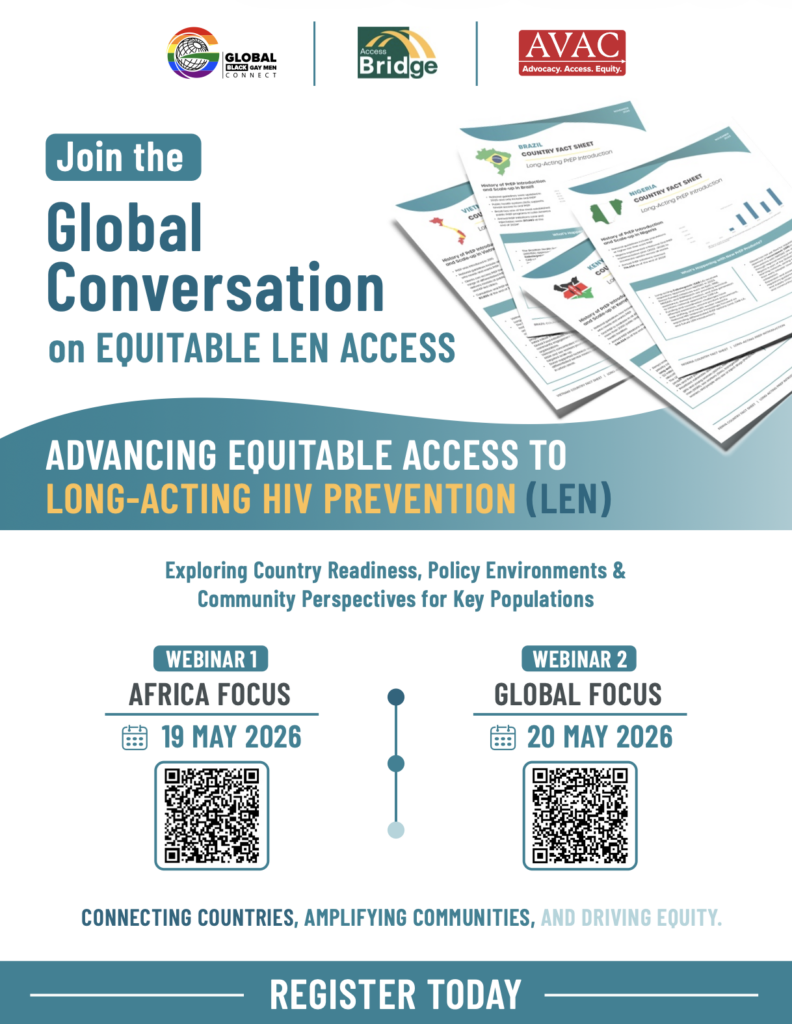
PrEP Power Webinar — Global Countries
The recent significant changes to global health funding have severely impacted HIV prevention services for those who need them most, in particular key populations (KPs). Already, some countries are seeing concerning trends in data suggesting a resurgence in new infections. At the same time, powerful new HIV prevention options are now a reality, though their promise is not set to be fully realized according to current planning.
This is the second in a series of two webinars providing an overview of what is happening now in countries to HIV prevention services for KPs, featuring tools and analyses produced by GBGMC, in partnership with Access Bridge to support advocacy and planning at country levels.
Speakers will include an array of experts on the global landscape, as well as country and community perspectives.
Discussions Will Explore:
- Global product introduction experiences
- Lessons from early adopter countries
- Policy environments and implementation realities
- Strategies for equitable LEN access
Featured Countries: Brazil, France, Philippines, Ukraine, United States, Vietnam