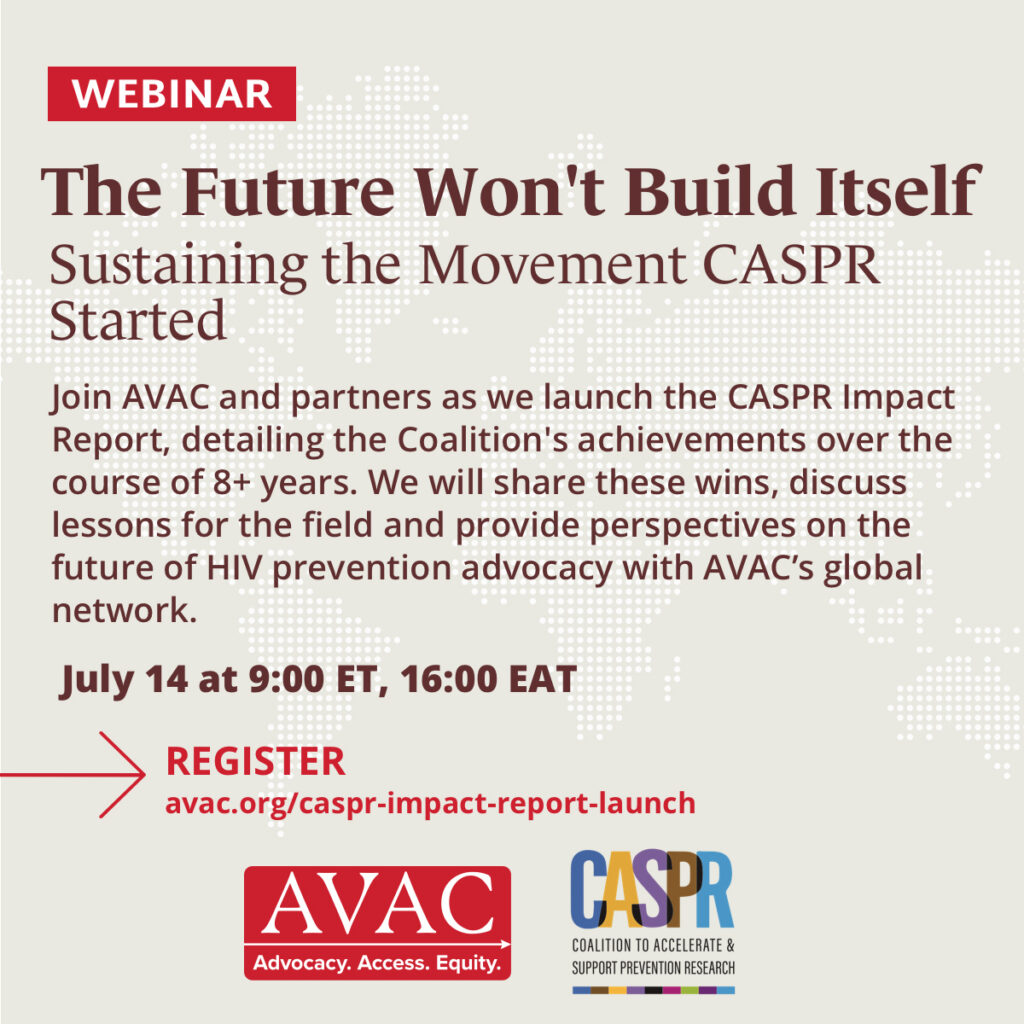
The Future Won’t Build Itself: Sustaining the Movement CASPR Started
Join AVAC and partners as we launch the CASPR Impact Report, detailing the Coalition’s achievements over the course of 8+ years. We will share these wins, discuss lessons for the field and provide perspectives on the future of HIV prevention advocacy with AVAC’s global network.
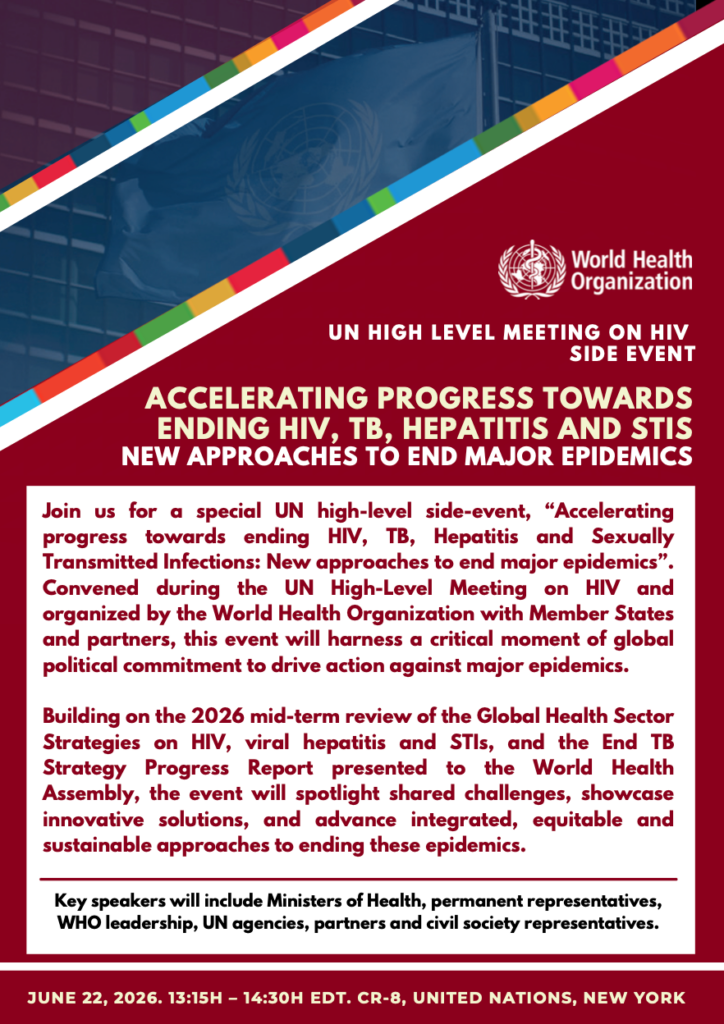
Accelerating Progress Towards Ending HIV, TB, Hepatitis and STIs
New Approaches to End Major Epidemics
The UN high-level side-event “Accelerating progress towards ending HIV, TB, Hepatitis and Sexually Transmitted Infections: New approaches to end major epidemics,” will be held on the margins of the UN High Level Meeting on HIV. The event will be organized by the World Health Organization in collaboration with Member States and partners.
Avac Event
Delivering the HIV Prevention Ambition
Partnership, Country and Community Leadership, and Shared Accountability
The purpose of the session is to identify how the prevention ambition of 40+20 can be delivered at scale through country-owned, community-accountable and partner-supported HIV prevention responses. The discussion will focus on how to expand access to new and existing prevention options, integrate prevention within sustainable HIV and health systems, address barriers faced by communities, and mobilise the financing and coordination needed to reach the 20 million prevention ambition by 2030.
Avac Event
The HIV Endgame: Can the World Deliver on Lenacapavir?
Leadership transitions and structural reforms across major global health institutions are reshaping the system. This conversation will explore what changes at the World Health Organization, Global Fund, UNAIDS, and UNITAID mean for coordination, accountability, and deliver, particularly as US bilateral approaches shift the dynamics in Geneva.
Speakers
Mitchell Warren, Executive Director, AVAC
Michel Joly, Vice-president of Gilead Global Patient Solutions, Gilead Sciences
Rhoda Igweta, Director of public policy and advocacy for Africa, Elizabeth Glaser Pediatric AIDS Foundation
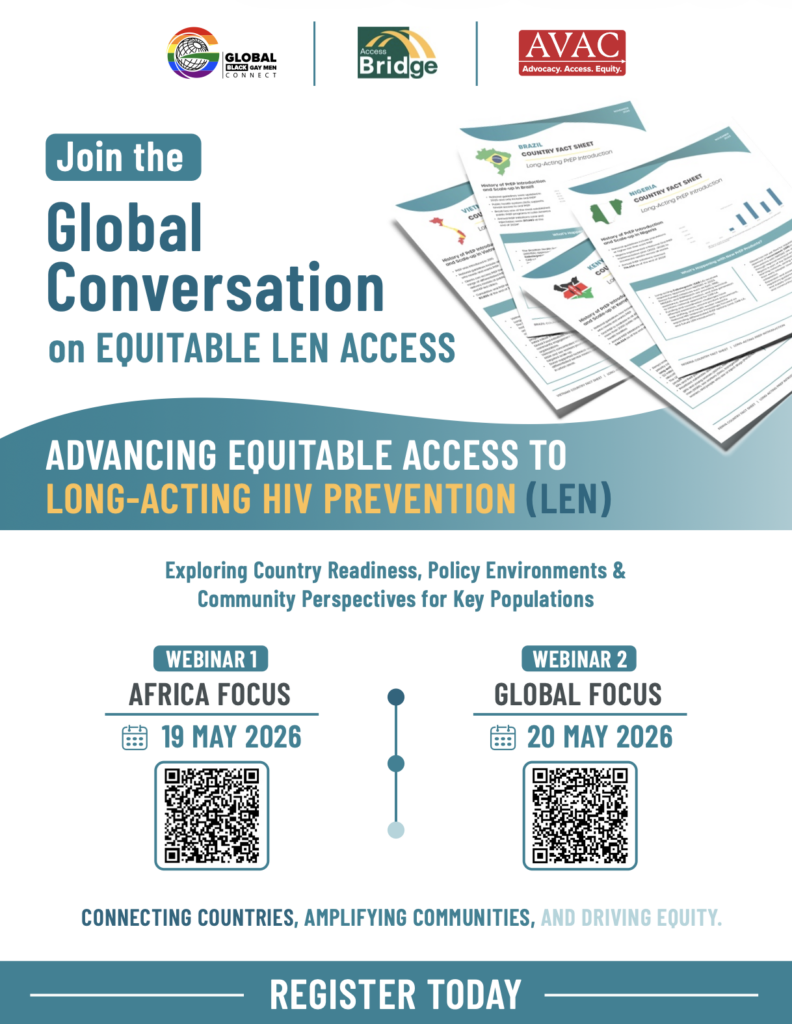
The recent significant changes to global health funding have severely impacted HIV prevention services for those who need them most, in particular key populations (KPs). Already, some countries are seeing concerning trends in data suggesting a resurgence in new infections. At the same time, powerful new HIV prevention options are now a reality, though their promise is not set to be fully realized according to current planning.
This is the second in a series of two webinars providing an overview of what is happening now in countries to HIV prevention services for KPs, featuring tools and analyses produced by GBGMC, in partnership with Access Bridge to support advocacy and planning at country levels.
Speakers will include an array of experts on the global landscape, as well as country and community perspectives.
Discussions Will Explore:
Global product introduction experiences
Lessons from early adopter countries
Policy environments and implementation realities
Strategies for equitable LEN access
Featured Countries: Brazil, France, Philippines, Ukraine, United States, Vietnam
Avac Event
PrEP Power Webinar — African Countries
The recent significant changes to global health funding have severely impacted HIV prevention services for those who need them most, in particular key populations (KPs). Already, some countries are seeing concerning trends in data suggesting a resurgence in new infections. At the same time, powerful new HIV prevention options are now a reality, though their promise is not set to be fully realized according to current planning.
This is the first in a series of two webinars providing an overview of what is happening now in countries to HIV prevention services for KPs, featuring tools and analyses produced by GBGMC, in partnership with Access Bridge to support advocacy and planning at country levels.
Speakers will include an array of experts on the global landscape, as well as country and community perspectives.
Featured countries: Eswatini, Kenya, Lesotho, Malawi, Mozambique, Nigeria, South Africa, Uganda, Zambia, Zimbabwe
Avac Event
Transgender Research 2026 – Findings from CROI and Beyond
Powerful research focused on transgender people was presented at CROI 2026. Join this webinar to hear from three scientists who shared their work, exploring everything from cervical tissues to healthcare policies and community priorities beyond HIV prevention and care.
Speakers
Bokani Nleya, University of Alabama at Birmingham
Sari Reisner, University of Michigan
Yuanqi Mi, Johns Hopkins Bloomberg School of Public Health
Moderator
Brian Minalga, Office of HIV/AIDS Network Coordination (HANC)
Inside the Decisions that Changed Global Health: An AVAC Conversation with Nicholas Enrich
On Wednesday, May 20, AVAC’s Mitchell Warren was joined by Nicholas Enrich, author of Into the Wood Chipper and former global health lead at USAID, and Rosemary Mburu, Executive Director of WACI Health, for Inside the Decisions that Changed Global Health: An AVAC Conversation with Nicholas Enrich.
During the call, Enrich shared an inside perspective on the decisions that led to the dismantling of USAID and the foreign aid freeze and what they mean for global health today.
Avac Event
Accelerating the Health Equity Impact of Interventions for Infectious Diseases in Africa
Innovations in infectious disease prevention and control can exacerbate, rather than reduce, health inequities. More advantaged populations and higher-income countries are often better positioned to benefit from new technologies, while infectious disease risk and limited access to health services remain concentrated among disadvantaged groups.
These patterns, often described as “inverse laws”, are not inevitable. Evidence from multiple settings demonstrates that their underlying determinants are modifiable.
This symposium marks the launch of the Infectious Disease Equity (InDiE) Consortium, a collaborative initiative involving researchers from Zimbabwe, Zambia, The Gambia, South Africa and Kenya. The consortium aims to develop an equity-focused framework to support the implementation of new technologies without widening existing disparities in health access.