October 7, 2026

By Navita Jain, AVAC Senior Program Manager & Team Lead: Partnership Network
The power and leadership of advocates were on full display at AIDS 2026. Following global funding cuts and concerns about de-prioritization of communities and civil society, advocates brought evidence of their impact and the value of continued investment in communities to Rio. On topics ranging from HIV prevention access to the future of artificial intelligence in HIV programs, advocates were driving conference discussions to ensure the community agenda was seen, heard and acted upon.
During the HIV prevention pre-conference, we were reminded that the time to engage communities in research was “yesterday” – but the next best time to act is now.
Adaobi Olisa of Root to Rise in Nigeria highlighted the impact of AVAC’s Clinical Trial Design Academy as an example of what “getting it right looks like.” Platforms like the Academy focus on translating complex scientific concepts to inform specific and nuanced research advocacy priorities for the field.

“This [trials] is the hardest place to get community engagement right and is also the easiest place to skip it…if communities are not at the table when solutions are being conceived, being conceptualized, or when trials are being designed, then we’re already missing the point.”
Advocates also brought a reality call to the conference, illustrating what the HIV community is up against – from combatting vaccine hesitancy to maintaining confidence in research. Ntando Yola of Advocates for the Prevention of HIV in Africa (APHA) drew on the People’s Research Agenda‘s recommendations and priorities for HIV vaccine R&D, reminding stakeholders that in the current environment “we need to continue fighting against all of these agendas that are anti-vaccine, as well as threaten a lot of work that we have put into advancing HIV prevention, and in particular, HIV vaccine research and development.”
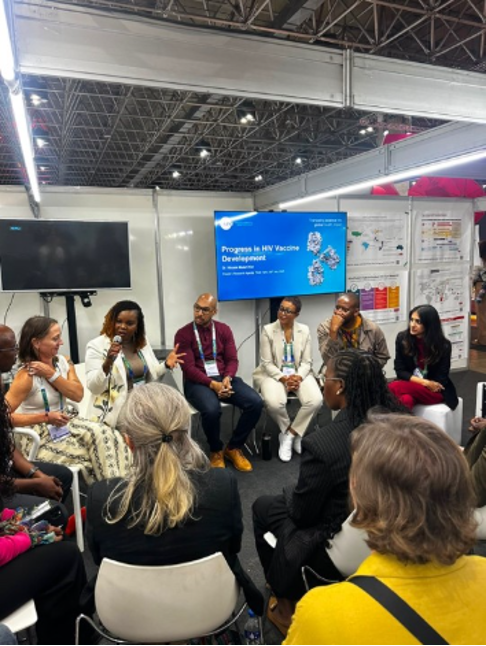
AVAC Regional Program Manager Grace Kumwenda leads advocates through a discussion around HIV vaccine research and development.
Throughout the conference, on panels, at protests and in private meetings, advocates seized opportunities to directly communicate where the field is falling short in delivering equitable access to HIV prevention. They pushed for the expansion of licensing of HIV prevention products, price transparency, ambitious supply volumes and a commitment to prioritize key populations. In a satellite session co-hosted by AVAC and Global Black Gay Men Connect (GBGMC), Josephine Aseme of the Nigeria Key Populations Health and Rights Network and the first person to receive lenacapavir (LEN) for PrEP in Nigeria stated, “It is good for stakeholders to understand that communities build trust, and without trust there is no prevention option that is going to have effective impact.” Erasure of key populations cannot be tolerated and leads to the breakdown of trust among communities. Danielle Campbell echoed this message in a satellite on long-acting HIV prevention implementation.

“Scientific breakthroughs alone do not end epidemics. We do. People do. Community does. Innovation only changes lives when it reaches the people who need it most…that’s representative of every individual stakeholder that you see on the stage and how we can bring to bear long-acting injectables for our respective communities.”
The African Women’s Prevention Community Accountability Board (AWPCAB), a leader in advancing HIV prevention choice for women, convened critical discussions on public stages and via strategic meetings with country leadership, gaining tangible commitments from heads of government around choice. Ministry of health representatives from South Africa and Zimbabwe endorsed moving forward a framework toward integrated, domestically-owned and -managed, primary health care-centered systems in which HIV prevention and treatment remain visible and community-based and community-led platforms are recognized as essential. The AWPCAB also advanced its focus on women across their lifecycle – ensuring young women had a platform to speak and providing critical mentorship to the next generation of advocates while also emphasizing care and support for women living with HIV as they age. Yvette Raphael, AWPCAB co-chair and advocacy leader in South Africa and globally, reminded audiences to look at women holistically and not just based on clinical results:

“We are made vulnerable when systems refuse to see us, listen to us, fund us, or design care around our real lives.”
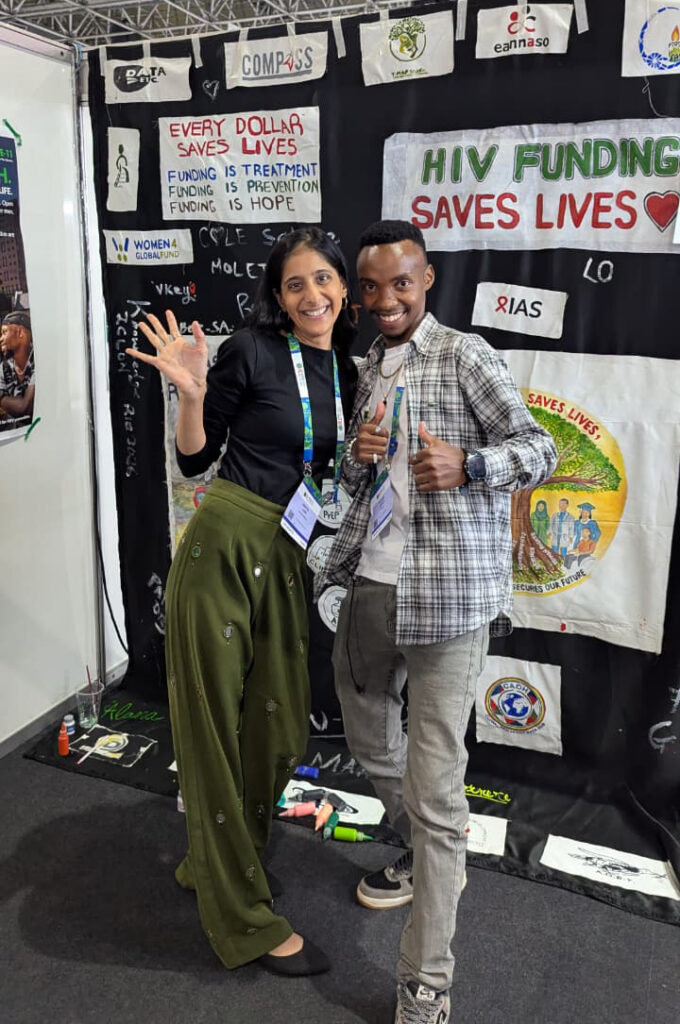
AVAC’s Navita Jain and Victor Adula, Executive Director at Consolation East Africa in Kenya and member of the Global Advocacy Data Hub (GADH), in front of the community quilt
Throughout the conference, AVAC’s HIV Cure and Prevention Research Networking Zone served as a space to connect researchers and advocates, refine advocacy strategies and tactics, share advocacy tools and resources, and network with influential stakeholders. Advocates came together to discuss new research on HIV cure, challenges across geographies for access to LEN for PrEP, ongoing trials of monthly oral alimatravir (AMI) for PrEP and HIV vaccine and antibody research. The Zone also hosted the launch of a new community quilt, created by the Global Advocacy Data Hub, the Coalition to build Momentum, Power, Activism, Strategy & Solidarity (COMPASS) and the Save HIV Funding campaign, that builds on the history of community quilts for AIDS advocacy. Participants added personal advocacy messages to the quilt to drive home a key message: community and civil society data is critical to advocacy.
In looking to the future, ITPC Executive Director and AVAC Board member Solange Baptiste elevated the role of community in innovation, noting “the future of AI in HIV should be shaped with communities, not simply built from data about them.”
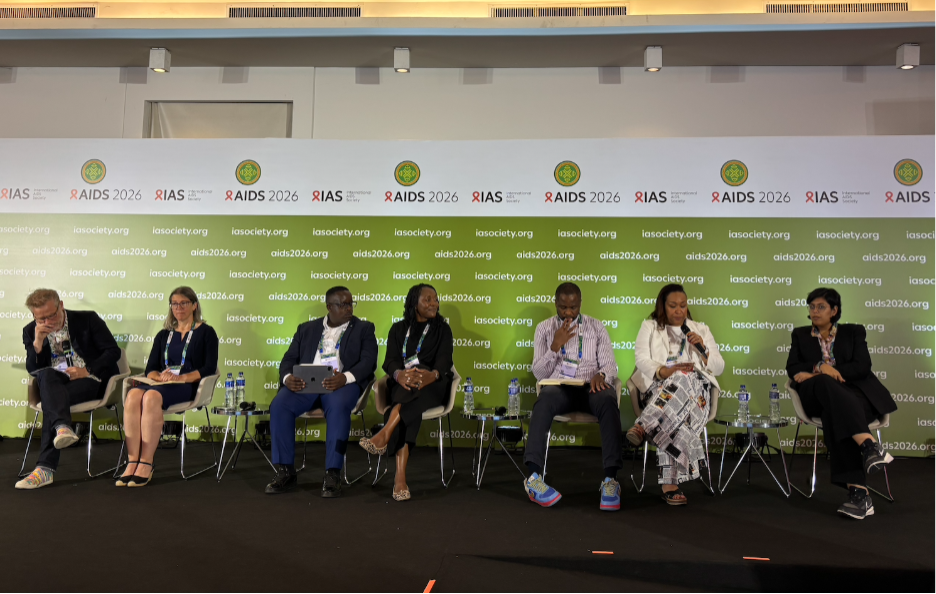
Solange Baptiste speaks at AI and HIV: Who owns the future of public health? satellite
As Dr. Tedros Adhanom Ghebreyesus, World Health Organization (WHO) Director-General said, “Communities have never been an optional partner in this response. They are its architects. They reach the people health systems cannot. They defend human rights. They hold all of us to account. The next chapter of the HIV response must be written not only for communities but with communities.”
This is the collective impact and leadership of communities. Since AIDS 2026, advocates have continued to come together to write the next chapter in the HIV response – working diligently to advance priorities and ensure civil society and community leadership are built into new and evolving global health platforms. AVAC and partners continue to fight for a future where advocates chart the course for the HIV response.