New issue of POSITIVELY AWARE points the way towards a more equitable future

By Kenyon Farrow

In many ways the world is entering an era of HIV prevention that many of us have spent the last 40 years fighting for— there now exists multiple options for preventing HIV that are safe, highly effective and easy to use. 2012 saw the introduction of the first ARV-based prevention option—daily oral PrEP. And over the past two years, WHO recommended, and several national regulatory agencies have approved, injectable ARVs for treatment and prevention, as well as the dapvirine vaginal ring.  

While these advances are something to celebrate, this is far from the end of the road. Technological gains only go as far as people’s awareness of them, desire to use them, and access to them. And this is where we — as a public health community and as a planet of humans — struggle. Just like with the first ARV therapies in the mid 1990s, and the first PrEP pill for prevention a decade ago, we’re now four years into the FDA approval of the first long-acting ARV therapy and we are several years away from scaling up these long-acting medications and truly seeing the impact they can have on the lives of people (whether living with HIV or in need of PrEP), and on the HIV epidemic itself.  

It takes the HIV response far too long to move these innovative inventions to the point where they become medical miracles, experienced by everyone who needs and wants them, regardless of race, ethnicity, national origin, religion, sexual orientation, gender identity, sex assigned at birth, pregnancy status or income. 

There is a new special issue of the magazine POSITIVELY AWARE, co-edited by Kenyon Farrow, AVAC’s communications director, and Jim Pickett, AVAC’s senior advisor and lead of the Choice Agenda, that explores the impact of long-acting injectable treatment and PrEP. The articles, including a piece co-authored by John Meade, AVAC’s senior policy manager, and Danielle Campbell of PrEP in Black America and longtime AVAC partner, speak to the humans involved in downstream research, and what their experiences as patients, researchers, advocates and medical providers of long-acting treatment and PrEP teach us about how these products could be transformative. These stories make clear how far we still have to go to change our health systems so that they can meet their maximum potential. 

AVAC will continue our work to advocate for global equity in access to prevention and treatment in all their current and future forms. We celebrate this issue of POSITIVELY AWARE as one collection of voices helping to point the way towards a more equitable future. 

New COMPASS Governance Structure to Accelerate HIV Policy and Advocacy

Pangaea Zimbabwe selected as new Secretariat

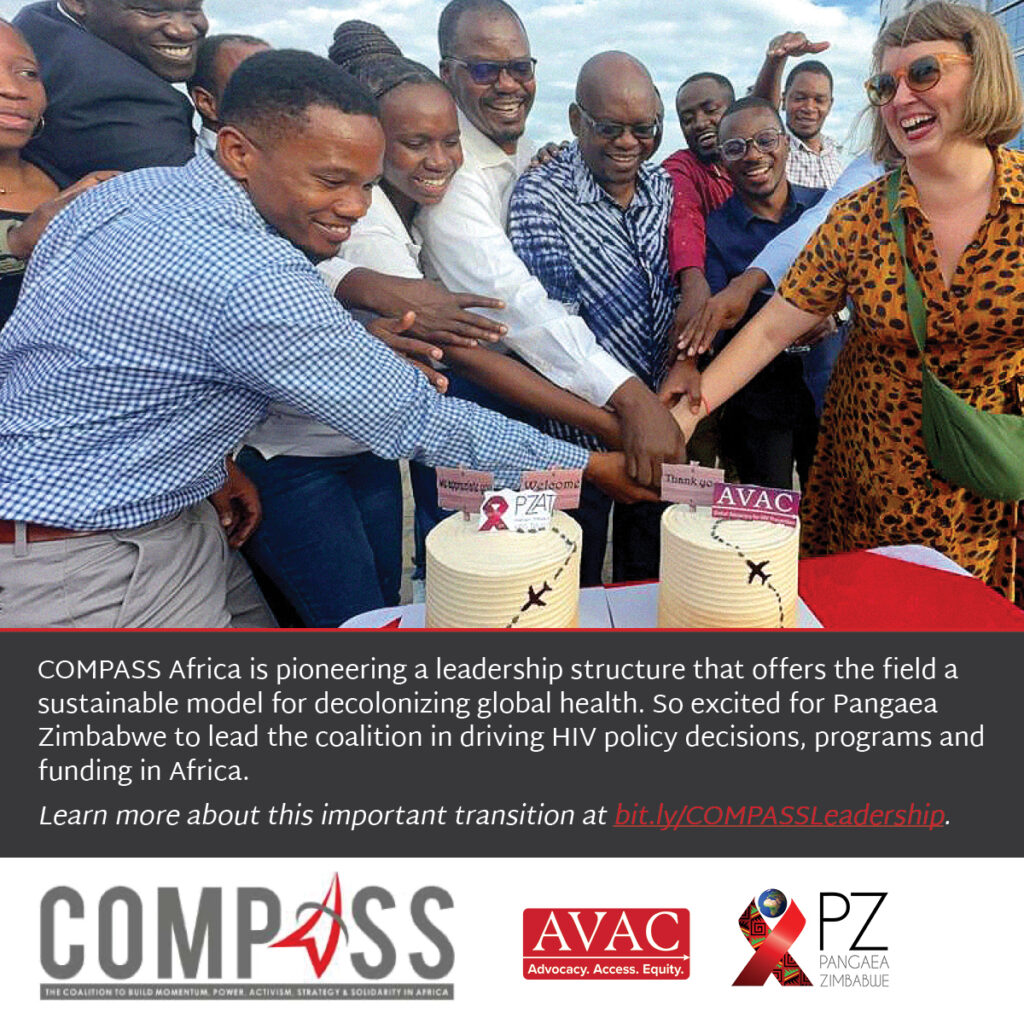
AVAC and Pangaea Zimbabwe are thrilled to announce Pangaea Zimbabwe’s new leadership of the Coalition to build Momentum, Power, Activism, Strategy & Solidarity (COMPASS) Africa, a historic milestone in the development of innovative models for power-sharing in coalition and an important step toward decolonizing global health.

Launched in 2017, COMPASS Africa is a civil society coalition with 29 organizations working in three countries as well as regionally and globally, using data-driven advocacy to improve the HIV response with high-impact campaigns. Its achievements to date have set new standards for mobilization and advocacy, improving laws and policies, increasing investment in programs, elevating the leadership of affected communities in the HIV response, and holding all stakeholders to account for targets, commitments and impact.

In December 2023, Pangaea Zimbabwe signed a new two-year, $4.9 million grant agreement with the Bill & Melinda Gates Foundation as the new secretariat of COMPASS Africa. For the first 6 years, AVAC served in this role, and worked with a coalition-wide governance committee to develop a clear transition plan for COMPASS to be led by African civil society organizations.

“Since 2017, we’ve been breaking new ground under COMPASS Africa. We’ve expanded our networks and brought together the superpowers of new and seasoned advocates who have diverse strengths and have joined together to develop and share technical expertise and winning strategies,” said Imelda Mahaka, executive director of Pangaea Zimbabwe. “This is a foundation of collaboration, knowledge-exchange and trust that can and will accelerate innovative advocacy under African leadership. We are so proud to take this step with AVAC and with support and collaboration of the entire consortium.”

COMPASS Africa supports coalitions and organizations based in Malawi, Tanzania, the United States and Zimbabwe, and COMPASS Africa members are currently leading more than two dozen active campaigns to advance HIV prevention and treatment. 

“From its founding, COMPASS Africa pursued a vision of collective power and shared decision-making that planned for a future in which an African-based organization would assume leadership as a vital step to sustaining this essential work,” said Mitchell Warren, executive director of AVAC. “The communities who are most affected by HIV uniquely understand their context, challenges and opportunities—their leadership is essential to developing solutions that work. With inclusive governance structures formalized, including Pangaea Zimbabwe as the new secretariat, that leadership is in place, and we are excited that AVAC will continue to be part of the coalition in its new form.”

“As planned from the inception of COMPASS Africa, coalition members are taking their highly successful model to the next level. We are jointly investing in the long-term success of African leadership because it is absolutely essential to breaking cycles that perpetuate inequity and that stall progress in the HIV response,” said Justine MacWilliam, senior program manager and COMPASS Africa partner at AVAC. 

Along with the handover of the secretariat from AVAC to Pangaea Zimbabwe, COMPASS Africa has developed a new governance manual strengthening operating structures for the growing coalition. AVAC will continue as a COMPASS Africa sub-grantee and technical partner focused on advocacy strategy and tactics, including ensuring community priorities are influencing global-level HIV policies, funders and programs.

“This effort put a premium on creating structures to deepen and sustain transparency, accountability, effectiveness and continuing growth within the coalition. COMPASS has a track record of remarkable achievements, this new leadership structure ensures we leverage lessons learned, scale up our advocacy, strengthen each other, and set ambitious goals for impacting the HIV response,” said Dr. Lilian Benjamin Mwakyosi, executive director of DARE Organization in United Republic of Tanzania and co-chair of the COMPASS Governance Working Group.

COMPASS Africa has been unparalleled in testing and succeeding with new models for transnational collaboration. The results have brought campaign after campaign that have marshalled the power of data-driven advocacy to advance community priorities and have convinced policymakers to do the right thing. With these latest innovations, COMPASS Africa is now pioneering a leadership structure that offers the field a sustainable model for decolonizing global health.

New Resources to Support Understanding of Scientific Research

We are delighted to share our new Translation Index, a resource for journalists and advocates, to help bridge the gap between scientific research and community understanding. The Translation Index offers health journalists and advocates accurate translations of commonly used and essential scientific and medical terms in 10 African languages.

Journalists and community health workers are often at the forefront of helping people understand complicated science and health terms in their own languages. Providing information in the language it will be reported minimizes errors and helps journalists reach a wider audience. AVAC is grateful for the Sabin Vaccine Institute‘s support in the development of the Translation Index.

“Since many journalists in community radios may not be highly specialized, the translation of technical science terms into vernacular languages is essential for audience comprehension. This becomes particularly relevant during crises, as witnessed during the pandemic when different radio stations provided varying names for COVID-19 in the same language.”

—Esther Nakkazi, founder of the Health Journalists Network in Uganda

Since 2012, AVAC has collaborated with health journalist associations in East and Southern Africa through its Media Science Café Program to strengthen the capacity of journalists to report on HIV prevention research. In 2020, AVAC and partners  expanded this work to include COVID-19 science. Today, AVAC partners with health media associations in Kenya, Malawi, Tanzania, Uganda, Zambia and Zimbabwe to bring journalists together with researchers, implementers, civil society, policy makers, regulators and policy makers to build relationships that will foster accurate reporting of HIV, COVID-19 and other science or health stories in those countries.
 
Join us, Tuesday, January 23 for a webinar, Reporting the African Science Story: Decoding scientific research to support public health in Africa where we will share highlights from our Media Science Café Program. Click here to register.

“Having a platform in Malawi for communicating science in local languages is a great innovation that will also enable more of the population to be able to follow science, research and other innovation in global and public health from a scientific perspective and participate in the discourse.”

– Dingaan Mithi, journalist and JournAIDS program manager

We hope you will visit the Translation Index and join us on the 23rd.

Remembering a Legacy and Celebrating AVAC Fellow Alumni

For over a decade, the AVAC Advocacy Fellows Program has played a role in shaping the landscape of HIV prevention by strengthening leadership skills and building a growing and evolving network of fierce and unstoppable advocates. Last year, AVAC released A Legacy of Impact: The power and reach of AVAC’s Advocacy Fellows to tell the story of the Fellows program and to share testimonies of impact from research to policy, and beyond.  

Today, on Martin Luther King Jr. Day, a day dedicated to the importance of advocacy to influence change, AVAC honors its nearly 100 Fellow alumni and applauds our most recent class which closed out their fellowship in December.  

Read on for testimonies from the AVAC 2022/2023 Fellows and explore their work in their individual pages. 

AVAC 2022/2023 Fellows in their words

Learn about Ruth’s work around the approval and rollout of the dual prevention pill (DPP) in Uganda here

Learn about Onward’s work with engaging religious institutions on adolescent sexual and reproductive health in Zimbabwe here.

Learn about Prince’s work ensuring access to injectable CAB for PrEP for trans people in Malawi here

Learn about Catherine’s work in the rollout and implementation of the dapivirine vaginal ring for adolescents and young women (AGYW) in Tanzania here

Learn about Natasha’s advocacy for the approval of the dapivirine vaginal ring and injectable CAB for PrEP in Zambia here

Learn about Peter’s work with differentiated service delivery of PrEP and expediting new PrEP tools in Lesotho here

Learn about Elizabeth’s work advocating for sex workers and people who use drugs (PUD) here

Learn about Liyema’s work on advocating and implementing the decriminalization of sex work in South Africa here.  

Get to know the full AVAC Fellows community by exploring the full alumni database and stay tuned to meet the 2024/2025 class to be announced in April! 

New Year, New PrEPWatch Resources

In 2024 we look forward to continuing to provide advocates with tools to support our collective work to ensure access to PrEP in all its forms to all who can benefit from it.  

PrEPWatch.org has grown significantly in the past year, reaching a growing number of implementers, policy makers and advocates with continually updated tools and information that are instrumental to delivering the growing range of HIV prevention options. Throughout 2023, visitors from every country in the world have used PrEPWatch.org, a one-stop online clearinghouse of data, guidelines, tracking tools and other resources to help the global community speed the delivery of every proven method of PrEP to everyone who needs it. Check out what’s new and updated on PrEPWatch.org! 

New on PrEPWatch

Modelling the Scale-Up of Injectable CAB for PrEP 

Our Biomedical Prevention Implementation Collaborative (BioPIC) teamed up with the HIV Modelling Consortium to produce this analysis of the potential impact of scaling up injectable cabotegravir (CAB) for PrEP, What can modelling tell us about the scale-up of CAB for PrEP? The findings can help implementers and policymakers understand what to expect and guide early policy decisions to maximize the impact of CAB for PrEP on the HIV epidemic. 

Country Pages 

PrEPWatch has added 35 new country pages where you can find the status of drug registration for PrEP products, data on PrEP initiations by product, country-level PEPFAR targets, and links to key policy documents and guidelines.  

The Integrated Study Dashboard  

Produced under the BioPIC project, the Integrated Study Dashboard tracks all currently known activities relating to implementation research, modelling, clinical research, and landscaping for new biomedical HIV PrEP options, including CAB for PrEP and the dapivirine vaginal ring (DVR), and has been recently expanded to include links to study results and study websites. The dashboard is updated in real time, and links to results will be added as they become available. 

More Essential Resources on PrEPWatch.org

Tracking Country Planning for Product Introduction 

The Country Planning for Product Introduction Matrix tracks key indicators for the introduction of injectable CAB and the DVR by country, including regulatory status, late-stage clinical trials and implementation research, procurement plans, and recent oral PrEP provision. 

Training PrEP Champions  

Among the most popular resources on PrEPWatch, the HIV Prevention Ambassador Training Package and Toolkit prepares potential and current PrEP users to be leaders – and “Ambassadors” – in the rollout of PrEP for HIV prevention in their communities. Developed as part of the MOSAIC project, it includes a training manual and resources for Ambassadors to use in peer outreach and community education.  

Trends in PrEP Initiations  

The Global PrEP Tracker provides quarterly updates on global trends in PrEP initiation by geography, delivery models, and more. The Global PrEP Tracker has become an indispensable resource for following the state of the field in delivering PrEP.  

We hope these tools, created through strong partnerships and joint effort, support your work to accelerate the delivery of HIV prevention options. We are always interested in collaboration to ensure needed resources are developed and up to date.  If you have information to share or resource needs, please let us know by reaching out to [email protected] and [email protected].  

Upcoming Webinars and Workshops You Won’t Want to Miss!

Happy New Year! We hope you had good holidays and are ready for all that we need to do in 2024. To get started, kick-off the new year with an exciting lineup of webinars and workshops that will set a foundation for our collective advocacy in the year ahead. Read on for details! 

PrEPVacc: An in-depth look at the trial, and what’s next

January 11, 9:30-11:00 am EST 

Join the PrEPVacc team and AVAC to review the PrEPVacc trial, which is testing two different vaccine candidates and two daily oral PrEP regimens. Join us to learn about PrEPVacc’s innovative study design and implementation, how the trial integrated social and behavioral science, details on the latest decision to discontinue vaccinations, and what the results mean to the field. Register here

January is Cervical Cancer Awareness Month and AVAC is sponsoring a series of webinars to help advocates who care about sexual and reproductive health and rights to understand who is impacted by cervical cancer, what it means for key populations, its intersection with HIV, and the status of treatment and prevention. Register here for topics that interest you most or the full series.   

Cervical Cancer: What, where, and prevention and treatment options 

January 11 8:00-9:00 am EST 

Register here 

Advocacy and Cervical Cancer: Voices that are creating change 

January 18, 8:00-9:00 am EST  

Register here 

Screening and Treating Cervical Cancer 

January 25, 8:00-9:00 am EST  

Register here 

Cervical Cancer Among Key Populations 

February 1, 8:00-9:00 am EST  

Register here 

Reporting the African Science Story: Decoding scientific research to support public health in Africa 

January 23, 9:30-11:00 am EST 

The Media Science Cafés bring together journalists, researchers, implementers, civil society, policy makers, and regulators to build relationships that will foster accurate reporting of HIV, COVID and other science or health stories in those countries. Learn more about this model, lessons learned and why relationships across these fields are a must for advancing HIV prevention and global health.  

Register here

African Workshop on HIV & Women 2024 

February 22-23, 8:30 am-4:30 pm EAT 

This regional workshop sponsored by the Academic Medical Education platform of Virology Education is for healthcare providers, researchers, government, industry, and community representatives to increase their knowledge of issues related to HIV and women living in Africa. Early-career investigators will also have opportunities to present their research and meet with experts. Organizers will use this hybrid workshop as a launch for ongoing participant engagement, identifying partnerships, projects and continuing collaboration.   

Regular fee deadline, February 8. 

Register here

Px Pulse: A season of listening

As we look ahead to 2024 and the vital work AVAC and partners will be carrying forward, the conversations from 2023 offer guidance and insights. Px Pulse, AVAC’s podcast on critical issues facing HIV prevention research, hosted several not-be-missed conversations in 2023 that will reverberate into the year ahead.  

From a stalled PEPFAR reauthorization to LGBTQIA+ voices fighting persecution in Uganda; from efforts to bring equity to a new global architecture for pandemic readiness to advances in HIV vaccine science and advocacy to include pregnant people in research—we hope that all of these conversations can inform our advocacy in 2024. Click on the episode for both recordings and resources.

PEPFAR at 20: Keeping the promise (23:16)

Considered one of the greatest US foreign policy and global development achievements of the century, the program has saved upwards of 25 million lives since it launched in 2003. But PEPFAR is marking its 20th anniversary while fighting for its future. LISTEN HERE.

LGBTQIA+ Advocacy in Uganda: Facing down fear and fighting for justice (24:19)

In March 2023, the Ugandan Parliament moved forward broad-reaching legislation to further criminalize LGBTQIA+ people. This podcast features Ugandan advocates and AVAC partners discussing the specifics of how these attacks have gained momentum and their ties to US-based religious extremists. The advocates discuss what needs to happen next. LISTEN HERE.

The Shape of Pandemic Preparedness is Being Decided. Now is the Time for Collective Action (15:14)

Health leaders around the world are in the midst of creating a new architecture to deal with pandemics. Chris Collins, the CEO and President at Friends of the Global Fight Against AIDS, Tuberculosis and Malaria, talks about what’s at stake, which policymakers get it already, why this year matters so much, and what advocates can do about it. LISTEN HERE.

PPPR Advocacy 101: Find out what it means to you (19:05)

Over the coming months, global leaders will make key decisions about several initiatives to prepare for the next pandemic. This podcast explores what they commit to, how much they will spend and how well these plans safeguard equity. LISTEN HERE.

Inclusion of Pregnant and Lactating People in HIV Research: What you need to know (34:28)

AVAC’s Manju Chatani-Gada takes us through conversations with a trial participant who became pregnant, researchers, policymakers and donors to understand why this population gets excluded, the impact it has and what to do about it. LISTEN HERE.

Evolving Strategies for an HIV Vaccine: One researcher explains where the field is going and why? (21:23)

Evolving Strategies for an HIV Vaccine: One researcher explains where the field is going and why? Dr. Katy Stephenson explores the implications of recent trial results, the big questions driving next generation vaccine development, and new strategies underway in early phase research. LISTEN HERE.

Happy listening—and let us know what topics you want to hear more about in 2024! 

The Search for an HIV Vaccine Must Continue

Field Will Learn for Halted PrEPVacc Arm

By Jeanne Baron

Today the PrEPVacc trial team announced at a special session at the International Conference on AIDS and STIs in Africa (ICASA) in Harare, Zimbabwe, that they were stopping vaccinations in the study following a review by an independent data safety committee that determined there was little chance the vaccines being tested could stop HIV acquisition. The oral PrEP arms of the study will continue. 

PrEPVacc was testing two different vaccine strategies against a placebo: one regimen combining a DNA vaccine with a protein-based vaccine (AIDSVAX), and another regimen combining DNA, MVA and a protein-based vaccine (CN54gp140). 

“We always hope for a positive outcome in HIV prevention trials, and this news is disappointing,” said Mitchell Warren, AVAC executive director. “We look forward to seeing the full PrEPVacc data in 2024 and hope it will add to the body of evidence that is helping scientists understand how to develop better vaccine candidates that will one day protect against HIV.”  

“The PrEPVacc outcome underscores yet again that the science of HIV vaccine development is extremely challenging,” he added. “Now is not the time to step back from vaccine research. There are several promising strategies in early-stage research that must continue, along with research for other HIV prevention options. We will not end HIV without ensuring that everyone who is vulnerable to HIV infection has a choice of effective and desirable prevention options.”  

Importantly, PrEPVacc’s PrEP arms will continue. The study is testing two different formulations of daily oral PrEP, looking to see if a new formulation – F/TAF (also known as Descovy) – is at least as good in the trial population at protecting against HIV acquisition as F/TDF (also known as Truvada and the most widely used version of PrEP). The trial will provide the first data for F/TAF among cisgender women (who make up 87% of the just over 1,500 PrEPVacc trial participants). F/TAF is approved for use in the US and UK, but not for those individuals who have receptive vaginal sex, since previous trials regrettably did not enroll cisgender women. 

The PrEPVacc study is scheduled to conclude in 2024 and data from all arms of the study are expected to be reported in the last half of 2024. 

“The PrEP arms of PrEPVacc will provide important insights into the potential of expanding access of F/TAF for PrEP to women in East and Southern Africa who need additional options to protect themselves from HIV. Equitable access to new interventions should be a goal of every research program,” said Stacey Hannah, AVAC’s director of Research Engagement. 

“PrEPVacc is a complex, innovative trial design, and, while the vaccine result today is disappointing, the trial team has worked from the outset to implement the Good Participatory Practice (GPP) Guidelines. The team’s hard work on the front-end to apply GPP to this trial is paying off especially now in the ability to deliver complex, disappointing results to trial participants, advocates, policymakers and other key supporters of PrEPVacc and of HIV prevention broadly.” 

ICASA 2023: Demands for equity and investment in the HIV response

By Jeanne Baron

At the ongoing International Conference on AIDS and STIs in Africa (ICASA), the struggle to sustain an evidence- and rights-based HIV response is heating up. HIV prevention and global health equity depend on continuing to build on the gains to date, to learn from mistakes, and to invest in scaling up now-proven solutions while developing additional ones. But all these principles are increasingly threatened by political reaction and short-sighted investment. AVAC and partners released four major calls to action at ICASA to confront these urgent challenges, which are imperiling the communities most burdened by HIV and other health inequities. Each of these resources set an agenda to address critical gaps. 

Upholding Civil Society Voices in Health International Conferences: A response to the suppression and cancellation of community voices at ICASA 2023

A permitted People’s March scheduled for December 5 in Harare was cancelled due to acute safety concerns following the arrest of conference attendees at a demonstration, and other intimidating police actions against civil society and key populations at the conference. AVAC is part of coalition that issued an open letter to the conference secretariat condemning the suppression of community voices and calling for the People’s March to go forward and future guarantees that ICASA host countries commit to allowing community voices to be heard and ensuring their activities are unhindered. 

The Global HIV Prevention Roadmap for Key Populations

This roadmap outlines a strategy for the equitable expansion and delivery of HIV prevention services to key populations (KPs) globally and regionally. It introduces a critical, coordinated approach led by KPs to accelerate the implementation of existing and new HIV prevention interventions. Developed by the Global KP HIV Prevention Advisory Group (KPAG) and allied stakeholders, this roadmap represents near-term priorities for funding, U=U, PrEP targets, the advancement of rights— particularly decriminalization of key populations and more for key stakeholders and regions to achieve by mid 2025. This roadmap is a terrific complement to the recently-released Choice Manifesto, led by women advocates throughout Eastern and Southern Africa.

“This is nothing new, we’ve been saying this for years, but now it is more urgent than ever: Funding to key populations must go beyond services to support our advocacy and our activism.  Decriminalization is imperative. We are not criminals, and with a stroke of the pen decriminalizing key populations could lead to lower incidence of HIV,” said KPAG member and former AVAC Fellow, Josephine Aseme at a press conference promoting the importance of this roadmap.

Mobilizing People of Faith to Build Networks to Protect Human Rights and Overcome Homophobia

Faith leaders from across the region convened by African Services Committee, AVAC, GALZ & Inerela joined in solidarity in defense of human rights and evidence-based HIV prevention, including for vulnerable populations. Among the pledges, participating faith leaders are committing to engage in cultural and legislative initiatives related to LGBTQIA+ issues that promote love, grace, compassion, equity and justice for all. 

Call to Action for Voluntary Medical Male Circumcision: The job is not done yet

Despite impressive achievements in bringing voluntary medical male circumcision (VMMC) to scale, the pace of funding and the expansion of programs delivering VMMC must intensify to reach 2030 global targets for HIV prevention. Modeling studies suggest the approximately 30 million VMMC’s conducted between 2008-2020 averted 615,000 new HIV infections. By 2030 that number could be 1.6 million infections averted, if the HIV response sustains and expands VMMC. This joint report was prepared by AVAC, Azali Healthcare, Bill & Melinda Gates FoundationJhpiego, the Coalition for Health Promotion and Social Development (HEPS-Uganda), Treatment Advocacy and Literacy Campaign (TALC), the Joint United Nations Program on HIV/AIDS(UNAIDS) and the World Health Organization (WHO). Find a two-page summary here and the full report here

“VMMC offers us an exceptional opportunity to get men into the healthcare system but we have gone off track. We can’t afford to lose momentum. The job is not yet done. New funding is needed now. Integration is needed now. Sustained commitment is needed now.” – Chilufya Kasanda Hampongo, TALC Zambi

All four initiatives launched at ICASA take aim at critical gaps in the HIV response. Each provide resources that outline next steps and roles for stakeholders across the field to advance equity, and in turn help the world reach global targets to end the epidemic.  

AVAC Commemorates World AIDS Day

This World AIDS Day we at AVAC are reflecting on remarkable gains and increasing threats to progress against AIDS. Our latest issue of PxWire, tracking trends in research, development and delivery of HIV prevention options, speaks to this important progress: 

However, as we look to 2024, all these gains could be imperiled by political and financial choices facing leaders today.

The answers to these questions will require donors and political leaders to do the right thing, and it will depend on us, a global movement of advocates with a track record of world-changing achievements, to stay the course and build the road to reach everyone one of these goals. Below are a few key resources to support your work. 

From the Lab to the Jab

A series of advocates guides on key issues to ensure equitable access to safe, effective, and affordable vaccines.

Learn more.

Call to Action for Voluntary Medical Male Circumcision

A report on next steps to advance the role of VMMC in ending the epidemic.

Learn more.

Good Participatory Practice: Body of Evidence

An online package of resources to support advocacy for GPP as an international standard for clinical trials.

Learn more.

The HIV Prevention Choice Manifesto

A historic milestone in the power of community-led leadership and prioritization of choice in HIV prevention.  

Learn more.

Progress Against HIV and AIDS is Fragile

POZ Magazine’s interview with Mitchell Warren, with a comprehensive look at the status of the fight against HIV/AIDS and the scientific breakthroughs to date and still needed to end the epidemic.

Read more.

The Anti-HIV Jab is Coming to South Africa

Bhekisisa’s Mia Malan and AVAC’s Mitchell Warren breakdown what it will take to get injectable CAB for PrEP to everyone who needs it.

Listen here.

A Call to Action: Scale Up HPV Vaccination in People Living with HIV

In a new call to action, Mitchell Warren and Heather White, executive director of TogetHER for Health, argue that the time is now to invest in efforts to ensure that people living with HIV can live their lives without the threat of cervical cancer.

Read more.


At AVAC, we believe it’s up to all of us to make sure the world does not squander another decade in slow, fragmented rollout of life-saving innovation in HIV prevention or risk underfunding research and development. If we work together to build equity into the rollout of options that exist already and support the promise of expanding choices in the near future, the world will at long last bend the curve of HIV.