30 Years of Standing for Science and Equity

This month, AVAC marked our 30th anniversary. Over three decades, the HIV field has evolved dramatically—but what we do, and why we do it, has remained constant: standing for science, equity, and community leadership, and ensuring evidence drives decisions that affect people’s lives. We’ve been able to do this work because of your partnership and support, and we are deeply grateful.

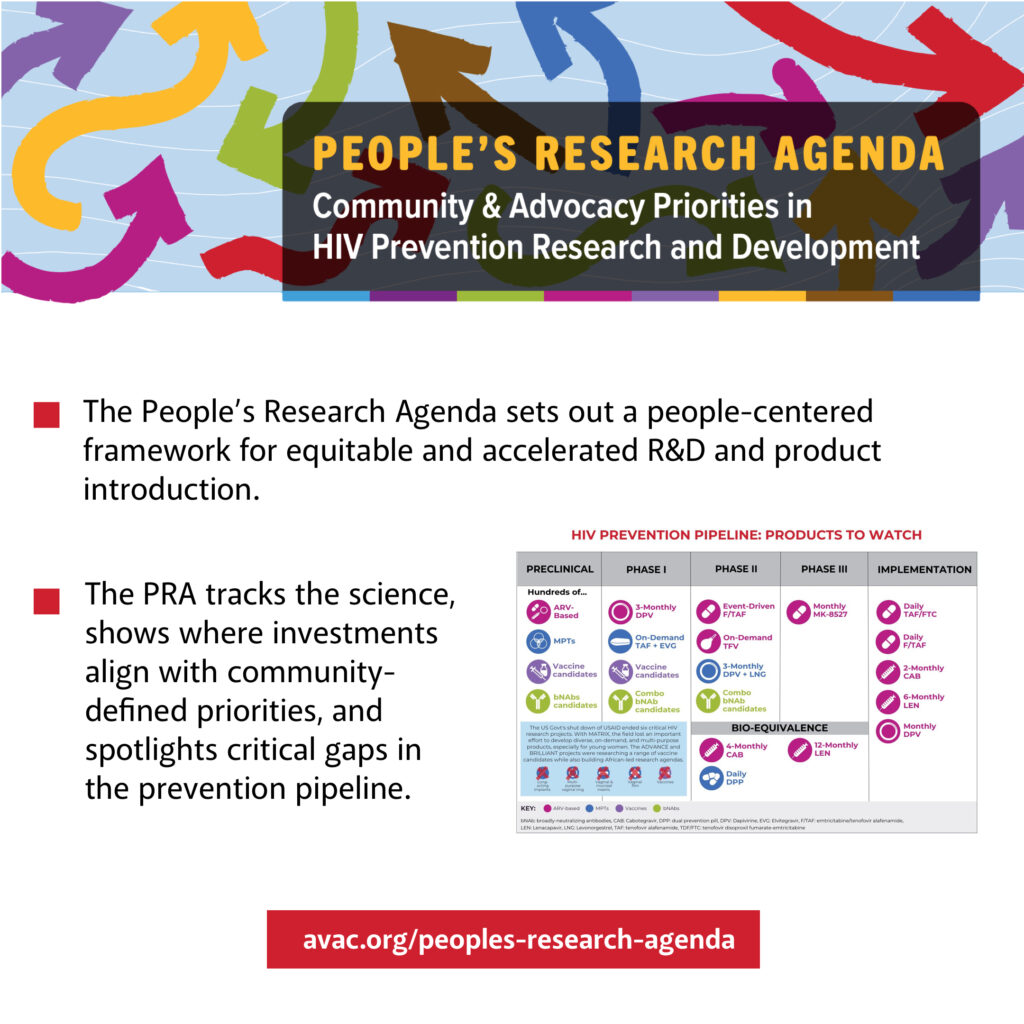
Last week, we also released the 2025 update of the People’s Research Agenda (PRA), which tracks the science, highlights where investments align—or fail to align—with community priorities, and identifies critical gaps that must be addressed to ensure the prevention pipeline meets the needs of diverse populations. After ten months of disruption and uncertainty across biomedical research and global health, we hope this agenda helps share a path forward, one that will demand sharper priorities, smarter investments, and a balanced portfolio focused on real epidemic impact.

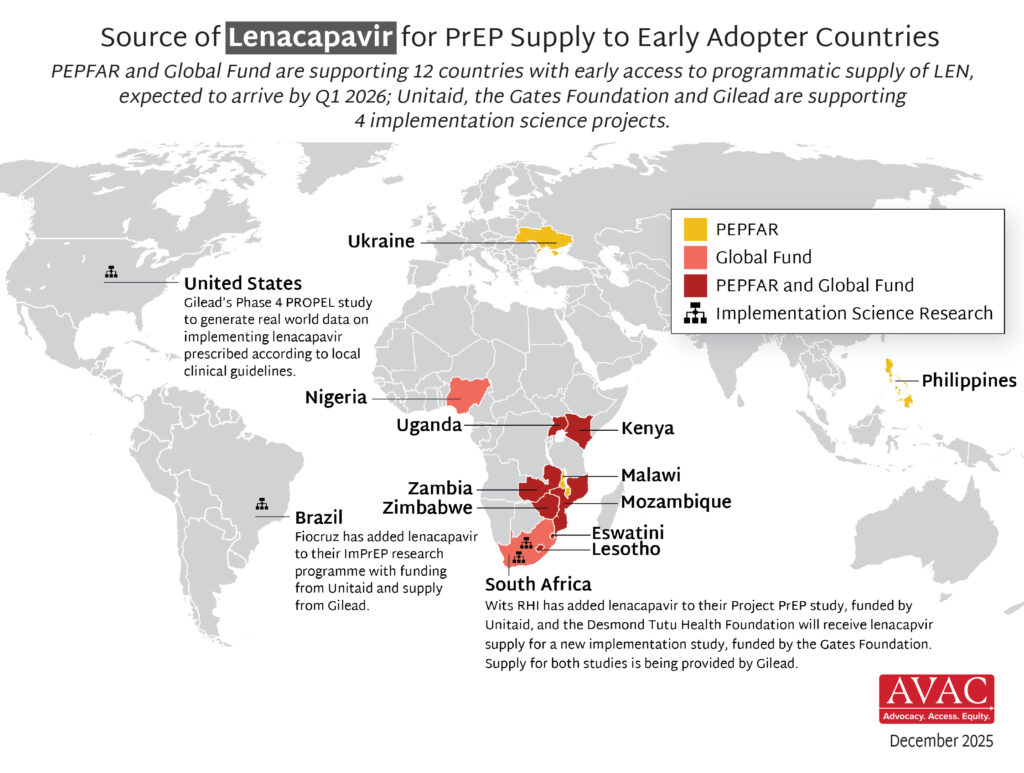
At the same time, we are seeing real progress. In just the past month, people in Brazil, Eswatini, South Africa, and Zambia began receiving the first doses of lenacapavir for PrEP (LEN) through early implementation programs outside the US, with additional deliveries of LEN planned for Eswatini, Zambia, Kenya, Lesotho, Mozambique, Nigeria, Uganda, and Zimbabwe.

AVAC’s updated map of Global Fund and PEPFAR-supported LEN supply shows how quickly this breakthrough is moving and what’s possible when political will, funding, community engagement, and innovation align. But there is still so much more to do – as we wrote last week, science alone won’t get us there: the future of HIV prevention depends on speed, scale and equity. 

As these advances continue to develop, AVAC will continue to help make sense of the rapidly shifting global health landscape. From World AIDS Day passing with little acknowledgment by the US government, to the LEN rollout (and South Africa being left behind), to the gutting of foreign aid and impact on HIV prevention and global health, to new bilateral health MoUs under the US “America First” strategy, AVAC has shared real-time analysis and context on the most pressing issues of December. Global Health Watch, now in its 46th week, will continue providing consistent, trusted context so you can navigate the turmoil with clarity, purpose and solidarity.   

As we enter our fourth decade, your support makes it possible for AVAC to keep tracking the science, elevating community priorities, and delivering real-time analysis when it matters most. If you’re able, we invite you to consider making a year-end gift to sustain this work. 

Thank you for being part of this work, and for standing with AVAC. 

Global Health Watch: NIH turmoil + a high-profile lawsuit, future of UNAIDS, more Countries sign “America First” MoUs with US

Issue 47

This week covers the significant turmoil at the US National Institutes of Health (NIH), including a close look at the NIH deputy director’s role in disruptions in leadership and funding cuts, and a lawsuit filed by the former Director of the National Institute of Allergy and Infectious Diseases (NIAID). It also covers urgent civil society pushback against efforts to sunset UNAIDS, the rapid expansion of US “America First” bilateral health agreements across Africa, and what’s next for STI research, prevention and diagnostics.

NIH Leadership Turmoil

A new investigation by The Atlantic’s Katherine Wu examines the central role of the Deputy Director of the National Institutes of Health (NIH), Matthew Memoli, in recent leadership changes and funding cuts across the NIH, including the firing of former NIAID Director, Jeanne Marrazzo, and the reassignment of Carl Dieffenbach, longtime director of NIAID’s Division of AIDS, to another NIH center. The Atlantic’s reporting shows how these decisions have significantly weakened NIAID, with particularly acute impacts on HIV prevention and vaccine research, where programs, expertise, and long-term scientific capacity are being eroded amid broader restructuring and budget shifts.

In addition, this week, Dr. Marrazzo, the newly appointed chief executive officer of the Infectious Diseases Society of America (IDSA), filed a lawsuit against the US federal government. The lawsuit alleges that Marrazzo was illegally fired from her position and seeks to be reinstated as head of NIAID and to receive formal declarations that her rights were violated. The suit argues that her firing was retaliation for a whistleblower complaint she filed on September 3, in which she raised concerns about anti-vaccine positions held by newly appointed NIH officials; demands to halt clinical trials; and requests to cut international research collaborations. Twenty-two days after filing the complaint, Marrazzo was fired by Health and Human Services Secretary, Robert F. Kennedy Jr.

IMPLICATIONS: The developments at the NIH show instability at its leadership level and severe consequences for infectious disease research, particularly vaccine research. This comes at a time when sustained R&D investment is most critical. Without robust research support, future advances in next-generation options could stall. See the new People’s Research Agenda, which calls for a balanced HIV prevention portfolio that is optimized for impact. However, Marrazzo’s new role at the IDSA, which represents clinicians, scientists and public health experts who are driving policy and advocacy to address critical issues in combating infectious disease, will be pivotal in ensuring rigorous science, inclusion and equity in research, community engagement, and evidence-based communications remain central to tenors in global health discourse and debate.

READ:  

Future of UNAIDS 

Member states and civil society convened at the 57th meeting of the UNAIDS Programme Coordinating Board (PCB) in Brazil this week to discuss urgent decisions about the future of the global HIV response amid deep funding cuts and a shifting global health landscape. They reviewed and approved the Global AIDS Strategy 2026–2031 and assessed the impact on communities from disruptions to services for HIV prevention and treatment. Civil society representatives on the PCB shared comments, and African women leaders and other civil society groups issued statements (and sign-ons) denouncing efforts to sunset UNAIDS by the end of 2026: “Any move to sunset UNAIDS before ending AIDS as a public health threat is premature and unacceptable. No sunsetting until we finish the job. AIDS is not over.”  

The PCB also held a special thematic session on long-acting ARVs for treatment and prevention. See this clip from Yvette Raphael where she included AVAC’s latest blog in her remarks about the current context: “We cannot let cruel international policy allow historic gains to collapse, just as a few highly effective prevention options arrive. That is why rolling out LEN to all countries that need it with speed, scale and equity must be our uncompromised, uncompromising priority. If we do this, we can change the trajectory of the epidemic, but only if we act at the pace that data and science demand.”

IMPLICATIONS: As the world moves toward the June 2026 High-Level Meeting on HIV, and the rollout of the new Global AIDS Strategy, the strong pushback by civil society at the PCB underscores that any reform must preserve UNAIDS’ core mandate and ensure that the global HIV response remains centered on those most affected — especially women, girls, and key populations — rather than being quietly dismantled at a moment of crisis.

READ:  

Eswatini and Mozambique Join Growing List of African Countries to Sign “America First” Bilateral Health MoUs

Mozambique and Eswatini are the latest countries to sign the bilateral health Memorandums of Understanding (MoUs) with the United States under the America First Global Health Strategy, adding to earlier agreements with Kenya, Liberia, Rwanda and Uganda. These agreements provide 5 to 10 years of funding and health support in exchange for co-financing, health data, pathogen-specimens, and national health system data, marking a major shift in how global health cooperation is structured under US leadership.   

IMPLICATIONS: The pace of these agreements shows how quickly the Administration is moving to reshape US global health with little time for discussion and debate on transparency, consultation, and how civil society fits within this evolving framework. As the landscape shifts, civil society and non-governmental organizations must quickly reassess their roles in the hope of preserving aid delivery, accountability, and equity. 

READ:  

The Future of HIV Prevention Depends on Speed, Scale and Equity

“Every funding cut can represent at minimum, a delay. Every delay in rollout is a missed chance to prevent infections. Every un- or underfunded clinic is a barrier to access. Every policy is a choice to be inclusive or leave someone behind…”

Read AVAC's New Blog

What We’re Reading

STIs Spotlight

AVAC’s STI program looks back at 2025—and ahead to 2026—tracking rising STI rates, major HPV vaccination gains, slow but promising diagnostics, the growing role of self-care, and what’s next for STI research, prevention and diagnostics.

Read More

Press Release

AVAC Board Member Jeanne Marrazzo named CEO of IDSA 

Contact: [email protected]

New York, NY, December 18, 2025 — AVAC enthusiastically applauds the selection of Jeanne Marrazzo, MD, to serve as the new chief executive officer of the Infectious Diseases Society of America (IDSA). Marrazzo brings outstanding leadership and research expertise to this role. She has demonstrated decades of unwavering commitment to research and advocacy for HIV and STI prevention, and a deep understanding of the importance of equity, accountability and trust in science, research and global health.

“Jeanne Marrazzo is an extraordinary choice and perfectly suited to lead IDSA and the larger infectious disease field into the future, especially at this particularly perilous moment,” said AVAC’s executive director, Mitchell Warren. “Her deep commitment to rigorous science, inclusion and equity in research, community engagement, and accurate, evidence-based communications is unparalleled — and is needed now more than ever.”

IDSA represents clinicians, scientists and public health experts from around the world, who are driving policy and advocacy to address critical issues in combating infectious disease, from workforce development to clinical guidelines to pandemic preparedness. Marrazzo’s vision, abiding integrity and leadership at IDSA will be a boon for the field.

Marrazzo, an AVAC board member, previously served as the director of the NIH’s National Institute of Allergy and infectious Disease (NIAID). Marrazzo was put on administrative leave by the new US presidential administration earlier this year and was formally dismissed from her position in September. She has consistently displayed extraordinary commitment, courage and leadership in responding to attacks on the NIH and on science generally.

“Her actions are a model for all who believe equity and evidence are the bedrock of science, research and health. We proudly stand with Dr. Marrazzo, and we look forward to her leadership and partnership in sustaining progress against HIV and other infectious diseases and in helping re-build trust and confidence in science and public health,” said Warren.

###

About AVAC
AVAC is an international non-profit organization that provides an independent voice and leverages global partnerships to accelerate ethical development and equitable delivery of effective HIV prevention options, as part of a comprehensive and integrated pathway to global health equity. Follow AVAC on Bluesky and Instagram. Find more at www.avac.org and www.prepwatch.org. 

Global Health Watch: PEPFAR negotiations leave communities behind, Global Fund replenishment falls short, continued chaos at CDC and NIH

Issue 44

UNAIDS World AIDS Day report: Overcoming disruption, transforming the AIDS response

Decisions and actions this week further weaken the global HIV response — from the exclusion of communities in the new PEPFAR US global health strategy negotiations to a Global Fund replenishment that falls short of what’s needed to deliver emerging HIV, TB, and malaria innovations at scale. Major disruptions at the US CDC and NIH – including halted non-human primate research, politicized vaccine messaging, leadership changes that jeopardize HIV research, and “skipping” World AIDS Day — continue the erosion of accountability, trust, and the integrity of the public health system. 

US Global Health Strategy Negotiations Leaving Communities Behind 

African advocacy partners including Eastern Africa National Networks of AIDS and Health Service Organizations (EANNASO) and the Coalition to build Momentum, Power, Activism, Strategy & Solidarity in Africa (COMPASS) have been taking stock of the ongoing country negotiations around the US government’s Memorandums of Understanding (MoUs) as part of its new “America First” global health strategy. They are finding that communities are being systematically excluded from the “government-to-government” negotiations for new 5-year PEPFAR MoUs, a direct reversal of the community engagement that has defined decades of the HIV response. Efforts to ensure program effectiveness, implementer accountability, programs for key populations, and commodity security are all at stake. The new framework would also require partner countries to share pathogens and patient data, potentially with US commercial interests, without privacy safeguards or assured access to resulting products — for decades longer than the life of the actual MOUs. With an MoU signing deadline of December 12, there is a great need to mobilize to demand transparency, inclusion and fair terms for all parties. 

IMPLICATIONS: The exclusion of communities from the new MoU negotiations is an abrupt shift away from the community-centered model that has been at the center of PEPFAR’s success for decades. These closed-door, government-to-government negotiations undermine the hard-won progress on reaching key populations, protecting data privacy, and delivering services that are responsive to the real-life needs of communities. Sidelining communities threatens the effectiveness, and legitimacy of the next phase of the HIV response and without immediate transparency and meaningful engagement, these MoUs risk weakening impact and trust. 

READ: 

Global Fund Replenishment Support, But Falls Short of Target 

Last Friday, donors pledged just over $11 billion at the Global Fund’s 8th Replenishment in Johannesburg. This was an important show of support, especially given the challenging political and economic climate, but well short of the $18 billion target needed to fully harness today’s unprecedented scientific advances against HIV, TB and malaria. The US pledged $4.6 billion, a decrease from the previous cycle, even as it reaffirms the 1:2 matching commitment, placing renewed pressure on Congress to fully appropriate funds, and on other donors to step up.  

IMPLICATIONS: As long-acting HIV prevention, new malaria tools and improved TB treatments enter the market, this shortfall threatens the speed, scale and equity of their rollout. And with communities already facing service disruptions, this shortfall could cost millions of lives and squander a historic opportunity to turn innovation into impact. 

READ: 

Big Disruptions at US CDC and NIH – and World AIDS Day

In the last week, decisions and actions at the Centers for Disease Control and Prevention (CDC) and the National Institutes of Health’s (NIH) Division of AIDS (DAIDS) further jeopardize the future of HIV research and confidence in vaccines. The CDC abruptly ordered an end to all non-human primate research, including critical macaque studies that have long supported HIV prevention science. The agency also altered language on its website implying a link to vaccines and autism and contradicting established scientific consensus. At the NIH, long-time DAIDS Director, Carl Dieffenbach, was reassigned to the Fogarty International Center, a move that removes a trusted leader who played a central role in guiding HIV research. See AVAC’s resource, HIV Prevention R&D at Risk, which tracks the impact of all this and more. Also, just ahead of December 1, the US administration announced that it will no longer commemorate World AIDS Day. 

IMPLICATIONS: Together, these actions continue the decline in US global health leadership, unraveling decades of scientific progress and trust in vaccines and public health institutions. Halting essential preclinical research in macaques, politicizing vaccine messaging and sidelining experienced leadership weakens the pipeline of innovation and threatens the integrity of HIV science at a moment when sustained investment and credibility are most needed. As for World AIDS Day, Congressman Mark Pocan, who leads the Congressional HIV/AIDS Caucus, said the administration’s refusal was “shameful and dangerous.” But it’s important to remember that World AIDS Day is not decided by the US government; it belongs to everyone – and the new UNAIDS report provides the theme: Overcoming disruption, transforming the AIDS response. Or as the International AIDS Society says: Rethink. Rebuild. Rise. 

READ: 

What We’re Reading

UNAIDS World AIDS Day report: Overcoming disruption, transforming the AIDS response

UNAIDS’ new report shows that we were closer than in decades to ending AIDS by 2030, yet new HIV infections stayed flat in 2024, even before funding cuts, and resources were not enough to drive them down. We must double down with bolder, more strategic action to drive real decline.

Read the Report

Global Health Watch: Global Fund replenishment, LEN for PrEP arrives, HIV funding uncertain post gov’t shutdown

Issue 43

This week’s newsletter publishes just as the Global Fund’s 8th Replenishment Summit in South Africa is taking place. The Global Fund represents one of the strongest symbols of global solidarity in the fight against HIV, TB, and malaria, but, despite early pledges from several European Union member states and private partners, key donors (including the UK, Germany and France) appear to be stepping back, with smaller or uncertain pledges at this critical moment, and it is not yet clear what the US will do. A budget-constrained Global Fund raises serious concerns about losing ground against all three diseases and failing to seize opportunities to scale up new innovations in all three, including long-acting injectable PrEP for HIV. This Global Fund Advocates Network (GFAN) tracker tallies pledges, and this resource for scenario building shows how potential donor pledges could impact the funds available for health programs. Be sure to watch AVAC’s channels for the latest on the pledges.  

Read on for more including the arrival of injectable lenacapavir for PrEP in Eswatini and Zambia, the uncertain future of US health funding post-shutdown, and new research exposing the impact of NIH clinical trial cuts.

Lenacapavir Arrives in Eswatini and Zambia  

The first doses of injectable lenacapavir for PrEP (LEN) arrived in Eswatini and Zambia. These initial deliveries mark a historic acceleration in PrEP access, moving faster than we’ve seen with past introductions (see  AVAC’s new graphic comparing the rollout of LEN to past PrEP products) and signaling momentum and an ability to apply lessons from past delays. With additional regulatory reviews underway across the region, this early action represents a promising step forward. 

IMPLICATIONS: While these first shipments are worth celebrating, they’re just a down payment on what’s needed to deliver LEN at scale with equity. The joint Global Fund and PEPFAR commitment to reach two million people in the first three years is far more ambitious than past introductions, but falls short of delivering the impact that is needed. For LEN to have maximum impact, global donors and governments must align on transparent volume commitments, prioritize high-need markets and ensure that rollout strategies are rooted in community-led approaches. While South Africa is slated to receive LEN with Global Fund support, the fact that they are excluded from PEPFAR’s program is a huge, missed opportunity. If we really want to build a sustainable market as quickly as possible, one that will drive volume up and prices down and deliver real impact, South Africa must be THE center of the market and needs PEPFAR and Global Fund both to work with the South Africa government. AVAC’s full LEN resource library, including infographics on supply and demand, is designed to support advocates working to make that vision real. 

READ: 

US Government Reopens, Health Funding Remains Uncertain 

The US Congress officially reopened the federal government after the longest shutdown (43 days) in the country’s history. Funding for most agencies is now extended until January 30, and three appropriations bills were passed to cover several departments through all of fiscal year 2026 which ends next September. However, key health initiatives remain vulnerable: the deal keeps major health programs, including the nation’s HIV response, on a short-term continuing resolution only through January, and does not address spiking US health insurance costs. 

IMPLICATIONS: HIV prevention, treatment, and care programs will continue at last year’s levels through January 30, which avoid devastating cuts for the time being, with the fight to increase investments ongoing. The broader budget agreement also sidesteps major reforms demanded by lawmakers that threaten to gut these programs. It’s not clear if or when future disruptions might further impact public health programs and US global health engagement. 

READ: 

Clinical Trials Affected by NIH Research Grant Terminations 

A new study published in the Journal of the American Medical Association (JAMA) shows that more than 74,000 clinical trial participants were affected when 383 clinical trials lost funding from the National Institutes of Health (NIH) between February 28 and August 15, 2025. These cuts disrupted research across a range of diseases, but most of the targeted trials were outside of the US and were testing preventive or behavioral interventions, primarily in infectious diseases. “Those findings suggest that there’s a bias towards termination of grants that have nothing to do with the quality of research being conducted,” the authors wrote.  

IMPLICATIONS: This is one of the first studies to officially document the impact of the Presidential Administrations’ hostile policies and funding cuts to science. The political willingness to gut science without warning erodes trust in public health institutions and undercuts the foundation of long-term innovation. The impact is being seen across geographies, industries, communities, and diseases. 

READ: 

What We’re Reading

Resources

Sexually Transmitted Infections: ‘Self-testing’ versus ‘self-collection’: the critical role of consistent language in the field of STI diagnostics

This editorial from AVAC’s Alison Footman and colleagues makes the case for precise and consistent language around self-testing and self-collection. because clarity impacts policy, expectations, and access.

Avac Event

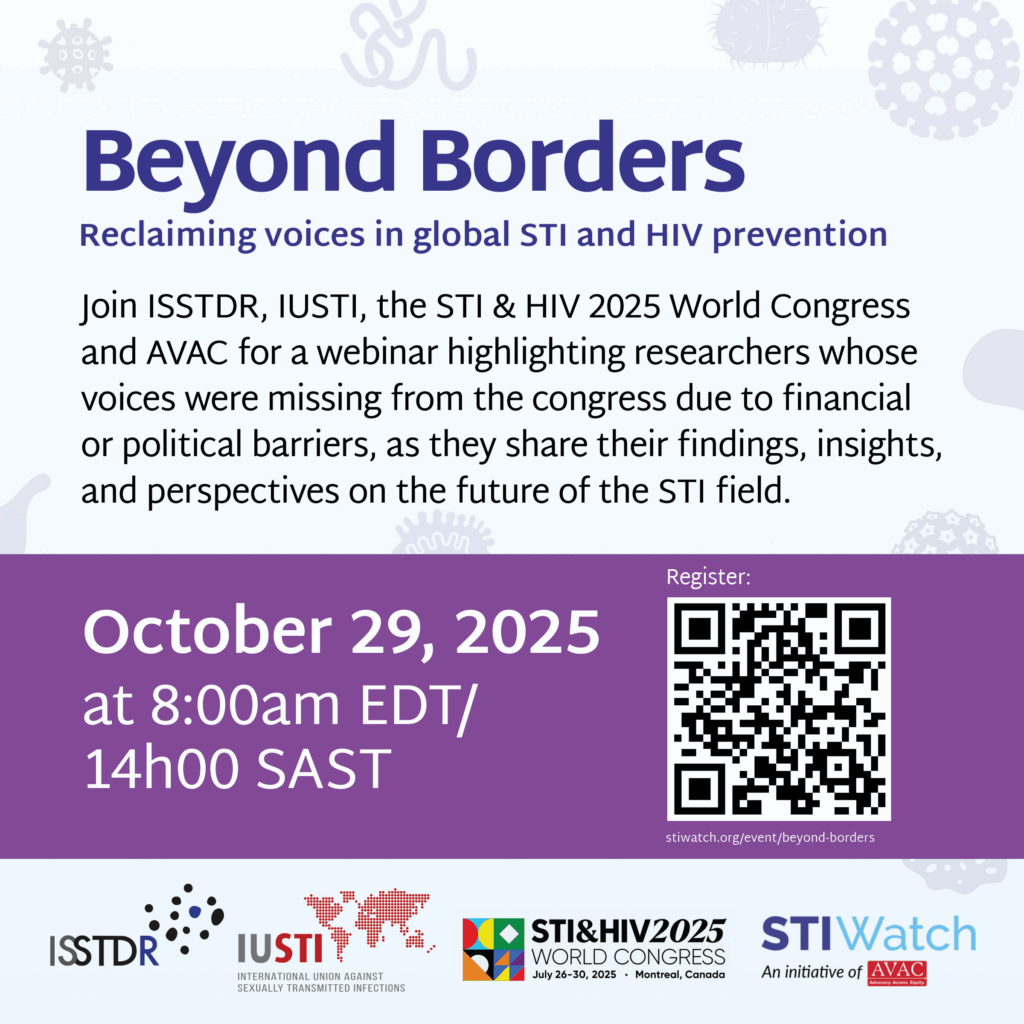
Beyond Borders

Join ISSTDR, IUSTI, the STI & HIV 2025 World Congress, and AVAC for a special webinar spotlighting speakers who were not about to join the congress due to financial and political barriers. Presenters will share their findings, debate their results, and discuss the work still ahead for the STI field. Don’t miss this opportunity to engage directly with cutting-edge research and the people driving it forward.

AVAC Input for Recompetition of the NIAID HIV/AIDS Clinical Trials Networks

AVAC’s formal input submitted on the re-competition of the NIAID HIV/AIDS Clinical Trials Networks. The recommendations were informed by the People’s Research Agenda (PRA), a comprehensive framework developed through consultations with over 130 community representatives across 23 countries.

Avac Event

Do Not Check That Box – Impacts From the Assault on Transgender Communities and DEI + Strategies to Sustain and Rebuild

Our panelists had an unflinchingly honest—and interactive—conversation assessing the impacts of the ongoing assault on transgender communities, gender affirming health care, data collection, and Diversity, Equity and Inclusion writ large. Strategies to restore trust, sustain programming, and rebuild from the ashes were explored.

Panelists:

  • Dr. Joseph Cherabie
    Washington University St. Louis
  • Dr. Melanie Thompson
    AIDS Research Consortium of Atlanta
  • Dr. Asa Radix
    New York City
  • Leigh-Ann van der Merwe
    Social, Health & Empowerment Feminist Collective, South Africa

Recording / Resources / Transcript

Global Health Watch: US government shuts down, foreign aid funding expires, Jeanne Marrazzo fired from NIH, issue 36

The US government shutdown that began at midnight on October 1 has stalled key public health operations just as the Supreme Court issued a ruling in AVAC v. Department of State that allowed $4 billion dollars in foreign aid to expire, eroding both health and human services and constitutional checks and balances. Meanwhile, Jeanne Marrazzo was officially fired as Director of NIAID, underscoring how politically motivated attacks on science are dismantling the infrastructure that has underpinned decades of progress in HIV prevention and research. 

US Government Shuts Down as Federal Funding Expires

At midnight on October 1, US federal funding expired and a government shutdown began after Congress failed to agree to pass a Fiscal Year 2026 (FY26) budget or even a temporary continuing resolution. The shutdown is largely rooted in disagreements over healthcare policy, especially access to healthcare coverage under the Affordable Care Act and Medicaid. The shutdown means “nonessential” federal work is stopped, including many public health operations. Approximately 750,000 federal employees are furloughed, including 40% of Health and Human Services (HHS) staff. CDC disease surveillance is disrupted, many NIH clinical trials are on hold, as is NIH grantmaking and basic research. Many PEPFAR staff have been furloughed as well, but essential “lifesaving” work is continuing. 

IMPLICATIONS: The shutdown further destabilizes the US health system and public health infrastructure already weakened by deep cuts. It now comes against the backdrop of a Presidential administration that is using official federal agency websites and social media as propaganda to blame Democrats for the crisis, while the Office of Management and Budget (OMB) director openly threatens mass firings across federal agencies, which is part of the Project 2025 vision he led. For the global health field, the situation highlights how fragile US commitments have become, with billions in foreign aid still frozen and HIV research and prevention programs facing uncertainty. Beyond the immediate loss of services, intimidation tactics on display during this crisis threaten to erode trust and stall science, which will extend beyond the US with consequences for health and human services worldwide. 

READ:  

US Supreme Court Grants Administration Request to Keep Foreign Aid Frozen as Clock Runs Out 

Just prior to the US government shutdown, the US Supreme Court (SCOTUS) handed down a decision in AVAC v. Department of State and Global Health Council v. Trump cases, challenging the foreign aid freeze. In a 6-3 decision by emergency order, the court granted the Administration’s request to not spend $4 billion of Congressionally appropriated foreign assistance funds before they expired on September 30, as required by law. This means that, despite the law, and a lower court order, those funds remain unspent. In its statement, AVAC’s Executive Director, Mitchell Warren, warned that the ruling gave the Administration a “free pass” to block disbursement of foreign aid, citing devastation with clinic closures, disruptions in essential services, and lives lost. Moreover, Warren said the ruling undermines constitutional checks on presidential power. “This is beyond foreign assistance; the Court’s decision is a chilling one for anyone who cares about the US Constitution.” In a dissent from the three other Justices, Justice Kagan cautioned that the stakes are too consequential to be decided through emergency orders without full briefing and oral argument and argued that the Administration has not met the stringent standards for such relief. 

IMPLICATIONS: While the SCOTUS ruling is not a final judgment, it signals a willingness to allow the President and the Executive branch to withhold funds that Congress has appropriated, potentially whenever it chooses. If unchecked, this precedent could erode the checks and balances that constrain executive overreach and jeopardize not only global health funding but every area of federal spending. 

READ:  

Jeanne Marrazzo Fired from NIAID 

Jeanne Marrazzo, former Director of the National Institute of Allergy and Infectious Diseases (NIAID), was terminated on October 1 by Health and Human Services (HHS) Secretary Robert F. Kennedy Jr. after being placed on administrative leave in April. This comes 22 days after Marrazzo and former Fogarty International Center’s director, Kathy Neuzil, filed a whistleblower complaint with the Office of Special Counsel. In her complaint, Marrazzo detailed the Administration’s unlawful cancellation of critical research grants, politicization of science, hostility toward vaccines, and censorship of research. Marrazzo’s lawyers claim that her firing was an act of clear retaliation for her defense of scientific integrity and public health research. Marrazzo succeeded Anthony Fauci as the director of the NIAID in 2023. 

IMPLICATIONS: The Office of Special Counsel has been severely weakened by the Administration as have other oversight mechanisms- leaving few pathways for federal scientists and other federal employees to resist politically motivated attacks on research. Holding federal offices accountable to standards of practice that protect the scientific enterprise from political and ideological gamesmanship is essential. Without those standards enforced, decades of progress in science and research are at risk. Marrazzo’s dismissal represents another blow to the independence of US science agencies.  

READ: 

FOLLOWING: The US May Expand Mexico City Policy / Global Gag Rule 

According to the Daily Signal, the US Department of State plans to extend the scope of the Global Gag Rule (often referred to as the Mexico City Policy), which is an executive order that restricts foreign non-governmental organizations (NGOs) from receiving US global health assistance if they provide, refer, or advocate for abortion services. The Global Gag Rule first enacted by the Reagan administration, has been rescinded by every Democratic president and put back in place under every Republican president. Reportedly, the language in this latest iteration of the policy would be expanded to also ban US funding for foreign assistance that promotes “gender ideology” or DEI initiatives. The inclusion of gender affirming care and DEI continues this Administration’s ongoing mischaracterization of existing foreign assistance programs, and attacks on programs that are trans inclusive or seek to address racial and gender disparities.  

IMPLICATIONS: This expansion of the Global Gag Rule would fulfill a long-standing conservative goal, explicitly named in Project 2025, to reshape US global public health funding away from evidence-based programs that affirm the needs and dignity of sexual and gender minorities. Turning away from these vulnerable populations further threatens and sets back progress towards ending the global HIV epidemic.   

READ:   

What We’re Reading:


Resources