August 18, 2026

By Grace Kumwenda, AVAC Regional Program Manager: Research Engagement
AIDS 2026 in Rio was extraordinary.
Big science across HIV prevention, treatment and cure headlined from podiums; in side rooms, we had difficult conversations around greater access to available products; and throughout, ongoing tensions played out over the future of the AIDS response and the role of the US Government. And—if you are like me—there was also a lot of trying to understand some very complicated vaccine and broadly neutralizing antibody (bNAb) science and immediately asking: What does this actually mean for people and the People’s Research Agenda? What does it mean for the field and the future? Simply put, Rio did not disappoint.
Big treatment news
A first-in-class once-weekly oral combination of islatravir plus lenacapavir achieved viral suppression as effectively as daily oral antiretroviral therapy (ART) at week 48 in the ISLEND trial, another exciting indication of where longer-acting and less frequent HIV treatment is headed. We also heard important data on long-acting treatment for adolescents. In the LATA study, injectable cabotegravir (CAB) and rilpivirine administered every eight weeks performed better than daily oral tenofovir disoproxil, lamivudine, dolutegravir (TLD) at 96 weeks, and the overwhelming majority of adolescents said they found injections easier than daily oral pills. That matters because long-acting treatment cannot only be designed for adults who already navigate health systems better than youth; adolescents and others who struggle with daily adherence also need to be part of this innovation story.
Then came the bNAbs
The CAPRISA 012C results readout was a powerful reminder that science does not always move in a straight line. A prevention trial evaluating two bNAbs together—CAP256-V2LS plus VRC07-523LS— administered subcutaneously every six months was reported to be safe but did not reduce overall HIV incidence. Unexpectedly high levels of viral resistance seen in the trial population raised important questions for the field, including whether it is time to pivot away from research on bNAbs for prevention.
It was disappointing that two bNAbs together did do any better than a single bNAb in Antibody-Mediated Prevention (AMP) studies a couple of years. These findings raise important questions about whether and how a combination bNAb approach can work for HIV prevention, as well as the implications for vaccine, treatment and cure research. In treatment and cure research, the bNAb story is more nuanced and, frankly, fascinating. Studies including RIO and FRESH are suggesting that bNAbs may be able to do something ART does not: in a small proportion of participants, immune control may persist even after the antibodies themselves have washed out of the body. There were also promising signals in children. In Botswana, two bNAbs kept 44 percent of children in the Tatelo study undetectable at six months after stopping ART, while early results from the ongoing Tatelo+ study using three bNAbs showed all participants remaining undetectable at week 24. But this is also where we have to manage expectations. The science is exciting, but effects are still seen in relatively small subsets of people, while resistance and incomplete HIV strain coverage remain challenges, strain sensitivity testing is complex and costly, and we still need much more evidence about who benefits and why. That is exactly why continued research matters.
Vaccine science is getting more precise
HIV vaccine science continues to make important—if sometimes complicated—progress. The challenge has not changed: HIV is extraordinarily diverse, it mutates rapidly and it has evolved sophisticated ways of escaping the immune system. But what has changed is the precision with which scientists are now trying to solve that problem. Instead of simply asking whether a vaccine candidate produces an immune response, researchers are increasingly asking: Can we deliberately guide the immune system, step-by-step, toward producing the exact bNAbs needed to recognize many different HIV strains? Several studies presented in Rio focused on doing exactly that.
Researchers are refining sequential vaccination, where one vaccine primes very rare B cells and subsequent vaccinations guide those cells through stages of maturation toward bNAbs. Work presented on coaxing the creation of V3 glycan-targeting antibodies showed that carefully designed vaccine sequences can steer antibody responses away from non-neutralizing pathways and toward potentially protective ones. Other approaches are trying to generate antibodies against several vulnerable sites on the HIV envelope at once. That may ultimately be critical because an effective vaccine is unlikely to rely on one antibody class alone. Scientists are increasingly exploring how to induce bNAbs targeting two or three different vulnerable sites, potentially making it harder for HIV to escape.
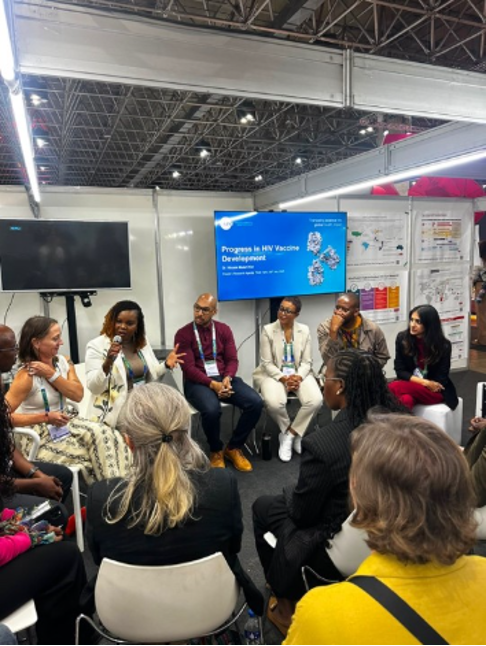
Grace advocates for the pursuit of a preventive HIV vaccine at the AVAC HIV Cure and Prevention Research Networking Zone
New vaccine platforms are also opening possibilities. An mRNA approach designed to express HIV envelope trimers produced neutralizing antibody responses in rhesus macaques and protected a proportion of animals from SHIV challenge. None of this means an HIV vaccine is around the corner. But it does mean that vaccine development is becoming increasingly deliberate. Scientists are not simply hoping the immune system will produce the right antibodies. They are learning how to engineer and guide the immune response toward them. And despite highly effective PrEP, the case for a vaccine remains strong. PrEP only works when people can access it, choose it and use it.
A vaccine could eventually reach people who face barriers to ongoing PrEP use, people who do not perceive themselves to be at risk and communities where sustaining repeated prevention visits remains difficult and/or expensive.
So yes—we still need a vaccine.
And the MPT pipeline is getting interesting
The multipurpose prevention technology (MPT) pipeline is another space that caught my attention at the HIV Prevention pre-conference in Rio. A removable injectable depot combining CAB with the contraceptive medroxyprogesterone acetate studied for three- and six-month durations in macaques provided complete suppression of ovulation through six months, with return to fertility shortly after depot removal and a relatively short CAB tail. And in another study, a 3D-printed, 90-day intravaginal ring containing islatravir, ethinyl estradiol and etonogestrel provided protection across 12 weekly HIV exposures in macaques. If we can develop products that respond to several needs at once—and importantly, products people actually want to use—that could be transformative. But again, the key phrase is want to use. A scientifically brilliant product that does not fit into people’s lives will struggle to achieve population-level impact.
Innovation in ARV-based prevention is moving
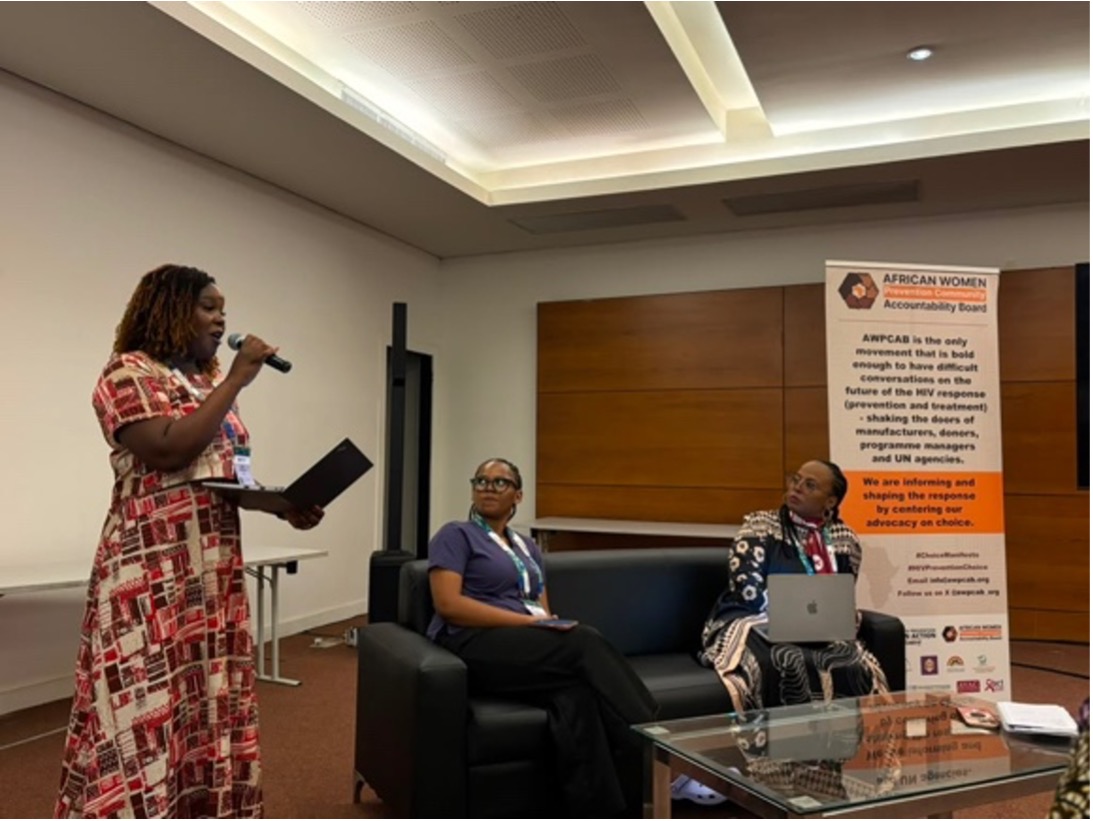
Grace advocates for the pursuit of a preventive HIV vaccine at the AVAC HIV Cure and Prevention Research Networking Zone
We are all watching closely the efficacy program for the once-monthly oral PrEP candidate now named alimatravir (AMI). What caught my attention was not only the science, but also how Merck/MSD, the developers, are thinking about the product in people’s lives: a small, discreet tablet that could potentially be delivered beyond traditional clinics, including through pharmacies, community settings and other entry points.
Access is already part of the conversation even as alimatravir is still more than a year out from phase 3 study results. MSD announced an initial access plan that includes voluntary licensing arrangements intended to support future generic production. That matters. Access cannot be a conversation we begin after approval; it needs to sit alongside product development from the beginning. And, to be fair, the access conversations around both LEN and AMI were some of the biggest—and at times hardest—conversations in Rio. Questions around pricing, licensing, manufacturing, financing speed to scale, and equity in access were not answered. But they are exactly the conversations we need to be having now, not later. Science is moving quickly, and access planning has to move one step ahead.
Rio also provided encouraging implementation data on existing long-acting prevention options. In the PURPOSE 1 open-label extension, 95% of eligible participants chose twice-yearly lenacapavir (LEN) for PrEP, with no HIV acquisitions during follow-up and 96% injection adherence. PURPOSE 2 also reported very low HIV incidence, while real-world CAB studies continued to show strong effectiveness even as questions around late injections, testing and delivery remain important. The pipeline continues to widen, with early data on 90-day dapivirine-levonorgestrel vaginal rings adding to the range of longer-acting and MPT options under development. All this data adds another dimension to an increasingly diverse prevention pipeline—one that is more responsive to people’s different prevention and reproductive health needs.
PEP also needs its own innovation moment
And if we are talking about innovation in PrEP, then we also have to talk about post-exposure prophylaxis—PEP. PEP is one of our oldest biomedical HIV prevention interventions, yet it can still feel like the mis-placed or forgotten tool in the prevention box. We heard several times in Rio that PEP is a race against time: it needs to be started as quickly as possible after a potential exposure. But accessing it can still mean travelling to a facility, explaining what happened, navigating stigma, finding a provider who understands PEP and then completing a 28-day regimen. That hardly sounds like an intervention designed for success.
Amidst the ongoing normalization of long-acting PrEP, AIDS 2026 addressed the implications of long-acting ARVs for PEP. But how do we generate strong evidence for new and potentially better PEP products when traditional efficacy trials may be extremely difficult—or even unethical—to conduct? Researchers are now exploring innovative approaches, including zero-event trial designs, that could help us build credible evidence without relying on HIV incidence as an endpoint or traditional trial models.
But just as with PrEP, product innovation alone will not be enough. Policy and delivery have to move to address the gaps we have today. During an AVAC side meeting, we discussed the need to simplify national PEP guidelines, address gaps across different types of exposure, support differentiated service delivery, strengthen provider information and rethink how we communicate about PEP. One point from that discussion stayed with me: we celebrate someone choosing PrEP as responsible self-care, yet someone seeking PEP can still be met with judgement—as though needing PEP means they did something wrong.
That has to change.
Seeking PEP is also an act of responsibility and self-care. If we want people to use it quickly, we need to make PEP easier to find, easier to understand and easier to use—and we need the next generation of PEP products and delivery models to reflect the urgency of the moment in which people need them.
And then there is community
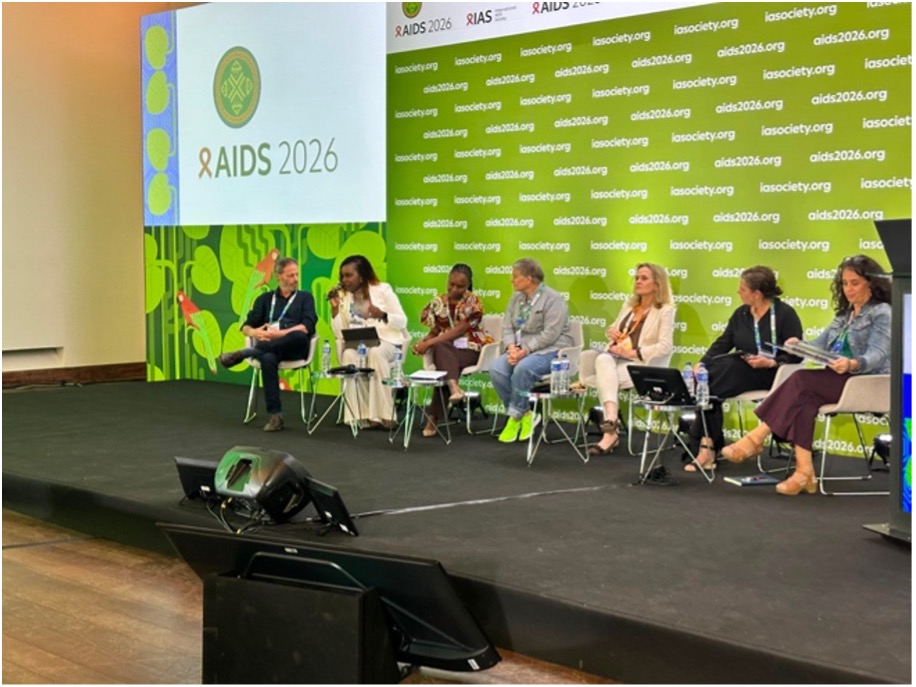
Grace provides a community perspective at the session “From Community to Innovation to Scale”
If the Global Village was the heart of AIDS 2026, then community remains the heartbeat of the HIV response and the “why” behind the HIV prevention pipeline. I had the opportunity to share community perspectives during a symposium on moving from community to innovation to scale, and one thing stayed with me: we still too often imagine innovation as a straight line from basic science to clinical trials, regulatory approval, implementation and then community.
Trials such as EXPrESSIVE and PURPOSE have reshaped that line, and we need to keep pushing. Community should be there from the moment we define the unmet need, through research priorities and trial design, to access, affordability, implementation and the final question that matters most: is this intervention actually working in people’s lives? And as prevention science becomes more complex, community engagement cannot simply mean inviting advocates into technical rooms; it also means investing in the knowledge and tools that allow communities to ask difficult questions and influence decisions. That is one reason I remain so passionate about initiatives like AVAC’s Clinical Trial Design Academy.
I left Rio thinking that perhaps the biggest shift is not only in the big news about what products are being developed and evaluated in the HIV prevention pipeline. The questions need to change.
For years, the biggest question in HIV prevention was: Can we develop highly effective tools to prevent HIV? Today, we increasingly know that we can. We have daily oral PrEP, two injectable PrEP products, the dapivirine ring, condoms, circumcision, and, hopefully, in the near future a monthly oral pill, with even longer-acting products anticipated in the near future. The harder questions now are: Can people get them? Can they actually choose between them – when and where and from whom they want them? Can countries afford them? Can health systems deliver them? And are we building the systems today that will be ready for the products coming tomorrow? That is where the big moves become important.
The big move we need NOW is from innovation to impact. That means moving from products to programs at scale; clinics to community-centered delivery platforms; product-focused interventions to choice-based prevention; and scientific breakthroughs to political courage, financing, solidarity and accountability.
The science is moving. “The science delivered beyond our wildest dreams,” said Dr. Raphy Landovitz in a moving plenary session.
Now everything around the science needs to move just as boldly. We need resources, moral compass, political will and government-owned prevention programs to move the science to people.
From Rio to the People’s Research Agenda: What next?
So where does all of this leave us? For me, Rio reinforced that the People’s Research Agenda has to keep pushing the field on whether the science will actually matter in people’s lives.
- HIV vaccines: keep investing—but design for the real world now. We still need an HIV vaccine, and we need to stay the course. But as scientists refine sequential immunization and increasingly precise vaccine approaches, the field must also ask early what a future vaccine regimen would look like in people’s lives: how many doses, over what period, for whom, at what cost and how it could realistically be delivered at scale.
- MPTs: start with people’s lives, not just what science can combine. We need to develop MPTs around the lives and priorities of the people who will use them. The research question cannot only be: what products can we technically combine? It must also be: what combinations, durations and delivery forms do people actually want—and what gives them meaningful choice and control?
- ARV-based prevention: match the speed of innovation with the speed of access. Affordability, licensing, manufacturing, financing, country readiness and delivery must be planned alongside product development, not after approval. At the same time, implementation research must tell us how long-acting products work in the real world, including persistence, late injections, switching and what it truly takes to deliver genuine choice.
- PEP: give PEP the innovation and urgency it deserves. PEP needs a new research, product and delivery agenda. We need shorter, simpler and more forgiving regimens; innovative trial designs that can generate credible evidence; and delivery models that get PEP to people within hours, not after they have navigated multiple barriers in the health system. And perhaps just as importantly, we need to reposition PEP as what it is: an act of self-care and responsibility.