The Future Won’t Build Itself: Sustaining the Movement CASPR Started
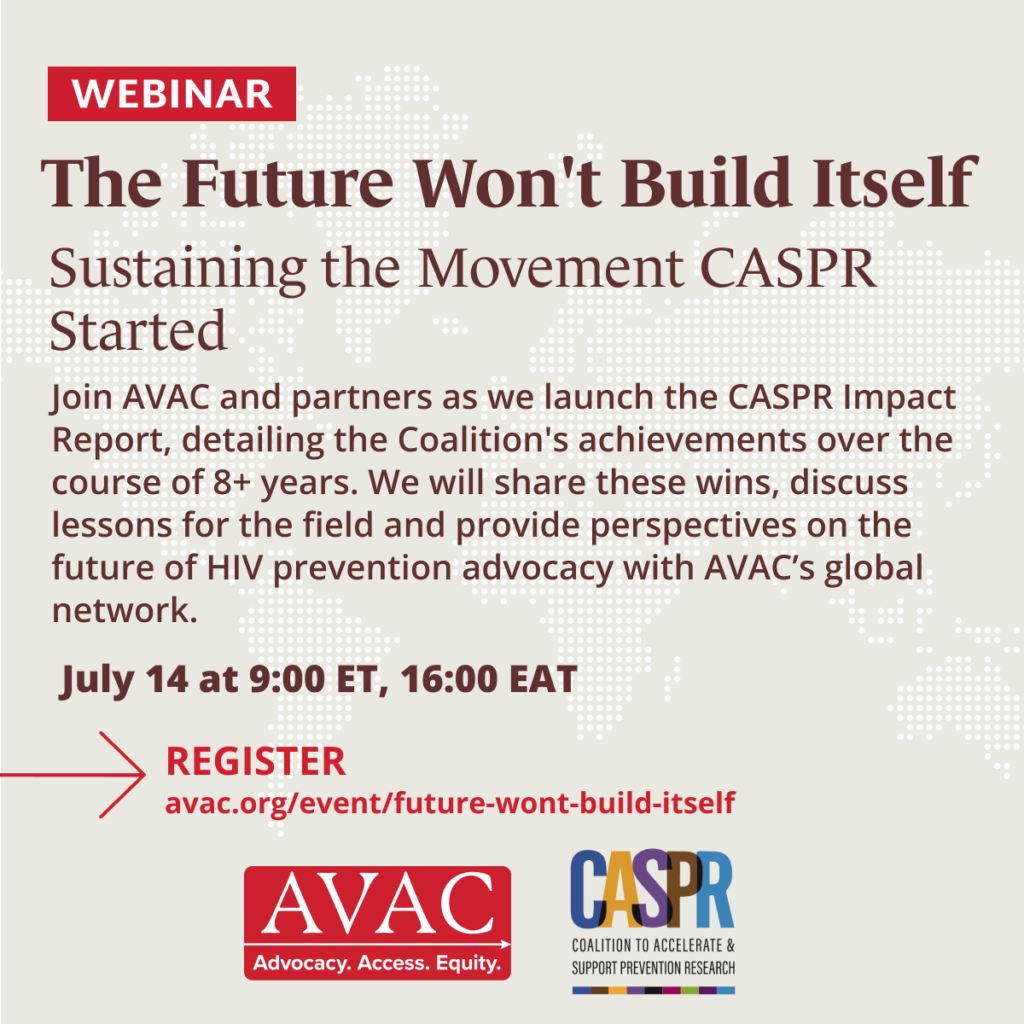
On Tuesday, July 14, AVAC and partners discussed the impact stories of ten years of the Coalition to Accelerate and Support Prevention Research (CASPR). Established in 2016, CASPR was funded by the United States Agency for International Development (USAID) and designed by AVAC in collaboration with leading civil society partners to influence HIV prevention research, policy and implementation.
And with attacks on global health and shrinking resources dismantling hard-won gains, the lessons from CASPR are a call for continued action: strong, community-led advocacy is indispensable to safeguard the future of HIV prevention.
Coalition members from APHA and Internews shared how they transformed HIV prevention – helping to shape ethical research practices, amplifying community leadership, influencing policy, and ensuring that the voices of those most affected by HIV help guide research and access agendas – as well as their action plan for the future.
HIV Prevention Advocates Applaud South Africa’s Introduction of Lenacapavir for PrEP
Call on Donors and Governments to Accelerate Access to Deliver Actual Impact
In a landmark moment, South Africa today became the 9th African country to introduce lencapavir (LEN) for HIV prevention. South Africa’s introduction of LEN is especially significant given the country’s central role in shaping the regional HIV response and the global PrEP market. As the largest PrEP market in the world, South Africa’s leadership can help drive the demand, volume, market confidence and lower prices needed to accelerate equitable access across the continent and the world. HIV prevention partners AVAC, Advocates for the Prevention of HIV in Africa (APHA), and Access Bridge welcomed today’s news of increased commitments and support from the Global Fund, while calling for further ensure access is realized and impact achieved.
“Today is a breakthrough. Not only for our country and the African continent, which continues to carry some of the world’s largest HIV burdens, but for the global HIV response. Access to LEN allows us to reimagine prevention, especially for young people and adolescent girls and young women who need more choices that fit their lives. It is important to centre our efforts around girls and young women who need to be the focus of our efforts. We must move with urgency to ensure that everyone who could benefit from lenacapavir can do so,” said Yvette Raphael, Executive Director of Advocates for the Prevention of HIV in Africa (APHA) and co-chair of the African Women’s Prevention Community Accountability Board (AWPCAB).
“Today is a sign of what is possible when communities, governments, and partners work together. LEN will offer my generation the chance to protect their health with greater freedom and confidence. We must now make sure this innovation reaches the people who need it most—quickly, equitably, and without barriers. Today is exciting, but it is also a call to action for all of us,” said Lerato Morulane, APHA Ground Force coordinator.
During the launch event, the Global Fund announced that with additional backing from the Children’s Investment Fund Foundation (CIFF), it will scale-up support for South Africa’s LEN roll-out, increasing funding from $29M to nearly $70M to support this more ambitious effort. This contribution to the Global Fund goes toward their joint commitment with PEPFAR to ensure access to LEN for at least three million people over three years – a more solid start than with previous PrEP introductions, but still below the levels needed to deliver impact.
In July 2025, AVAC published a market assessment that the world could go much faster than existing commitments allow and reach at least 1.5 million people with LEN in just one year in low- and middle-income countries if resources were made available, and reach over seven million in three years, if resources were available.
“Lenacapavir has transformational potential for HIV prevention, and today’s launch is another step in the right direction,” said Mitchell Warren, Executive Director of AVAC. “But additional donor investments are urgently needed as the field is still nowhere near what the market can bear and what is needed for impact. A meaningful volume commitment of at least four million LEN users in two years is both possible and has the potential to unlock faster access, strengthen market confidence, and accelerate access to prevention for communities that need it most. Ultimately, LEN must reach more than five million people per year to have real impact, build a sustainable market, and drive prices down even further. Today’s announcement is progress, but we still need to go farther faster.”
LEN has been widely recognized as a transformative HIV prevention option, with the every-six-month injection providing highly effective protection. However, translating the scientific breakthrough of LEN into population-level access and impact requires coordinated action across many sectors, including financing, manufacturing, pricing, regulatory, and delivery.
“Today represents another important milestone, but now we need to roll up our collective sleeves and get to work,” said Wawira Nyagah, Executive Director of Access Bridge. “South Africa has an essential role to play in building the global market for LEN and driving the volumes needed to lower prices, strengthen supply, and accelerate access worldwide. To realize the full potential of this innovation, all stakeholders must work together with even greater urgency, ambition, and a commitment to speed, scale, and equity. The opportunity is in front of us; now we must seize it. To see LEN truly succeed, programs must be designed with communities at the centre and that commitments translate into real access for the people who need it. Access Bridge is working across countries in Eastern and Southern Africa to ensure countries are equipped to meet this moment.”
AVAC and Access Bridge have called on stakeholders to meet the current moment of scientific opportunity and public health need with bolder ambition. The past decade of PrEP programs have highlighted numerous lessons on how to get LEN rollout right as part of comprehensive HIV prevention programs so that today’s announcement translates into real-world impact. Key considerations include:
Regulatory approval and normative guidance: Stringent regulatory reviewers have approved LEN and high-quality studies have been completed — this should speed the process for countries to introduce LEN at scale.
Planning and budgeting: Pricing must be clear and transparent, and budgets must encompass the full range of activities needed to make PrEP successful.
Supply chain management: If there’s no product, there’s no program. Commitments need to be translated into orders, and orders need to be delivered consistently and without delay.
Health service delivery: Providers who deliver PrEP services need guidelines, training and tools to enhance differentiated service delivery.
Monitoring, evaluation and learning: To track project targets and provides insights for program improvement, and lessons for scaling future prevention products in the pipeline.
Today’s announcement builds on prior commitments from the Global Fund and PEPFAR, as well as investments from the Gates Foundation and Unitaid to accelerate development and access to generic LEN at lower prices. With generic LEN likely entering the market in the first half of 2027, now is the time to strengthen and grow the market with Gilead’s supply: the faster the market grows, the more infections that can be averted at lower cost.
“Commitments are important, but orders are essential. In Gilead’s own words, they can produce far more if orders are made,” said Warren. “Especially for 2027, clear timelines and ambitious orders for both originator and generic supply will be critical to avoid gaps in care of current LEN users and to expand the reach of this innovation.”
African Leadership Drives HIV Prevention Access
AVAC Impact Reports highlight the power of advocacy, research translation, and partnership to advance HIV prevention and global health equity. Read also about how PrEPWatch transforms data into action for PrEP access.
An estimated 40.8 million people globally are living with HIV, 65% of whom live in Africa. The fight to end the epidemic depends on African leadership that shapes the HIV response, informs research priorities, influences policy and funding decisions, and advances advocacy agendas that respond to community needs. AVAC has been a leading voice advocating for African leadership through mentorship and partnerships, working with the next generation of decision-makers and advocates as they drive the global movement to advance equitable access to HIV prevention.
AVAC’s history of partnership, collaboration and support of partner networks is part of a long-term vision to transition from traditional power structures towards a model in which those with lived experience and field expertise have influence and equal voice in the design and delivery of HIV prevention planning, priority-setting, and decision-making. For three decades, AVAC has developed projects and partnerships that advance these goals, including the Fellows program and the COMPASS and CASPR coalitions.
Now, Access Bridge, a Kenya-based organization incubated over a decade at AVAC, is positioned to responsively and sustainably lead country-level and regional efforts to accelerate new product introduction and access. Wawira Nyagah, Access Bridge’s Executive Director, has over two decades of experience leading global and country-led initiatives to advance HIV prevention, and has built long-standing relationships with Ministries of Health, civil society advocates, and global decision-making bodies.
In May, Access Bridge secured its first grant from the AidsfondsEmpowHER Fund, to lead a multi-country consortium spearheading national and regional efforts to accelerate access to and uptake of HIV prevention options for women and girls in Kenya, Uganda, and Zambia. The project emphasizes a women-centered approach, ensuring women and girls are meaningfully engaged, informed and that they contribute to design, priority setting, implementation, and accountability for PrEP products. The highly competitive process received more than 250 expressions of interest and awarded just nine grantees. In a testament to the strength of collaboration and partnerships, Advocates for the Prevention of HIV in Africa (APHA), the International Community of Women Living with HIV Eastern Africa (ICWEA) and Copper Rose Zambia – all long-time partners with AVAC – are also among the successful recipients.
The Access Bridge consortium is comprised of alumni of AVAC’s Advocacy Fellows Program who have gone on to found and lead major HIV prevention organizations and activities that advance global access to PrEP for women and girls. Since 2009, the AVAC Fellows program has supported over 90 emerging HIV prevention champions to hone their skills, shape the HIV prevention research agenda, and influence the rollout of new interventions. Today, alumni hold various leadership roles at the forefront of advancing equitable HIV prevention, nationally, regionally and globally.
Natasha Mwila, Access Bridge Project Coordinator and 2022 Alumni Fellow
“I am incredibly proud to lead this work alongside fellow AVAC Fellowship alumni as we continue to center women and girls in prevention and empowerment efforts.”
“Implementing EmpowHER is a great milestone for Access Bridge and a strong affirmation of the importance of investing in women-led initiatives. The project is deeply meaningful to me, not only as a project lead, but also as a woman who began her journey in HIV prevention advocating for woman-controlled prevention methods. This opportunity is an investment in women’s leadership, voices, and right to make informed choices about their health and futures.”
Ruth Akulu, HopeStone Insight Uganda Founder and 2022 Alumni Fellow
“Before the fellowship, I never imagined I could convene high-level policy dialogues, engage decision-makers, or negotiate for stronger HIV prevention responses.”
As an AVAC Fellow, Ruth Akulu mobilized regulatory authorities to prepare for the Dual Prevention Pill (DPP), and secured pharmacy distribution programs for PrEP in Uganda. Today, she says, “I am helping drive conversations and action in my country because I was showed that lived experience, when matched with knowledge and opportunity, can become a powerful force for leadership and change. The AVAC Fellowship has been transformative in my journey. It built my capacity, strengthened my confidence, and helped me recognize my ability to lead and influence change.”
Ruth’s organization, HopeStone Insight Uganda, is a forward-thinking organization that seeks to influence economic policy to advance equitable health outcomes and access to quality healthcare. In the EmpowHER consortium, she partners with Access Bridge to improve health systems by leading community engagement efforts in two districts in Uganda to accelerate access to HIV prevention options.
Chilufya Kasanda, Ascend Futures Foundation Executive Director and 2016 Alumni Fellow
“My journey in HIV prevention has reinforced one truth: communities are most effectively served when leadership comes from within.”
Chilufya Kasanda is an advocacy leader with over a decade of expertise rooted in her experience as a Fellow. “The AVAC Fellowship helped transform my passion for advocacy into action, equipping me to champion HIV prevention choices for women and young people in Zambia.” As a CASPR coalition partner — an Africa-centered network supported by AVAC to advance the biomedical HIV prevention research pipeline — Chilufya cultivated strong relationships with the Zambian Ministry of Health, elevated the Choice Manifesto as an advocacy tool for women to demand choice in PrEP products, and contributed to wins such as increasing the government’s allocation of DVR for female sex workers.
In 2024, she established Ascend Futures Foundation (AFF) and continues to lead advocacy efforts, including collaborating with Natasha and other partners to support the introduction of LEN in Zambia. “The EmpowHer project gives me an opportunity to partner with AVAC alumni to create impact at national and regional levels.” AFF will mobilize champions for HIV prevention and translate community-generated data into evidence to influence government priorities for AGYW in Zambia.
The future of HIV Prevention is African-led, and the pipeline of new leaders is advancing the needs of women and girls. Access Bridge, Ascend Futures Foundation and HopeStone Insight are proof that investing in partners and advocates fuels not only individual growth, but the growth of an expansive network of African leaders collectively powering the HIV response.
2025 underscored the vital role that AVAC plays in the global health ecosystem, and why our work and our partnerships have never been more essential.
This report highlights AVAC’s role as a trusted voice, a translator of science and catalyst for action and advocacy. It reflects an organization ready for the future: supporting African leadership, strengthening bridges from R&D to delivery and preparing for a new chapter as we move forward into our fourth decade as an organization. Read the PDF below or view as a webpage.
Our Reflections on Foreign Aid, Vaccine Science, Research Opportunities and the Future of Global Health
“The last year has been one of chaos, anger, panic, and frustration. I think the coming year has to be one of strategic rebuilding and building something different—not building back but building forward. That means a different architecture at the country level, community level, regional level, and global level. A year from now, I suspect we’ll see fewer acronyms, but hopefully the ones that remain will be stronger than ever.” —AVAC’s Mitchell Warren, Bhekisisa podcast
This week marks one year since the US Presidential Administration issued a deeply cruel executive order freezing foreign assistance, halting billions of dollars in already-approved funding under the bad-faith claim of a “90-day review”. What followed was not a brief pause, but a drawn-out, chaotic disruption that stopped life-saving work across the globe, shutting down valuable organizations, and harming lives, health, and livelihoods. And that was just the beginning of a year of chaos.
To mark this moment, AVAC’s One Year Later series reflects on the impact of the past 365 days on five key areas of global health and development:
These pieces show how the field navigated a year defined by disruption and resilience—and how policy decisions reverberate through science, programs, and communities.
The year has been a profoundly transformative one for AVAC. The Devex in-depth retrospective, Fighting for Billions: The legal battle to keep US foreign aid alive, chronicles the ongoing lawsuits brought by AVAC, the Global Health Council and partners challenging the foreign aid freeze. The piece highlights how legal action became a critical line of defense against the dismantling of lifesaving programs and why the outcome still matters.
“For me, the best message I can say is a year later, we as a community are still standing. And that is a resilience in its own right. We are going to succeed in global health and development. Not because of what happened in the last year, but in spite of it.”
—AVAC’s executive director Mitchell Warren on Bhekisisa’s new podcast, One year after Trump: The day HIV funding changed forever—and what came next
As Jeanne Marrazzo, the new CEO of the Infectious Diseases Society of America (IDSA) shared on our webinar earlier this week showcasing the 2025 update of the People’s Research Agenda (PRA), “We cannot yell it from the rooftops loud enough that new infections are going to rise and undermine efforts to end AIDS as a public health threat. But this is not a time to despair. It’s a time to fight. It’s a time to dig in and recognize not just what we’ve accomplished and why we need to protect that, but why we need to continue to move forward.” See the recording here and learn more about the PRA, which tracks the science, highlights where investments align—or fail to align—with community priorities and identifies critical gaps that must be addressed to ensure the prevention pipeline meets the needs of diverse populations.
The past year has reshaped global health—and AVAC—in ways that will be felt for years to come. The events of the past year also show that advocacy, evidence, and community leadership matter. Some courts provided the necessary check on power; advocates rallied; and scientists and civil society raised their voices and documented what was lost—and what must be protected (see 24 Hours to Save AIDS Research).
With your support, AVAC’s weekly Global Health Watch newsletter, now in its 52nd week, continues to track what happens, elevate what’s at risk, and help all of us navigate what comes next. Thank you to our community which stops at nothing to safeguard hard-won progress against HIV and in advancing global health equity.
Avac Event
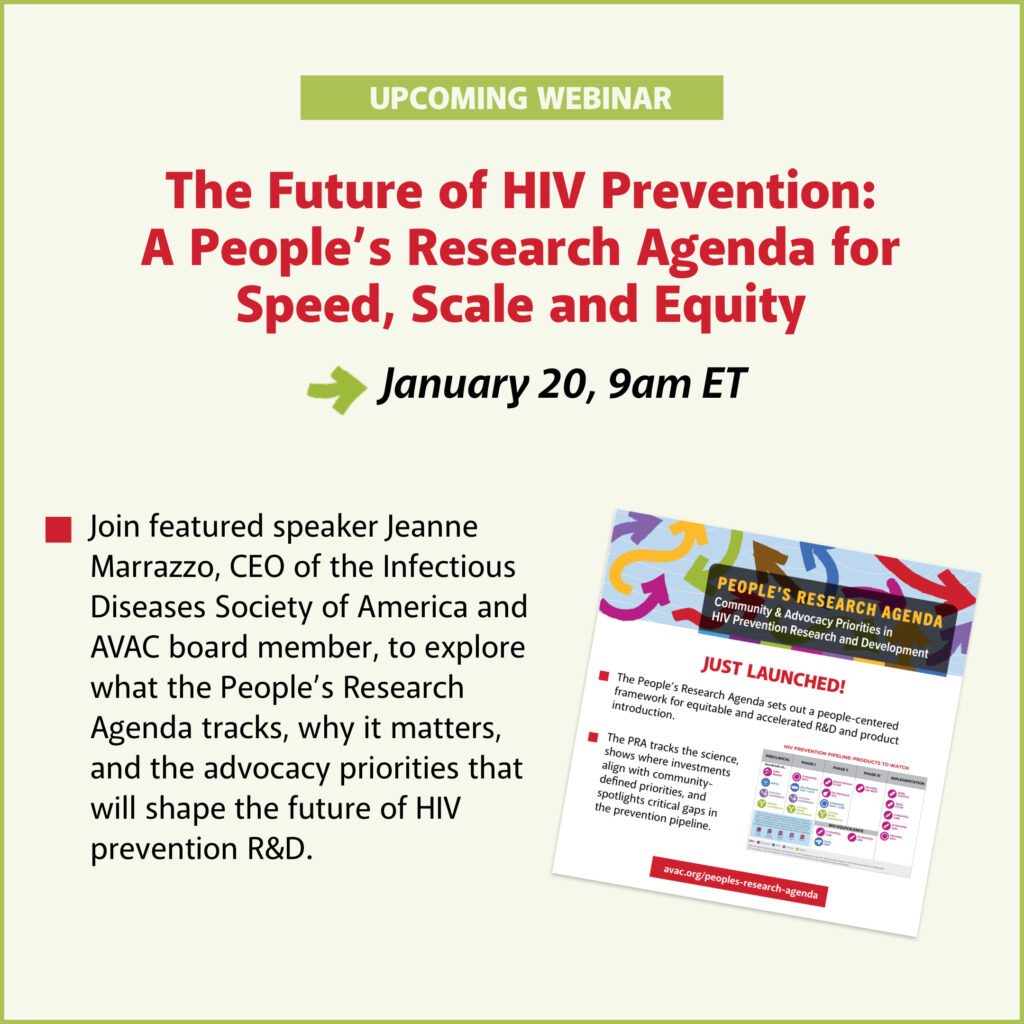
The Future of HIV Prevention: A People’s Research Agenda for Speed, Scale and Equity
First developed in 2024 in partnership with global advocates and communities, the People’s Research Agenda sets out a people-centered framework for equitable and accelerated R&D and product introduction. The PRA tracks the science, shows where investments align—or fail to align—with community-defined priorities, and spotlights critical gaps in the pipeline of prevention options needed to meet the diverse realities of all populations.
Featured speaker Jeanne Marrazzo, CEO of the Infectious Diseases Society of America and AVAC board member.
We covered what the People’s Research Agenda tracks, why it matters, and the advocacy priorities that will shape the future of prevention R&D.
This brief from Audere and AVAC explains how artificial intelligence (AI) can support the HIV field by expanding reach, enhancing prevention, and improving care.
AVAC Input for Recompetition of the NIAID HIV/AIDS Clinical Trials Networks
AVAC’s formal input submitted on the re-competition of the NIAID HIV/AIDS Clinical Trials Networks. The recommendations were informed by the People’s Research Agenda (PRA), a comprehensive framework developed through consultations with over 130 community representatives across 23 countries.
The 12th SAAIDS Conference 2025, under the theme: Unite for Change – Empower Communities and Redefine Priorities for HIV/AIDS will be held in Johannesburg 8-11 September.
Prevention Advocates’ Corner program (forthcoming)
If you’re attending, don’t miss a keynote plenary where AVAC’s Mitchell Warren will share perspectives on the future of HIV prevention, and an important satellite on Wednesday, Bridging the Gap and Identifying Opportunities: Innovative Strategies to Accelerate HIV Prevention, Treatment, and Care for Key and Vulnerable Populations in South Africa.
Global Advocates Welcome the Launch of Merck’s EXPrESSIVE Program
Known as the EXPrESSIVE program, the drug maker Merck has two trials testing a monthly pill for PrEP. Merck is committed to stakeholder engagement, putting global advocates at the forefront of planning for the program. Numerous organizations and advocates commend Merck’s dedication to hearing from the community and shared this statement.