Shaping a new era of global health investment, policy, planning and prevention
AVAC Meeting in NYC
Advocacy and activism have been a linchpin in the history of HIV treatment and prevention. The visionary work of passionate advocates has resulted in hard-fought global gains against HIV.
AVAC is part of a robust civil society movement helping to shape a new era of global health spending and planning related to HIV prevention. We mobilize to ensure programs, products and policies are evidence-based, inclusive and effective. With our partner network, we identify critical needs and develop strategic campaigns to advance HIV prevention, with a focus on ensuring a rich pipeline of options move through research and development, and rollout effectively to reach the communities who need them most.
Our advocacy takes place:
Where funders, policies and programs come together.
At the point of service delivery, where options from the pipeline must become choices in people’s lives.
At Parliaments, State Houses, Ministries of Health, National legislatures, and international bodies,to press for global and country accountability.
In the hands of robust and sophisticated coalitions of African-led civil society organizations.
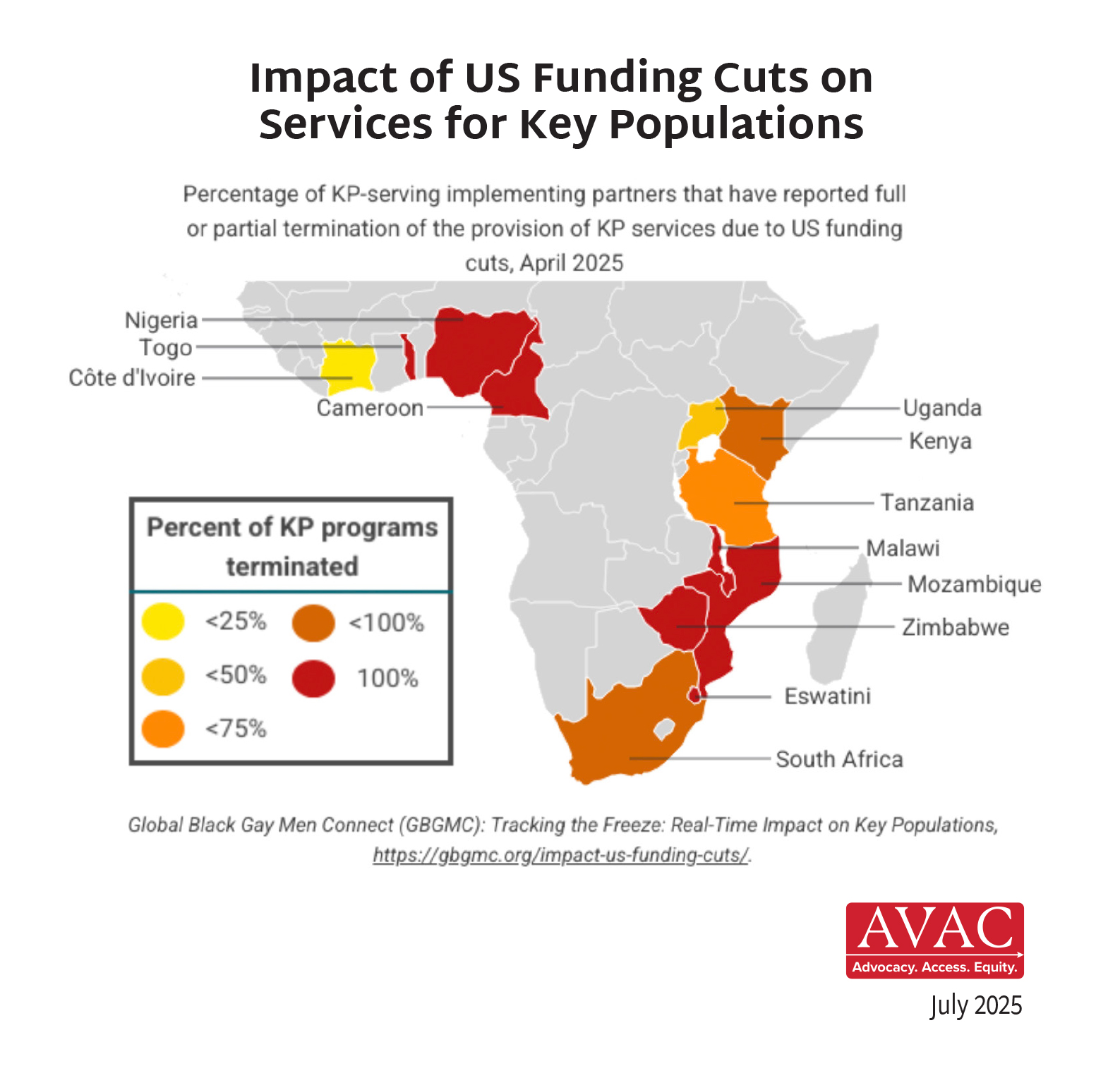
Impact of US Funding Cuts on Services for Key Populations
Percentage of key population-serving implementing partners that have reported full or partial termination of the provision of KP services due to US funding cuts (as of April 2025).
The timeline for generic LEN for PrEP to come to market is expected to be significantly shorter than for CAB for PrEP. Bioequivalence (BE) testing for LEN, which demonstrates a generic product works in the body in the same way as the originator product, is likely to be six months, vs. the 18 months for CAB for PrEP, because of differences in the drug formulation.
The EXPrESSIVE-10 Global Community Advisory Group (GCAG) released a statement on the future of alimatravir and HIV prevention. The statement reflects community perspectives and priorities around prevention choice, meaningful community engagement, equitable access, and ensuring that communities have a voice as research progresses toward potential introduction. As the GCAG writes, “The test is now whether early planning can translate into faster, more equitable action. An access plan is valuable not because it is announced, but because it creates a pathway that can be tracked, challenged, and delivered.”
The Dual Prevention Pill (DPP), a combination of PrEP and combined oral contraception (COC), offers a novel, female-controlled option for HIV and unintended pregnancy prevention. This article in AIDS Care, authored by AVAC Fellow Rhoda Msiska, AVAC staff members Kate Segal and Cindra Feuer, and Newton Donkola, demonstrates how early, multisectoral stakeholder engagement could accelerate DPP approval and adoption in Zambia.