Resources
To search for clinical trials and detailed information on products in development, visit our Prevention Research & Development Database

Results
showing 1-10 of 1059
AVAC Comment to the Office of AIDS Research Advisory Council
AVAC submitted comment to the Office of AIDS Research Advisory Council (OARAC) to address several critical issues facing the federally-funded HIV/AIDS research and development portfolio that threaten the outlook and trajectory of NIH’s success in delivering innovative prevention and treatment options for the U.S. and the world. Citing threats to clinical trial networks, funding timelines for the Centers for AIDS Research NOFO, and reorganization at NAIAID, the comment urges OARAC and OAR to address and mitigate the destabilization of the HIV research enterprise.
Webinar Summary: Investing in Biomedical Innovation for Health and Economic Growth
This Financial Times webinar, hosted in partnership with ViiV Healthcare, brought together policymakers, funders, researchers, philanthropies and industry leaders to explore how to keep medical innovation moving forward. The conversation examined how to create the right conditions for future breakthroughs – and deliver clear benefits for patients, health systems, economies and society. Speakers discussed how to better recognise the economic, health and social impact of new medicines, how partnerships can help share risk and accelerate progress, and how new funding models could support the next generation of drug development.
Funding for Prevention Rollout, Not Close-Out
AVAC’s new publication, Now What with Injectable LEN for PrEP: How to Translate Ambition into Accelerated Delivery and Impact, outlines pathways to reach at least three million people by the end of 2027, including two scenarios for LEN market...
Prevention Option:
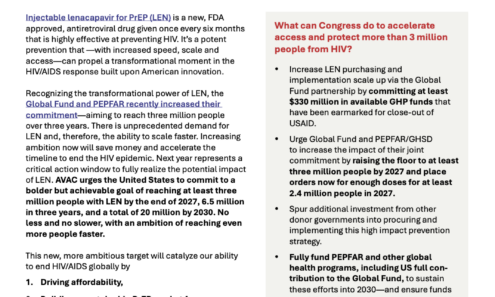
Long-Acting PrEP Generic Manufacturers
Licenses have been granted to manufacturers across multiple low- and middle-income countries to produce generic long-acting PrEP products. Cabotegravir (CAB) and Lenacapavir (LEN) are approved and rolling out, while alimatravir (AMI) is in Phase 3 efficacy trials. Generic manufacturing can play an important role in expanding access to PrEP, and licensing to three African manufacturers for AMI is a notable step toward strengthening regional supply and affordability.
Prevention Option:
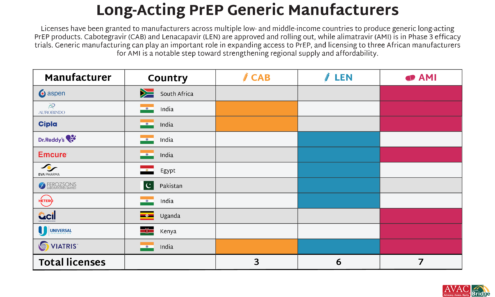
Source of Lenacapavir for PrEP Supply in Africa
Lenacapavir for PrEP has now reached seventeen countries in Africa. This map offers more detail on the LEN rollout.
Prevention Option:
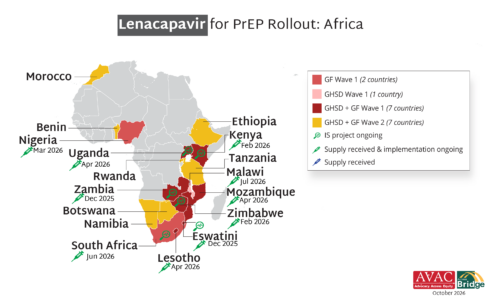
EXPrESSIVE Phase III Program Countries of Alimatravir
Seventeen countries are hosting sites for the Phase III efficacy trials of a monthly PrEP pill, called MK-8527, now known as alimatravir, being developed by Merck (also known as MSD outside of the US and Canada). Merck announced the launch of the Phase III trials at IAS 2025 in Kigali. Alimatravir (AMI) was found to be safe and well-tolerated in Phase II clinical trials.
Prevention Option:
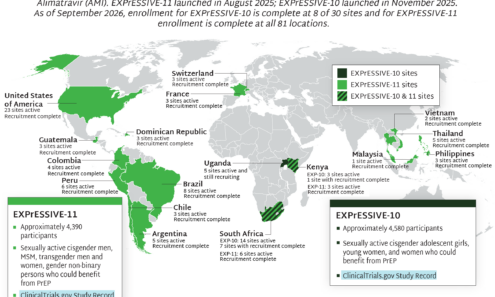
Now What with Injectable LEN for PrEP
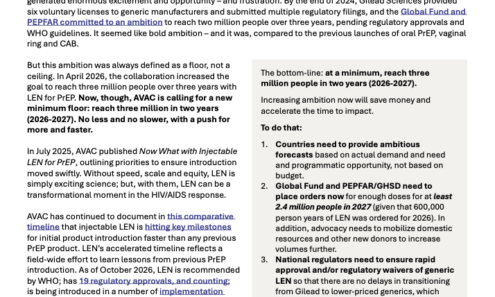
Since results of the PURPOSE efficacy trials were announced in 2024, injectable lenacapavir for PrEP (LEN) has generated enormous excitement and opportunity – and frustration. By the end of 2024, Gilead Sciences provided six voluntary licenses to generic manufacturers and submitted multiple regulatory filings, and the Global Fund and PEPFAR committed to an ambition to reach two million people over three years, pending regulatory approvals and WHO guidelines. It seemed like bold ambition – and it was, compared to the previous launches of oral PrEP, vaginal ring and CAB.
But this ambition was always defined as a floor, not a ceiling. In April 2026, the collaboration increased the goal to reach three million people over three years with LEN for PrEP. In July 2025, AVAC published a first edition of Now What with Injectable LEN for PrEP, outlining priorities to ensure introduction moved swiftly. Now, in this update, AVAC is calling for a new minimum floor: reach three million in two years (2026-2027). No less and no slower, with a push for more and faster.
Prevention Option:
Re: Imminent Threats to HIV Research: Organizational Sign-On Letter to Congress
AVAC joined dozens of other organizations in urging Congress to address imminent threats to HIV research from the Administration. These threats are part of a broader political effort to undermine the National Institutes of Health (NIH) and...
Investing in Biomedical Innovation for Health and Economic Growth
This Financial Times webinar, hosted in partnership with ViiV Healthcare, brought together policymakers, funders, researchers, philanthropies and industry leaders to explore how to keep medical innovation moving forward. The conversation examined...
Injectable PrEP Regulatory Approvals
This graphic tracks regulatory approvals for injectable cabotegravir and lenacapavir for PrEP as of October 2026.
Prevention Option:

showing 1-10 of 1059