Regulatory approvals and those pending for cabotegravir as of January 2026. For product approvals, volumes, implementation, and price comparisons of long-acting PrEP, visit our dashboard on PrEPWatch.org.
Cabotegravir Regulatory Approval
Global Health Watch: A Year That Reshaped Global Health
The Lancet journal ended the year with a provocative editorial – 2025: an annus horribilis for health in the USA. But sadly, it was not just in the US; it has been a year of chaos and disruption globally. This 49th issue of Global Health Watch looks back—like many news stories this week—across 2025 to highlight the most consequential decisions, disruptions, and debates that defined the year and will continue to shape what comes next.
The Foreign Aid Freeze and the Legal Fight to Restore it
On the first day in office, the new US Administration issued a sweeping foreign aid freeze that halted life-saving global health and HIV programs, severed active grants, research underway and cost millions of people their lives and livelihoods. In less than a month, AVAC responded suing the President, the State Department and the US Agency for International Development (USAID). The Global Health Council also led a similar lawsuit challenging the freeze as unlawful and harmful. Together, the two cases argued for months in various courts that the foreign aid freeze not only jeopardized health as a human right but also bypassed congressional authority and undermined trust in US leadership. Ultimately, the cases unlocked millions of dollars of development assistance for work done in January and February, but millions more dollars expired at the end of the fiscal year in September. The cases are ongoing and as important as ever, both to restore foreign assistance and to re-assert that it is Congress (and not the President) who has the power of the purse.
READ:
- The Monthslong Legal Battle to Save Foreign Aid—New York Times
- AVAC v. United States Department of State—AVAC
- “Lift the Freeze”: HIV/AIDS Advocates in Fight over Trump Foreign Aid Cuts—Democracy Now
- The Supreme Court’s Major Cases During the 2025-2026 Term—Washington Post
- Supreme Court has expanded presidential powers under Trump. How far will it go?—Washington Post
Research Under Assault
Science faced underfunding and systematic destabilization in 2025. In just one month under the new US Administration, the National Institutes of Health (NIH) abruptly canceled approximately 1,800 research grants. By April, mass layoffs and forced reassignments across Health and Human Services (HHS) agencies, including the Centers for Disease Control and Prevention (CDC), NIH, and US Food and Drug Administration (FDA), further crippled each agency’s capacity and expertise. A proposal to drastically cut the overall NIH budget and consolidate its 27 institutes was soon introduced along with the fiscal year 2026 budget, which proposed an $18 billion cut from the NIH and $1.5B cut in HIV prevention. Around the same time, the NIH signaled a major shift away from investments in basic science and clinical research, undermining the discovery pipeline that fuels future breakthroughs. Then, in November, HHS ordered the CDC to phase out all “non-essential” nonhuman primate research, threatening foundational preclinical studies, including those that have been pivotal to HIV PrEP and PEP, amongst many other health priorities. These actions were compounded by a pause or effective ban on some international research collaborations, a proposed cap on indirect cost rates that support core university infrastructure, and changes to the scientific review processes, together weakening the systems that sustain rigorous, independent research.
READ:
- The Trump Administration’s Most Paralyzing Blow to Science—The Atlantic
- HIV Prevention R&D at Risk: Tracking the Impact of US Funding Cuts—AVAC
- Trump has blown a massive hole in global health funding—and no one can fill it—Science
- Trump administration agrees to reconsider frozen and denied NIH grant submissions related to DEI—STAT
- Presidential HIV council warns proposed cuts could reverse decades of progress—CNN
- Nearly 2,000 top researchers call on Trump administration to halt ‘assault’ on science—STAT
The Cruel Irony of the Best Shot at HIV Prevention
Despite all the chaos, 2025 offered remarkable milestones in HIV prevention science, and a stark illustration of the contradictions shaping global health. Injectable lenacapavir for PrEP (LEN), the six-month injectable, which provides nearly complete protection against HIV infection, moved with unprecedented speed from regulatory approvals and guidelines to real-world introduction. South Africa and Zambia authorized LEN within months of US and EU regulatory approvals; the World Health Organization (WHO) rapidly issued guidance and prequalification; and initial LEN delivery began in Brazil, Eswatini, South Africa, and Zambia, setting the stage for expanded access in 2026. At the same time, efficacy trials began of the next promising PrEP option, the monthly oral candidate MK-8527, reinforcing what’s possible when innovation, evidence, and advocacy align.
Yet, all this scientific momentum occurred alongside the deepest assault on global health and the systems that make it possible. The cruel irony of this moment is that as the science breaks barriers, the infrastructure meant to support discovery, evaluation, and equitable delivery is being weakened, threatening the very gains the field has fought decades to achieve. As AVAC has emphasized, the greatest opportunity in HIV prevention lies in speed, scale, and equity.
READ:
- In under a year, Trump administration has threatened decades of progress in global fight against HIV/AIDS—Prism
- A ‘Breakthrough’ Drug to Prevent HIV, an ‘Unprecedented’ Rollout—NPR
- When Politics Trumps Science: Why the US isn’t giving South Africa LEN—Bhekisisa
- ‘Best of Times, Worst of Times for HIV Prevention’—Managed Healthcare Executive
Attack on Vaccine Science
Actions in the last 11 months have eroded evidence-based policy, disrupted institutional capacities, and deepened mistrust and uncertainty in vaccine science. In May, NIH’s National Institute of Allergy and Infectious Diseases (NIAID) announced that funding for the Consortia for HIV/AIDS Vaccine Development (CHAVD) would end after the current grant cycle in June 2026 — eliminating $67 million annually and about 10% of global HIV vaccine research funding. Then, $500 million in Biomedical Advanced Research Development Authority (BARDA) grants for research and development of the mRNA vaccine platform were soon cancelled, and members of the CDC’s Advisory Committee on Immunization Practices (ACIP) were replaced. The US also stopped supporting Gavi, the vaccine alliance, and language on the CDC website was replaced with anti-science and anti-vaccine sentiment. As AVAC said in an August statement, “These actions dangerously sow vaccine disinformation and mistrust, which has proliferated since the COVID-19 pandemic. Dangerous ideology results in dangerous policymaking, putting many lives at stake and complicating efforts to both discover and implement clinical and cost-effective interventions to make America and the world healthier, safer, and more prosperous.”
READ:
- We Don’t Seem to Be Making America Healthy Again—New York Times
- This Is the Damage Kennedy Has Done in Less Than a Year—New York Times
- Experts Question Denmark’s Vaccine Program as a Model for the U.S.—New York Times
- The U.S. vaccine schedule is a jet engine. Denmark’s is a toy plane.—Washington Post
- The Guardian view on mRNA vaccines: they are the future – with or without Donald Trump—The Guardian
Changing Global Health Architecture
As rising nationalism, geopolitical tensions, and funding retrenchment intensify, the architecture of global health and how countries engage in it and with one another is being fundamentally reshaped. Longstanding multilateral systems are giving way to a more fragmented, country-to-country model under the US America First Global Health Strategy. The strategy prioritizes bilateral health Memorandums of Understanding (MoUs) with individual countries in exchange for funding support, data sharing, and pathogen access, signaling a major recalibration away from traditional multilateral institutions and frameworks. Meanwhile, the US stepped back from longstanding global health platforms including an unprecedented absence at the World Health Assembly, withdrawal from the WHO, and diminishing support for joint initiatives like Gavi, the vaccine alliance. Civil society and advocates are actively debating what this means for shared goals and equity in global health, even as institutions like WHO and UNAIDS explore how to adapt in a rapidly evolving landscape.
READ:
- ‘America First’ in Global Health: Oxymoron or opportunity?—Devex
- 4 more African nations secure $2.3bn US health funding under America First strategy—Business Insider Africa
- Writing in Real Time: How 2025 Rewired Global Health—and My Work Alongside It—Lights, Camera, Equity! Substack
- UNAIDS board launches new process for transition amid sunset calls—Devex
What We’re Reading:
- In a tumultuous year, US health policy has been dramatically reshaped under RFK Jr.—Associated Press
- Podcast: Unmasking Global Health: Reflections on 2025—Global Health Unfiltered
- How Cameroon Fought to Save Its Malaria Program After the U.S. Cut Critical Funding—New York Times
- Evaluating the impact of two decades of USAID interventions and projecting the effects of defunding on mortality up to 2030: a retrospective impact evaluation and forecasting analysis—The Lancet
- Podcast: Global Health | The rollercoaster continues in 2026—Pandemia (German language)
Global Health Watch: UNAIDS launches review, NIH GoF controversy, support for IDSA’s Jeanne Marrazzo, UK authorizes LEN for PrEP
This week the UNAIDS board approved a new Global AIDS Strategy and launched a formal review of the agency’s future; turmoil at the NIH continues over gain-of-function research; and the scientific community rallies around the Infectious Diseases Society of America’s (IDSA) appointment of Jeanne Marrazzo as its chief executive officer. Also, the UK regulatory agency approved lenacapavir for PrEP (LEN) marking its seventh regulatory approval in just six months.
UNAIDS Launches Review Process on its Future
Following last week’s intense discussions at the UNAIDS Programme Coordinating Board (PCB), the UNAIDS board this week launched a new, formal process to examine the organization’s future and potential transition pathways. This comes from within the UN80 reform initiative that proposed to sunset UNAIDS by the end of 2026. But civil society and PCB members pushed back, and the board agreed to initiate a “structured review” that explores different scenarios for UNAIDS’ role, mandate, and positioning within a changing global health architecture. This announcement came on the heels of the PCB approving the Global AIDS Strategy for 2026–2031 and alarms raised by civil society about funding cuts, service disruptions, and the risk of losing a central coordinating body at a critical moment in the HIV response.
IMPLICATIONS: The launch of this process to examine UNAIDS’ future raises important questions about governance, accountability, and continuity in the global HIV response. Civil society’s strong pushback underscores that any reform must preserve UNAIDS’ core mandate and ensure that the global HIV response remains centered on those most affected — especially women, girls, and key populations — rather than being quietly dismantled at a moment of crisis.
READ:
- UNAIDS board launches new process for transition amid sunset calls—Devex
- New Global AIDS Strategy and Transition Working Group adopted at UNAIDS’ 57th Board meeting—UNAIDS
Continued Turmoil at the NIH – Gain-of-Function (GOF) Research
Turmoil at the NIH continued this week as, John Beigel, a prominent influenza researcher and acting director of NIAID’s Division of Microbiology and Infectious Diseases (DMID), resigned following controversy over an NIH-supported seasonal flu virus study and how its potential risks were assessed and communicated. Beigel’s departure unfolds amid ongoing debate over how the NIH defines and oversees gain-of-function (GOF) research—work that could increase the transmissibility or virulence of pathogens with pandemic potential.
Science reports that the controversy was a “‘pseudomanufactured concern’ that was meant to force him out, so officials could bring in a researcher who has strongly supported Trump.” Beigel is being replaced by an infectious disease scientist from NIH’s Fogarty International Center and who has publicly expressed support for the President and donated to his affiliated political committees.
IMPLICATIONS: Alongside last week’s revelations and Jeanne Marrazzo’s whistleblower lawsuit, Beigel’s departure heightens concerns about instability and governance at NIH at a time when scientific leadership and public trust are critical. Debates over GOF research, including its definition, oversight, and whether the White House or the NIH sets the rules show the precariousness of the agency. As Science reports, concerns about GOF work have gained momentum with the popularization of the belief that Chinese scientists who received NIH funding created the virus that caused the COVID-19 pandemic. Many Republicans have promoted this unproven theory, and Trump signed an executive order in May that called for stricter oversight of GOF work.
READ:
- NIH official resigns after flap over risks of seasonal flu virus study—Science
- Researchers have a moral obligation to push back when their studies are twisted to promote false health claims—STAT
Leaders Support Jeanne Marrazzo as new CEO of the Infectious Diseases Society of America (IDSA)
Leaders in the scientific and infectious disease communities praised the Infectious Diseases Society of America (IDSA) appointment of Jeanne Marrazzo as its next chief executive officer. Former NIAID Director Anthony Fauci called her a “superb choice,” and AVAC’s Mitchell Warren said, “It speaks to IDSA’s desire to emphasize science over politics and science over ideology, and that’s what you will get with Jeanne Marrazzo.” Virologist Angela Rasmussen, said Marrazzo’s appointment “suggests to everybody who’s a member of that professional society that they’ve got a leader who’s actually going to do something about this rather than trying to protect the institution more than its members.” Marrazzo begins her tenure January 12.
READ:
- As Marrazzo prepares for helm at IDSA, scientific community praises choice—Center for Infectious Disease Research and Policy
UK’s Medicines and Healthcare products Regulatory Agency (MHRA) Approves LEN for PrEP
This is the seventh regulatory approval of LEN for PrEP. See AVAC’s detailed map of regulatory approvals, pending decisions, and appeals, along with other LEN resources here.
What We’re Reading
- Trump removes nearly 30 career diplomats from ambassadorial positions—Associated Press
- 2025: an annus horribilis for health in the USA—The Lancet
- Some patients face hurdles getting HIV prevention drugs. Here’s what to know—NPR
- Podcast: Trans Life: How to Survive Trump’s 2nd Administration | Dr. Tatyana Moaton—A Shot in the Arm
- Kennedy ‘deeply committed to ending animal experimentation’—Science
- Perseverance Is the Prescription for Global Health Challenges—Harvard
- I’m the former head of Pfizer R&D. I’m very worried about biopharma’s future—STAT
- America’s new top health diplomat has strong opinions on abortion and gender—NPR
- The vaccine cold chain: A fragile link in global health infrastructure—Health Policy Watch
- UNICEF, Gavi deal slashes malaria vaccine price to $2.99 per dose—Devex
- How HIV Capsid Research Sparked a New Era in Prevention—American Society for Microbiology
- U.S. Global Health Country-Level Funding Tracker—KFF
- Forget quiet quitting, the State Department appears to be quiet hiring—Devex
- Trump Officials Celebrated With Cake After Slashing Aid. Then People Died of Cholera.—ProPublica
- Exclusive: Senate Democrats introduce bill to protect UN Population Fund—Devex
- California Hires Former C.D.C. Officials Who Criticized Trump Administration—New York Times
- Update on Lives Lost from USAID Cuts—CGD
- U.S. Global Health Country-Level Funding Tracker—KFF
30 Years of Standing for Science and Equity
This month, AVAC marked our 30th anniversary. Over three decades, the HIV field has evolved dramatically—but what we do, and why we do it, has remained constant: standing for science, equity, and community leadership, and ensuring evidence drives decisions that affect people’s lives. We’ve been able to do this work because of your partnership and support, and we are deeply grateful.
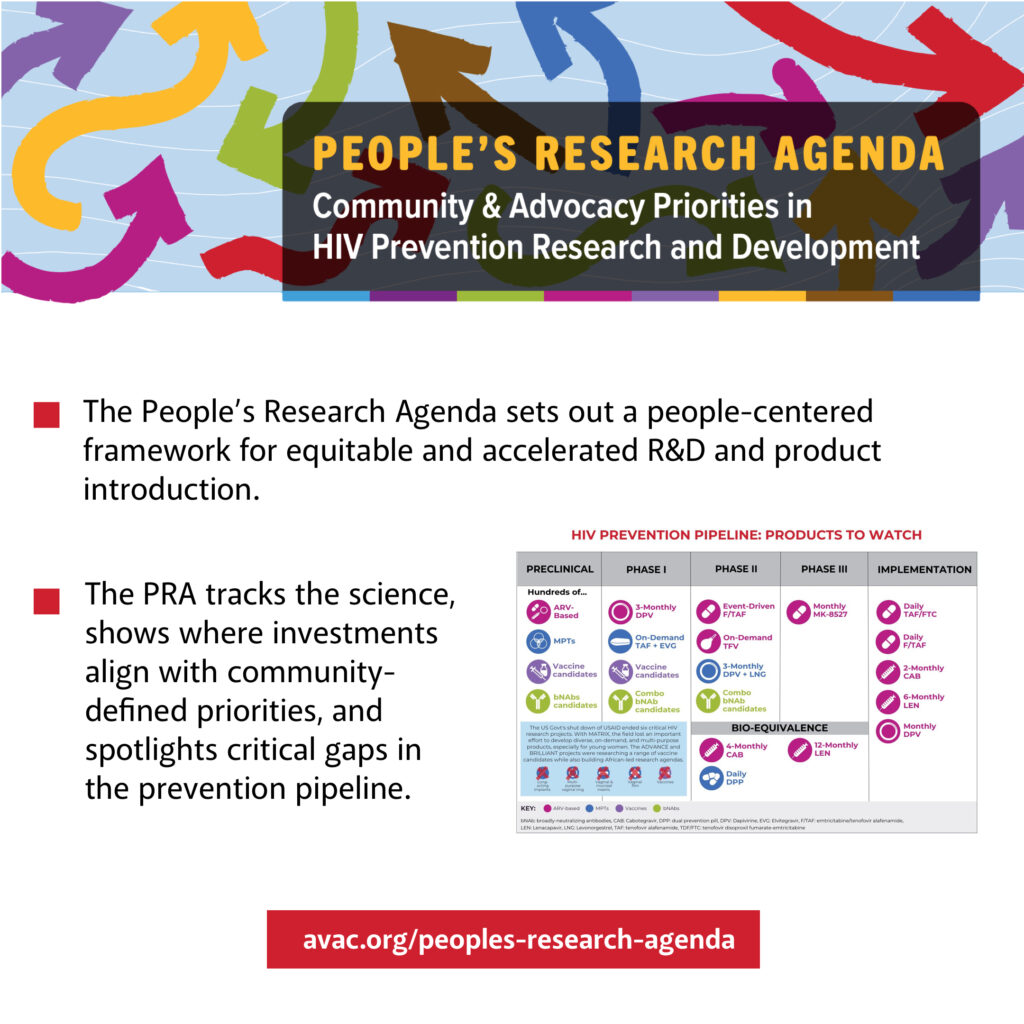
Last week, we also released the 2025 update of the People’s Research Agenda (PRA), which tracks the science, highlights where investments align—or fail to align—with community priorities, and identifies critical gaps that must be addressed to ensure the prevention pipeline meets the needs of diverse populations. After ten months of disruption and uncertainty across biomedical research and global health, we hope this agenda helps share a path forward, one that will demand sharper priorities, smarter investments, and a balanced portfolio focused on real epidemic impact.
At the same time, we are seeing real progress. In just the past month, people in Brazil, Eswatini, South Africa, and Zambia began receiving the first doses of lenacapavir for PrEP (LEN) through early implementation programs outside the US, with additional deliveries of LEN planned for Eswatini, Zambia, Kenya, Lesotho, Mozambique, Nigeria, Uganda, and Zimbabwe.
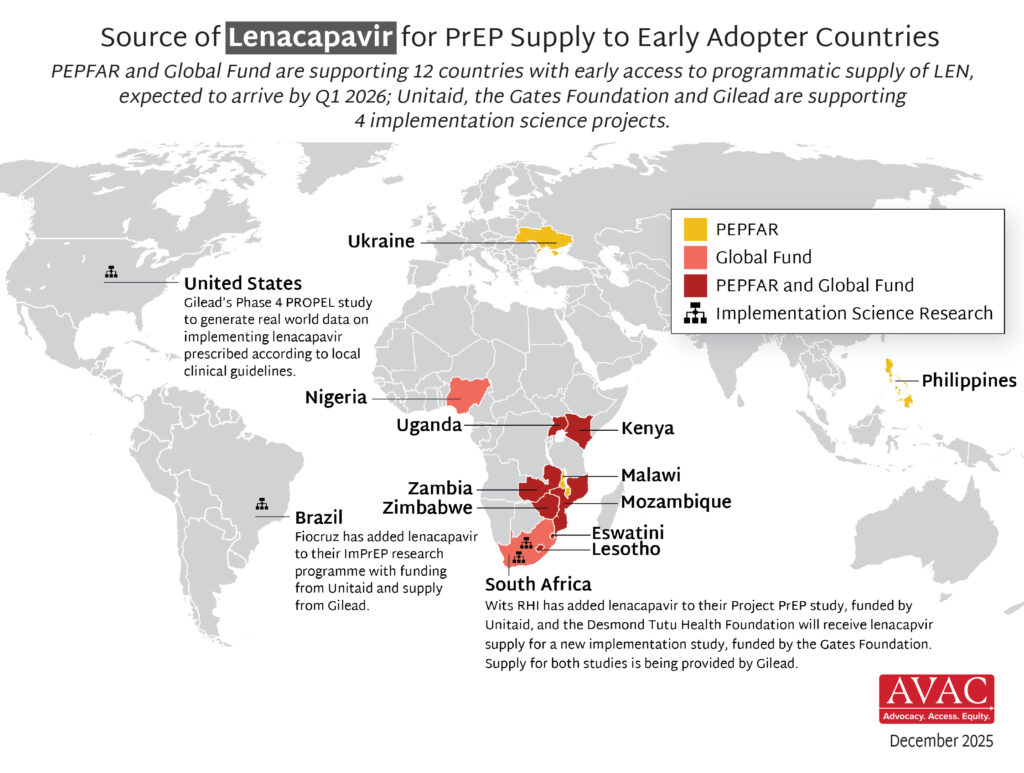
AVAC’s updated map of Global Fund and PEPFAR-supported LEN supply shows how quickly this breakthrough is moving and what’s possible when political will, funding, community engagement, and innovation align. But there is still so much more to do – as we wrote last week, science alone won’t get us there: the future of HIV prevention depends on speed, scale and equity.
As these advances continue to develop, AVAC will continue to help make sense of the rapidly shifting global health landscape. From World AIDS Day passing with little acknowledgment by the US government, to the LEN rollout (and South Africa being left behind), to the gutting of foreign aid and impact on HIV prevention and global health, to new bilateral health MoUs under the US “America First” strategy, AVAC has shared real-time analysis and context on the most pressing issues of December. Global Health Watch, now in its 46th week, will continue providing consistent, trusted context so you can navigate the turmoil with clarity, purpose and solidarity.
As we enter our fourth decade, your support makes it possible for AVAC to keep tracking the science, elevating community priorities, and delivering real-time analysis when it matters most. If you’re able, we invite you to consider making a year-end gift to sustain this work.
Thank you for being part of this work, and for standing with AVAC.
Global Health Watch: NIH turmoil + a high-profile lawsuit, future of UNAIDS, more Countries sign “America First” MoUs with US
Issue 47
This week covers the significant turmoil at the US National Institutes of Health (NIH), including a close look at the NIH deputy director’s role in disruptions in leadership and funding cuts, and a lawsuit filed by the former Director of the National Institute of Allergy and Infectious Diseases (NIAID). It also covers urgent civil society pushback against efforts to sunset UNAIDS, the rapid expansion of US “America First” bilateral health agreements across Africa, and what’s next for STI research, prevention and diagnostics.
NIH Leadership Turmoil
A new investigation by The Atlantic’s Katherine Wu examines the central role of the Deputy Director of the National Institutes of Health (NIH), Matthew Memoli, in recent leadership changes and funding cuts across the NIH, including the firing of former NIAID Director, Jeanne Marrazzo, and the reassignment of Carl Dieffenbach, longtime director of NIAID’s Division of AIDS, to another NIH center. The Atlantic’s reporting shows how these decisions have significantly weakened NIAID, with particularly acute impacts on HIV prevention and vaccine research, where programs, expertise, and long-term scientific capacity are being eroded amid broader restructuring and budget shifts.
In addition, this week, Dr. Marrazzo, the newly appointed chief executive officer of the Infectious Diseases Society of America (IDSA), filed a lawsuit against the US federal government. The lawsuit alleges that Marrazzo was illegally fired from her position and seeks to be reinstated as head of NIAID and to receive formal declarations that her rights were violated. The suit argues that her firing was retaliation for a whistleblower complaint she filed on September 3, in which she raised concerns about anti-vaccine positions held by newly appointed NIH officials; demands to halt clinical trials; and requests to cut international research collaborations. Twenty-two days after filing the complaint, Marrazzo was fired by Health and Human Services Secretary, Robert F. Kennedy Jr.
IMPLICATIONS: The developments at the NIH show instability at its leadership level and severe consequences for infectious disease research, particularly vaccine research. This comes at a time when sustained R&D investment is most critical. Without robust research support, future advances in next-generation options could stall. See the new People’s Research Agenda, which calls for a balanced HIV prevention portfolio that is optimized for impact. However, Marrazzo’s new role at the IDSA, which represents clinicians, scientists and public health experts who are driving policy and advocacy to address critical issues in combating infectious disease, will be pivotal in ensuring rigorous science, inclusion and equity in research, community engagement, and evidence-based communications remain central to tenors in global health discourse and debate.
READ:
- AVAC Board Member Jeanne Marrazzo named CEO of IDSA—AVAC
- The Most Feared Person at the NIH Is a Vaccine Researcher Plucked From Obscurity—The Atlantic
- Fired NIH institute head sues Trump administration—Science
- IDSA selects next CEO—Infectious Diseases Society of America
Future of UNAIDS
Member states and civil society convened at the 57th meeting of the UNAIDS Programme Coordinating Board (PCB) in Brazil this week to discuss urgent decisions about the future of the global HIV response amid deep funding cuts and a shifting global health landscape. They reviewed and approved the Global AIDS Strategy 2026–2031 and assessed the impact on communities from disruptions to services for HIV prevention and treatment. Civil society representatives on the PCB shared comments, and African women leaders and other civil society groups issued statements (and sign-ons) denouncing efforts to sunset UNAIDS by the end of 2026: “Any move to sunset UNAIDS before ending AIDS as a public health threat is premature and unacceptable. No sunsetting until we finish the job. AIDS is not over.”
The PCB also held a special thematic session on long-acting ARVs for treatment and prevention. See this clip from Yvette Raphael where she included AVAC’s latest blog in her remarks about the current context: “We cannot let cruel international policy allow historic gains to collapse, just as a few highly effective prevention options arrive. That is why rolling out LEN to all countries that need it with speed, scale and equity must be our uncompromised, uncompromising priority. If we do this, we can change the trajectory of the epidemic, but only if we act at the pace that data and science demand.”
IMPLICATIONS: As the world moves toward the June 2026 High-Level Meeting on HIV, and the rollout of the new Global AIDS Strategy, the strong pushback by civil society at the PCB underscores that any reform must preserve UNAIDS’ core mandate and ensure that the global HIV response remains centered on those most affected — especially women, girls, and key populations — rather than being quietly dismantled at a moment of crisis.
READ:
- African Women Leaders Condemn Any Move to Sunset UNAIDS: AIDS is Not Over—African Women Prevention Community Accountability Board
- Deputy Secretary-General, Addressing UNAIDS Programme Coordination Board, Highlights Transition Strategy, Legacy as United Nations Success Story—Press UN
- The Future of HIV Prevention Depends on Speed, Scale and Equity—AVAC
- UNAIDS Must Be Retained as a Distinct, Independently Mandated Joint Programme within UN Reform—KP-TNC Statement
- The HIV Response Orphaned: At the Cost of Women Living with HIV—ICWEA
Eswatini and Mozambique Join Growing List of African Countries to Sign “America First” Bilateral Health MoUs
Mozambique and Eswatini are the latest countries to sign the bilateral health Memorandums of Understanding (MoUs) with the United States under the America First Global Health Strategy, adding to earlier agreements with Kenya, Liberia, Rwanda and Uganda. These agreements provide 5 to 10 years of funding and health support in exchange for co-financing, health data, pathogen-specimens, and national health system data, marking a major shift in how global health cooperation is structured under US leadership.
IMPLICATIONS: The pace of these agreements shows how quickly the Administration is moving to reshape US global health with little time for discussion and debate on transparency, consultation, and how civil society fits within this evolving framework. As the landscape shifts, civil society and non-governmental organizations must quickly reassess their roles in the hope of preserving aid delivery, accountability, and equity.
READ:
- NGOs must prove relevance to survive in ‘America First’ health strategy—Devex
- Far from over—Forsaken Substack
- US-Africa Health Agreements Targets Don’t Add Up—To End a Plagues … Again Substack
The Future of HIV Prevention Depends on Speed, Scale and Equity
“Every funding cut can represent at minimum, a delay. Every delay in rollout is a missed chance to prevent infections. Every un- or underfunded clinic is a barrier to access. Every policy is a choice to be inclusive or leave someone behind…”
What We’re Reading
- Reimagining HIV prevention programmes: the time is right, but what needs to be done?—The Lancet HIV
- Is science diplomacy still possible?—The Lancet
2025 Broke the System. 2026 Decides the Future of Global Health.—Lights.Camera.Equity Substack - When politics Trumps science: Why the US isn’t giving South Africa LEN—Financial Mail
- Will New US Aid Strategy Improve Countries’ Self-Reliance?—Medscape
- World leaders adopt a historic global declaration on noncommunicable diseases and mental health—WHO
- Forget quiet quitting, the State Department appears to be quiet hiring—Devex
- Trump Officials Celebrated With Cake After Slashing Aid. Then People Died of Cholera.—ProPublica
- Exclusive: Senate Democrats introduce bill to protect UN Population Fund—Devex
- California Hires Former C.D.C. Officials Who Criticized Trump Administration—New York Times
- Update on Lives Lost from USAID Cuts—CGD
- U.S. Global Health Country-Level Funding Tracker—KFF
STIs Spotlight
AVAC’s STI program looks back at 2025—and ahead to 2026—tracking rising STI rates, major HPV vaccination gains, slow but promising diagnostics, the growing role of self-care, and what’s next for STI research, prevention and diagnostics.
HIV Prevention R&D at Risk
Tracking the Impact of US Funding Cuts
The US presidential administration is actively working to dismantle HIV research and demolish the architecture of global health. The entire HIV response — from basic research and clinical development to policy, programs, and global access to life-saving treatment and prevention — is now under attack, and the world runs the risk of reversing the strides made to end HIV.
AVAC has put together this report, highlighting the impact of US cuts on the pipeline of HIV prevention research and development. AVAC will continue to track these cuts and their impact, to amplify the damage they will cause, and to fight for their reversal.
The Future of HIV Prevention Depends on Speed, Scale and Equity
When the US Food and Drug Administration approved lenacapavir (LEN) fro PrEP, it offered something rare in public health: a genuine turning point. We now have one of the greatest opportunities and scientific breakthroughs that we’ve had in HIV in 44 years: a twice-yearly injectable that showed near-complete protection against HIV in major trials. Science has given us a breakthrough. What happens next is up to us.
But as AVAC Executive Director Mitchell Warren recently noted on ABC News and CNN, this moment of possibility is colliding with a moment of profound danger. The US administration’s proposed cuts to HIV prevention programs could reverse decades of progress in research, care, and rollout of new options. If that happens, even the most powerful tools like LEN will fall short. This is not a theoretical concern. It’s a warning, and one we must urgently act on.
We cannot let cruel international policy allow historic gains to collapse just as a new, highly effective prevention option arrives. That is why rolling out LEN — to all countries that need it — with speed, scale, and equity must be our uncompromising priority. If we do this right, we can change the trajectory of the epidemic — but only if we act at the pace the science demands.
- Speed means national programs must approve, adopt, and distribute LEN now — not after years of bureaucratic drift or pilot-project hesitation. People at risk cannot wait.
- Scale means strengthening and funding the infrastructure to make LEN widely available — across entire systems and communities.
- Equity means ensuring LEN reaches the people most affected by HIV — including and prioritizing those historically sidelined, discriminated against, or left behind — not just the communities that are easiest to reach.
Without speed, we lose momentum. Without scale, we limit impact. Without equity, we repeat the failures of the past.
We are in a golden moment, where innovation, evidence and opportunity align. But proposed funding cuts could undo everything. These aren’t abstract numbers on a page. These cuts would shutter clinics, slow prevention, restrict treatment, and roll back the very systems that allow new tools like LEN to reach people. Watch this powerful call-to-action from APHA Executive Director and longtime AVAC partner Yvette Raphael at the recent UNAIDS meeting.
As Mia Malan recently reported in Bhekesisa, the US government recently announced that it would, join the Global Fund to buy LEN for African countries with high HIV infection rates. She reports, “the Trump administration revealed its support was a “market-shaping initiative” with the goal to increase LEN production and uptake, and, in effect, bring down the price of the jab as fast as possible, so that countries could eventually buy the medicine themselves. But they left South Africa — with the largest market for LEN, because it has the highest number of new HIV infections in the world — off the list.”
Warren spoke with Malan about this misguided decision, saying “If you want to build large volumes of a product, whether it’s lenacapavir or Coca-Cola — because we know that large volumes will lower prices — you make sure you start off with the biggest market, because that’s how you will shape the market the fastest and most meaningfully. So South Africa is the place where you’d want to be. Economically, because that’s how you will build the market the quickest. Epidemiologically, because that’s how you will prevent the most new infections. Practically, because that’s the country with the most mature HIV prevention medication market in the world.”
It makes no sense to celebrate the arrival of a breakthrough PrEP option while simultaneously dismantling infrastructure required to deliver it. We cannot allow ideology take over epidemiology. And we cannot end HIV with half-funded programs and half-hearted commitments. We cannot end HIV by retreating just as we need to push forward. We cannot end HIV if we abandon the global leadership that have made decades of progress possible.
This is the paradox we face: extraordinary scientific promise shadowed by political short-sightedness. To realize LEN’s potential we need urgency, not hesitation. Governments must rapidly integrate LEN into national guidelines, commit domestic funding, and remove regulatory and logistical bottlenecks. Global donors, especially the US government, must protect and expand HIV investments, not shrink them. Scaling LEN requires resources, commitment, and sustained political leadership. Community organizations must lead rollout strategies, ensuring they are people-centered, stigma-free, and grounded in lived experience. And advocates must insist that LEN is rolled out now.
If we get this right, LEN will be a global prevention pillar: accessible, trusted, and transformative.
Let’s be clear. Every funding cut can represent at minimum, a delay. Every delay in rollout is a missed chance to prevent infections. Every un- or underfunded clinic is a barrier to access. Every policy is a choice to be inclusive or leave someone behind. No one should face risk of HIV simply because innovations didn’t move fast enough, weren’t scaled broadly enough, or weren’t delivered equitably.
We must act like the future depends on our choices, because it does. Science alone won’t get us there. Speed, scale, and equity will.
People’s Research Agenda
2025 Update
The People’s Research Agenda sets out a people-centered framework for equitable and accelerated R&D and product introduction. It tracks the science, shows where investments align—or fail to align—with community-defined priorities, and spotlights critical gaps in the pipeline of prevention options needed to meet the diverse realities of all populations.
People’s Research Agenda Pipeline Tracker
This tracker provides details on key HIV prevention trials to watch. It is updated on a quarterly and ad-hoc basis as developments occur.
If you would like to share additional information or corrections, please email Breanne at [email protected]. For more, visit the People’s Research Agenda.
Spotlight on MPTs Addressing STIs
This graphic outlines the development journey of multipurpose technologies (MPTs) that guard against STIs, including HIV, while also preventing pregnancy. It tracks the advancement of various potential products through different trial stages, emphasizing their combined protective roles.